

You sit down for a normal meal. Everything seems fine. Nothing unusual, nothing heavy, nothing that should cause a problem.
But minutes later, it hits.
Your stomach feels off. A wave of nausea creeps in. Your energy suddenly drops. Your body feels heavy, your focus fades—and you’re left wondering:
Why do I feel nauseous after I eat when everything seemed completely normal?
Quick Answer: Feeling nauseous after eating happens when your body rapidly shifts blood flow, energy, and nervous system activity toward digestion. This sudden internal change can create a temporary imbalance between your brain and gut signals, leading to nausea, fatigue, or a “sick” feeling—even after a normal meal.
This reaction is more common than most people realize. And in many cases, it has nothing to do with bad food or overeating.
Instead, it’s about how your body handles the transition into digestion.
The speed of eating, your stress level, your hydration, your sleep quality, and even your mental state before the meal can all influence how smoothly this shift happens.
Why does your body suddenly feel off, heavy, and drained right after eating—when nothing seems wrong?
That answer isn’t just in your stomach.
It’s in how your entire system responds to food.
Table of Contents
Why Do I Feel Nauseous After I Eat Even When Meals Seem Normal
Feeling nauseous after eating can be confusing because the meal itself may not look like the problem. You might eat a regular lunch, a simple dinner, or even a healthy breakfast and still feel sick afterward.

If your system is already tired, stressed, underhydrated, overstimulated, or running on poor sleep, the digestion shift may feel stronger. Instead of simply feeling satisfied after a meal, you may feel queasy, foggy, heavy, or slightly weak.
This is why the question is not only “What did I eat?”
A better question is:
What conditions were present before the meal began?
If you were rushing, scrolling, working, arguing, driving, drinking too much coffee, or waiting too long between meals, your body may enter the meal already tense. Then digestion adds another demand.
That combination can make you feel nauseous after eating even when the meal itself was not unusual.
For readers who also feel drained after meals, this connects closely with the same energy pattern explained in why you feel tired after eating.
What Happens When Digestion Pulls Energy Toward Your Gut After Meals
Nausea after eating is often not random. It usually follows repeatable patterns based on timing, stress, eating speed, and how your body enters digestion.
When digestion begins, your body sends more attention toward the stomach and intestines. Blood flow shifts inward. Your stomach stretches. Digestive juices increase. Hormones help manage appetite, fullness, and nutrient handling. Your nervous system moves toward a calmer “rest and digest” state.
If that shift happens smoothly, you may simply feel relaxed after eating.
If it feels abrupt, you may feel sick.
What Happens After Eating That May Trigger Nausea?
- Digestion begins and demands energy
- Blood flow shifts toward the gut
- Brain energy temporarily drops
- Nervous system switches to rest mode
- Gut and brain signals become unbalanced
- This imbalance triggers nausea and fatigue
To visualize this process clearly:
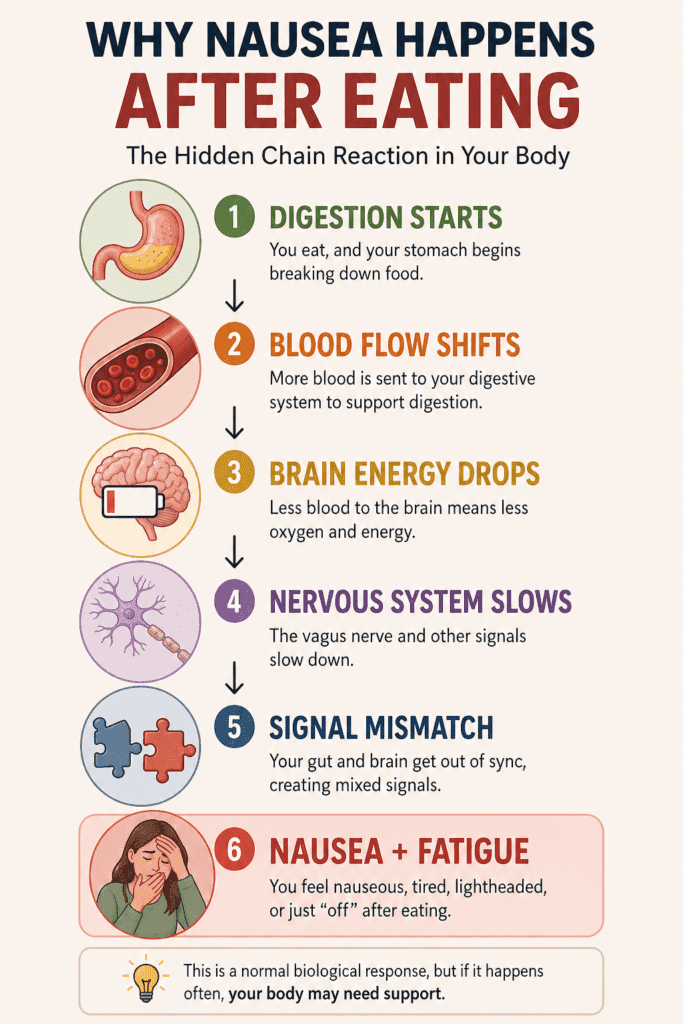
This is the deeper reason nausea after eating often comes with tiredness. Your body is not only processing food. It is redistributing energy.
If you ate a large meal, ate very fast, drank a lot with the meal, or ate after a long stressful stretch, the shift may feel sharper. That is when “I just ate” turns into “why do I suddenly feel sick?”
To make this easier to understand, here’s how your body’s internal shift after eating can translate into what you actually feel.
| Internal Change After Eating | What Your Body Is Doing | What You May Feel |
|---|---|---|
| Blood flow shifts inward | Supporting stomach and intestines | Lightheaded or heavy |
| Energy redirected to digestion | Prioritizing nutrient processing | Sudden fatigue |
| Nervous system slows down | Moving into “rest and digest” mode | Low focus or calmness |
| Gut-brain signals increase | Coordinating digestion and response | Uneasy or nauseous feeling |
| Stomach expansion | Handling incoming food volume | Pressure or fullness |
This is why nausea after eating rarely comes from just one thing. It’s the combined effect of multiple internal changes happening at the same time.
Why Do I Suddenly Get Nauseous While Eating Instead of After
Feeling nauseous while eating instead of after usually happens when your body is already in a stressed or overstimulated state. Your nervous system may not be ready to switch into digestion mode, causing an immediate conflict between brain activity and gut signals, which can trigger nausea during the meal itself.
The Hidden Reason Brain-Gut Signals Can Trigger Post-Meal Nausea
This is why stress can affect digestion, why hunger can change your mood, and why stomach discomfort can make your mind feel uneasy. Harvard Health explains that the brain and gastrointestinal system are closely connected through the gut-brain connection.
Your gut may send signals that say: “Food arrived. Digestion is active. Slow down.”
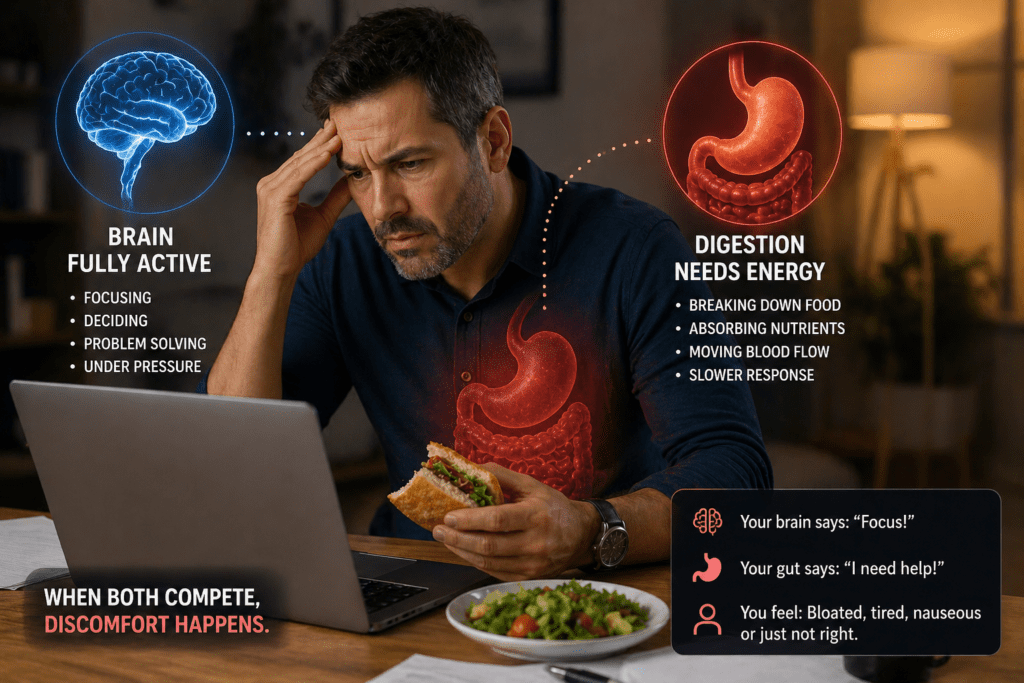
At the same time, your brain may still be in active mode: working, worrying, rushing, planning, or responding to stress.
That creates a mismatch.
Your digestive system wants calm. Your brain is still running fast.
This internal disagreement can show up as nausea, tightness, heaviness, or a strange uneasy feeling after eating. It can also explain why some people feel fine eating the same meal on a calm weekend but feel sick eating it during a stressful workday.
The body state changed.
How Blood Flow Shifts After Eating Can Trigger Nausea and Energy Drops
One of the most overlooked parts of post-meal nausea is blood flow.
When digestion starts, more blood moves toward the gut to support the stomach and intestines. But if your body is already low on energy, dehydrated, overheated, tense, or tired, that shift can feel more dramatic.
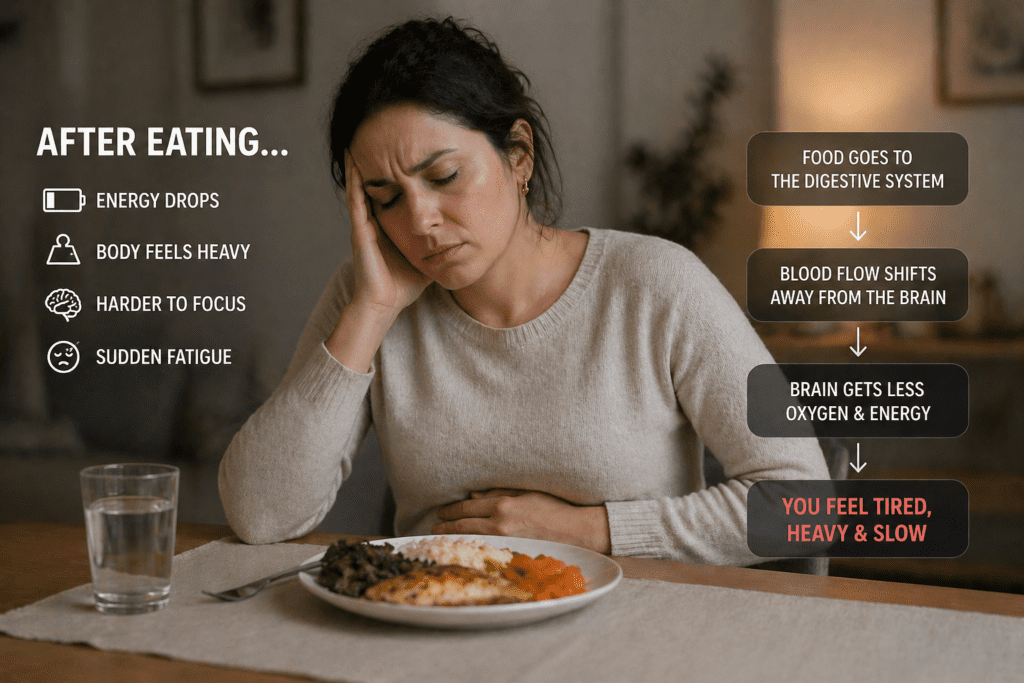
You may notice:
Signs your body may be struggling after eating
- Feeling sick or queasy after normal meals
- Sudden tiredness shortly after eating
- Brain fog or slower focus
- Heavy body feeling
- Mild dizziness or internal unease
- Feeling full faster than expected
- Wanting to sit or lie down after eating
It means your body has shifted resources inward. For some people, that shift feels relaxing. For others, it feels like an energy dip.
The meal may not be the only trigger. The timing matters too.
A heavy lunch during a natural afternoon dip can hit harder than the same meal earlier in the day. Add poor sleep, low hydration, too much caffeine, or a stressful morning, and the body may struggle to keep the transition smooth.
Feeling drained after meals too?
If nausea comes with heaviness, low focus, or a sudden energy dip, you may also want to understand the deeper pattern behind post-meal fatigue.
Read why you feel tired after eatingThe Link Between Stress, Fast Eating, and Feeling Sick After Meals
When your body is under pressure, it may stay more alert. Your breathing may become shallow. Your muscles may tighten. Your stomach may feel less settled. You might eat quickly because you are busy, distracted, or trying to squeeze lunch between tasks.
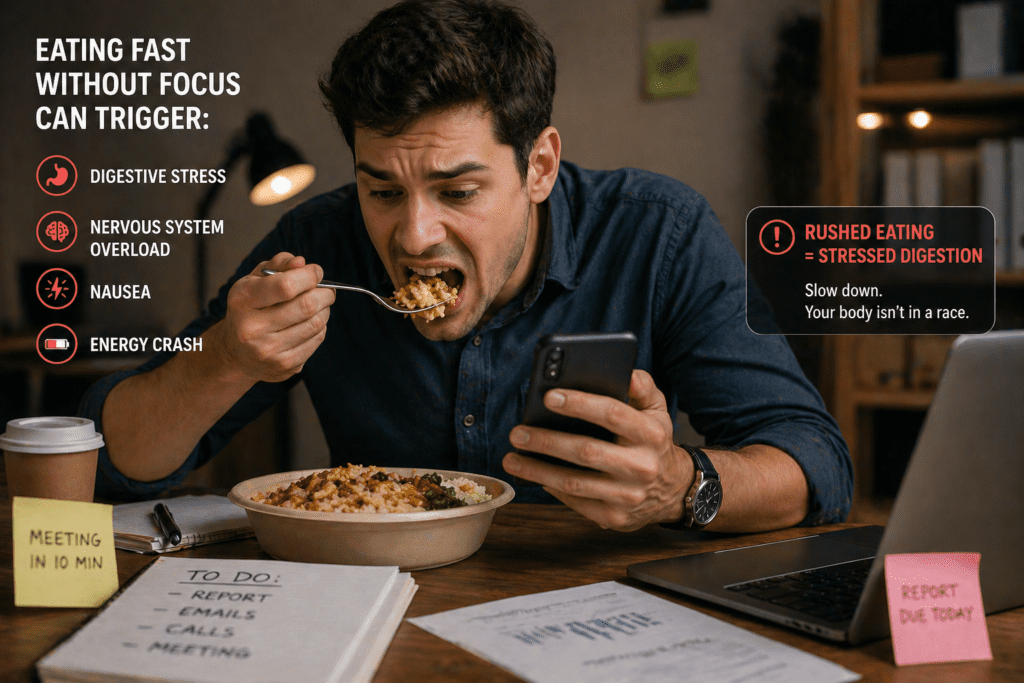
Then digestion begins before your body is fully ready to relax.
When you eat quickly, your stomach fills before your brain has fully registered fullness. You may swallow more air. You may chew less. The stomach has to handle a larger load in a shorter time.
That can create pressure, fullness, burping, reflux-like discomfort, and nausea.
If stress is part of the pattern, your article on whether anxiety can make you tired connects naturally because the same nervous system activation can affect both energy and digestion.
Cleveland Clinic also notes that nausea can involve multiple body systems, including the digestive system, emotions, nerve signals, and the brain itself, which is why it helps to understand what nausea means in the body.
Why Do I Feel Like Throwing Up After I Eat Even Without Vomiting
Feeling like throwing up after eating without actually vomiting is often caused by a strong digestive and nervous system response. Your stomach may feel overloaded, your brain may receive discomfort signals, and your body may struggle to regulate the transition into digestion. This creates an intense nausea sensation without leading to actual vomiting.
What Most People Miss About Nausea After Eating
What most people miss is that nausea is not always a direct food reaction.
Your body has to move from “doing mode” into “digesting mode.” If that switch is smooth, you may feel calm and satisfied. If the switch is messy, you may feel sick, heavy, or drained.
This is especially common when you eat while:
- working at a desk
- rushing between errands
- scrolling on your phone
- feeling anxious
- standing in the kitchen
- eating late after skipping meals
- drinking coffee instead of eating earlier
- eating right after intense focus
In those moments, your brain and gut may not be aligned.
Your body is asking for digestion. Your brain is still in stimulation mode. The result can feel like nausea, fatigue, pressure, or a sudden desire to stop eating.
This also explains why post-meal nausea may feel worse after mentally intense days. Your body is not only digesting food; it is trying to recover from the earlier demand. That overlaps with the same kind of mental energy drain covered in mentally drained in the afternoon.
Why Do I Feel Sick Every Time I Eat Normal Meals
But from an everyday body-response angle, there are several non-dramatic reasons this can become repetitive.
First, your meals may be too large for your current energy state. A meal that felt fine last year may feel heavier during a stressful season, poor sleep period, or low-activity routine.
Second, your timing may be inconsistent. Waiting too long to eat can make the next meal hit harder. Your body may move from low fuel to sudden digestion demand, which can feel uncomfortable.
Third, your nervous system may be staying activated. If you are constantly tense, rushed, or overstimulated, your gut may not receive the calm signal it needs for comfortable digestion.
A meal high in refined carbohydrates or low in protein and fiber may create a sharper energy swing for some people. That does not mean carbs are bad. It means balance and timing matter. You already cover this angle more deeply in why carbs make you tired.
Do you feel worse after large meals? After greasy meals? After eating fast? After coffee? After skipping breakfast? After stressful conversations? After late dinners?
The pattern gives you better clues than one isolated meal.
Why Do I Feel Sick Every Time I Eat Even Small Meals
Feeling sick after every meal, even small ones, can happen when your body struggles to adjust to repeated digestion cycles. If your nervous system stays slightly activated or your energy balance is already low, even light meals can trigger nausea, discomfort, or fatigue because the transition into digestion isn’t smooth.

Why You Suddenly Feel Like Throwing Up After You Eat
Your stomach may feel too full. Your gut may be moving slowly. Your brain may receive strong discomfort signals. Stress may amplify the sensation. Smells, heat, tight clothing, or movement right after eating may make it worse.
The body may be handling several signals at once:
- fullness
- pressure
- acid movement
- blood flow shift
- nervous system slowdown
- emotional stress
- food smell or texture sensitivity
When those stack together, the signal may become strong enough to feel like throwing up.
That does not always mean something dangerous is happening in that moment, but frequent or worsening patterns should not be ignored. If nausea becomes persistent, severe, or disruptive, it is worth treating the pattern seriously rather than trying to “push through” every meal.
For people who also feel tired after doing very little during the day, the same low-energy baseline may make digestion feel harder, which connects with tired after doing nothing all day.
What Different Levels Of Nausea After Eating Can Tell You About Your Body
Mild nausea usually feels like a light uneasiness. You notice it, but it doesn’t stop you from continuing your day.
Moderate nausea tends to come with fatigue, heaviness, or a drop in focus. At this level, your body is clearly asking for a slower pace.
Stronger nausea may feel sharp, sudden, or overwhelming. You might lose interest in food entirely or feel like you need to sit down immediately.
They reflect how much your system is struggling to manage digestion alongside everything else happening in your body.
Recognizing the level helps you respond better instead of treating every episode the same way.
Because a light imbalance and a strong overload don’t need the same reaction.
How Smaller Timing Changes Can Calm Post-Meal Nausea Patterns
The goal is to make digestion easier for your body to handle.
Small timing changes can make a big difference because post-meal discomfort often comes from how quickly your body is asked to shift demands. If you smooth the transition, the reaction may feel less intense.

Simple changes that can reduce nausea after eating include:
- Eating more slowly
- Avoiding large gaps between meals
- Staying hydrated
- Reducing stress before meals
- Avoiding heavy meals late at night
Take a minute to slow down. Sit if possible. Breathe normally. Avoid starting a meal while walking around, typing, driving, or rushing through a task. Your body digests better when it is not being pulled in two directions.
Then slow the first few minutes of eating.
You do not need to chew every bite like a robot. Just avoid inhaling the meal. Give your stomach and brain time to sync. This is especially important with lunch during a busy workday.
Choose a steadier meal structure.
A very large, greasy, sugary, or fast meal can be harder to process. A steadier plate with protein, easy-to-digest carbs, and moderate fat may feel smoother for many people.
Stay upright afterward.
Lying down right after eating can make discomfort more noticeable, especially if nausea comes with reflux-like feelings. A calm seated posture or a slow walk may feel better.
Harvard Health notes that mind-body approaches can influence digestive symptoms by working through the stress response and the parasympathetic system, which supports the idea that stress response can affect digestion.
The Impact Of Repeated Nausea After Eating On Daily Energy
When it happens often, it can change your whole relationship with food.
You eat less because eating feels bad. Then your energy drops. Then your nervous system becomes more reactive. Then the next meal feels harder.
That loop can also affect focus, mood, and afternoon productivity.
You might blame the meal, but the bigger issue may be your daily rhythm. Poor sleep, inconsistent meals, dehydration, caffeine timing, stress, and long screen sessions can all make the post-meal shift feel worse.
It is also:
- eat at more predictable times
- slow the first half of the meal
- avoid huge gaps between meals
- keep hydration steady
- reduce rushing around food
- notice stress before eating
- avoid turning lunch into another multitasking session
If you often wake up low-energy and then feel worse after eating, this may connect with the broader pattern in always tired even after sleeping.
Why The Timing Of Your Meals Can Trigger Or Reduce Nausea After Eating
The timing of your meals can influence how your body reacts just as much as the food itself.
Eating after a long gap can feel harder on your system because your body shifts from low fuel directly into digestion demand.
Late meals may also feel heavier, especially when your body is already moving toward rest and recovery.
For many people, nausea shows up more in the afternoon—not because of the meal itself, but because energy levels are already dipping at that time of day.
Even eating too soon after stress or intense focus can make digestion feel uncomfortable, as your body hasn’t fully shifted out of an active state.
This is why two identical meals can feel completely different depending on when you eat them.
When timing supports your natural rhythm, digestion tends to feel smoother.
When it clashes with your energy state, that’s when discomfort starts to appear.
Why Nauseous After Eating Is Usually A Pattern, Not One Cause
The biggest mistake is looking for one single cause every time.
Sometimes there is one obvious trigger. Maybe you ate too much, ate too fast, or had a food that did not sit well.
But many times, feeling nauseous after eating comes from a stack of smaller factors.
A realistic example:
You sleep poorly. You wake up tired. You drink coffee before eating. You skip breakfast. You work through stress. You eat lunch quickly at your desk. Then your body has to digest while your brain is still overstimulated.
The nausea after lunch may feel random.
But it is not random.
It is the final result of the whole morning.
This is why tracking only food can miss the full picture. Track the body state too.
Ask:
- How stressed was I before eating?
- Did I eat fast?
- Did I wait too long?
- Was I hydrated?
- Did I sleep well?
- Did I have coffee on an empty stomach?
- Did I sit calmly or eat while multitasking?
- Did the nausea come with tiredness, dizziness, or pressure?
These answers help you understand whether the pattern is mostly food-related, timing-related, stress-related, or energy-related.
Instead of looking at a single cause, it helps to see how everyday situations can combine to trigger nausea after eating.
| Real-Life Situation | What’s Happening Before the Meal | Why Nausea Shows Up After |
|---|---|---|
| Skipping meals then eating quickly | Low energy + sudden digestion demand | Body feels overwhelmed |
| Eating during stress or work | Nervous system still active | Digestion feels uncomfortable |
| Drinking coffee before food | Empty stomach + stimulation | Stronger reaction to food |
| Eating large meals late | Body preparing for rest | Heavier digestion load |
| Eating fast while distracted | Poor signal coordination | Pressure and nausea |
| Afternoon meals after long day | Natural energy dip | Stronger fatigue + nausea |

When you see these patterns, it becomes clear that nausea after eating is not random. It’s often the result of how your day builds up before the meal even starts.
How To Identify Your Personal Pattern Behind Feeling Nauseous After Eating
But what actually solves it faster is understanding your personal pattern.
Instead of asking “what caused this meal to feel bad,” shift to a broader question:
What was happening before, during, and after the meal?
Did the nausea happen after long gaps between meals?
Did it show up more during stressful days?
Did it feel worse when you ate quickly or while distracted?
Did it happen more in the afternoon than in the morning?
These patterns often repeat more than people realize.
For many, nausea is not random—it’s predictable once you step back and observe it.
And once you identify the pattern, you stop reacting blindly and start adjusting with intention.
That’s when the feeling begins to lose its intensity.
What Happens When You Support Digestion Instead Of Fighting It
For example, think about a typical workday lunch—eating quickly at your desk, checking emails, and jumping back into tasks immediately. In that situation, your body never fully shifts into digestion mode, which is why discomfort feels stronger.

Your body is already trying to digest. Your job is to make the job easier.
That means giving your system fewer competing demands.
Eat like your nervous system is involved, because it is.
A calm meal does not have to be fancy. It can be simple: sitting down, eating slower, not working through every bite, and giving yourself a few minutes before jumping into the next task.
A supportive post-meal routine can also help.
Try staying upright, taking a short slow walk, sipping water instead of chugging it, and avoiding intense movement right away. If your nausea connects with stress, a few slow breaths before and after eating may help the transition feel less abrupt.
It is about reducing the signal conflict.
When your brain, gut, blood flow, and nervous system move in the same direction, meals are less likely to feel like a shock to your body.
Why Do I Feel Nauseous After I Eat Even When Nothing Seems Wrong
You may feel nauseous after eating even when nothing seems wrong because your body is reacting to internal changes rather than the food itself. Shifts in blood flow, energy use, and nervous system activity can create temporary imbalances that trigger nausea, even after normal meals.

Simple Ways to Reduce Nausea After Eating
Simple ways to reduce nausea after eating include:
- Eating more slowly to help your body adjust to digestion
- Avoiding large gaps between meals
- Staying hydrated throughout the day
- Reducing stress before eating
- Avoiding heavy meals late at night
- Sitting calmly during meals instead of multitasking
- Staying upright or taking a short walk after eating
Final Thoughts On Feeling Nauseous After Eating
Feeling nauseous after eating is often misunderstood. It’s easy to assume the problem is always the food, but in many cases, what you’re feeling is your body reacting to a sudden internal shift—not just what’s on your plate.
After a meal, your body redirects its focus internally to handle digestion, your nervous system slows things down, and your gut and brain start communicating more actively. If that transition isn’t smooth—especially when you’re stressed, tired, rushed, or overstimulated—it can trigger that familiar “off” feeling.
That’s why feeling nauseous after eating often comes with fatigue, heaviness, brain fog, or a drop in focus. These symptoms are not random. They’re connected.
The key is to stop looking at meals in isolation and start looking at patterns.
Pay attention to how you eat, not just what you eat. Notice your stress level before meals, your eating speed, your hydration, your sleep, and how your body feels leading into digestion.
If you’ve been asking yourself “why do I feel nauseous after I eat,” the answer is often not just about food—it’s about how your body handles the transition into digestion.
Because once you see the pattern, the confusion starts to disappear.
Your body is not working against you.
And when you make meals less rushed and easier for your body to handle, that uncomfortable feeling after eating often becomes much easier to manage.
Want to understand your energy patterns better?
Post-meal nausea is often one piece of a bigger daily energy pattern. If you also feel drained, foggy, or low for no obvious reason, this guide can help you connect the dots.
Explore why you feel tired for no reasonCommon Questions About Feeling Nauseous After Eating
Why do I feel nauseous after eating certain foods but not others?
Some foods require more digestive effort or trigger stronger internal responses. High-fat meals, heavily processed foods, or meals low in fiber can change how quickly your body shifts into digestion mode. If your system is already stressed or low on energy, these foods can make nausea more noticeable.
Can dehydration make nausea after eating worse?
Yes. When your body is even slightly dehydrated, digestion becomes less efficient. Blood flow, nutrient transport, and stomach function may not work as smoothly, which can increase the chances of feeling nauseous or uncomfortable after eating.
Why does nausea after eating feel worse on some days than others?
Your daily condition plays a big role. Sleep quality, stress levels, hydration, and mental load all affect how your body handles digestion. On days when your system is already strained, the same meal can feel much harder to process.
Is it normal to feel nauseous after eating during busy or stressful days?
Yes, it’s common. When your body stays in an alert or high-focus state, it becomes harder to fully switch into digestion mode. This can create a mismatch between your brain and gut, making nausea more likely during or after meals.
Why do I feel fine after breakfast but worse after lunch or dinner?
Your energy naturally changes throughout the day. By the afternoon or evening, your body may already be dealing with fatigue, stress, or mental overload. This makes the digestion process feel heavier compared to earlier meals.
How This Article Is Built to Help You Understand Your Symptoms
This article is based on observable body patterns related to digestion, energy shifts, and nervous system responses that commonly affect how people feel after eating. It focuses on practical, everyday experiences rather than medical diagnosis.
The explanations are built around widely understood physiological processes such as blood flow distribution, gut-brain communication, and behavioral triggers like stress, eating speed, and daily routines.
The goal is to help readers recognize patterns, understand why symptoms may occur, and make informed adjustments to daily habits. This content does not replace professional medical evaluation, especially for persistent or severe symptoms.
