
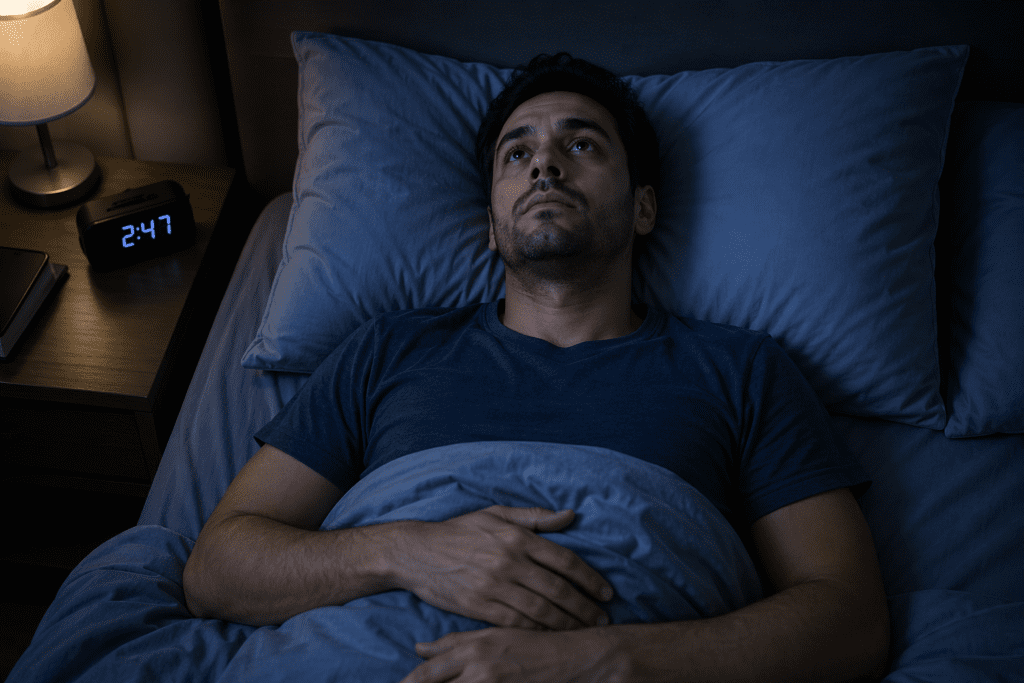
You’re not struggling to sleep because you’re not tired enough.
You’re struggling because your body and your brain are no longer operating at the same time.
That’s why you can feel exhausted all day… and still lie awake at night.
You have been tired all day. Work felt heavier than usual. Your focus faded in the afternoon. By evening, your body felt slow, your eyes felt worn out, and you were ready to rest.
But when you finally got into bed, something changed.
You were still awake.
Your body felt exhausted, but your mind kept moving. Thoughts stayed active. Sleep felt delayed. And the more you noticed it, the stranger it felt.
Why do I feel tired but can’t sleep? Feeling tired but unable to sleep usually happens when your body’s physical fatigue and your brain’s alertness signals are out of sync. This mismatch often involves circadian rhythm disruption, delayed sleep pressure, and mistimed alertness signals, making it harder to fall asleep even when you feel exhausted.
If you keep asking why this happens, the answer is often not simple stress or a lack of effort. In many cases, it comes down to internal timing. Your physical fatigue and your sleep signals are no longer lining up the way they should.
Many articles stop at quick explanations like anxiety, caffeine, or poor habits. Those factors can matter, but they do not explain the full pattern. The deeper issue is often that your body is running on the wrong schedule. You feel low energy when you should feel alert, and you feel mentally active when you should be winding down.
That is why this experience feels so frustrating. You are not imagining it. Your body may truly be tired while your brain is still operating as if it is not time to sleep yet.
What It Really Means When You Feel Tired but Can’t Sleep at Night
Feeling tired but unable to sleep does not always mean you need more time in bed. Sometimes it means the systems that control fatigue, alertness, and timing are not working together smoothly.
Your body and brain depend on coordination. Physical tiredness alone does not automatically create sleep. Sleep happens when several signals align at the same time:
- sleep pressure has built up enough
- your internal clock says it is time to rest
- your brain reduces alertness
- your body shifts into a lower-output state
When those signals align, sleep feels natural. When they do not, you can lie in bed feeling exhausted and still remain awake.
This is one reason broad sleep advice often feels incomplete. “Relax more” sounds nice, but it does not explain why you may feel terrible all day and still not fall asleep at night. The real issue is often that the body has built fatigue while the brain has delayed sleep readiness.
That mismatch creates the classic pattern: tired body, awake mind.
The Critical Difference Between Physical Fatigue and True Sleepiness Most People Overlook
One of the biggest reasons this experience feels confusing is that fatigue and sleepiness are not the same thing.
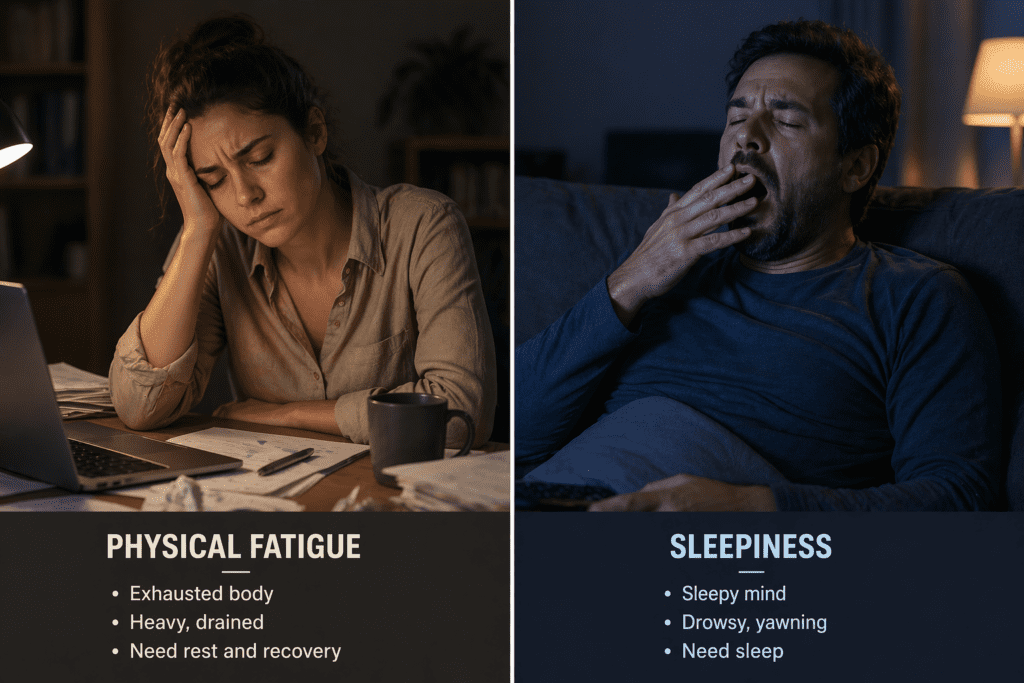
Fatigue is a physical signal. It reflects reduced energy, slower movement, and a need for recovery. You feel it in your body—heaviness, low drive, and difficulty maintaining effort.
Sleepiness is a neurological signal. It reflects your brain’s readiness to transition into sleep. It feels like a natural pull toward rest, where staying awake becomes difficult.
You can have fatigue without sleepiness.
This is exactly what happens in this pattern. Your body reaches a low-energy state, but your brain does not reach a sleep-ready state at the same time.
Understanding this difference changes everything. Instead of assuming you “should be able to sleep,” you begin to see that your body and brain are simply not arriving at the same point together.
To make this difference clearer, it helps to see how fatigue and sleepiness behave side by side in real situations.
| State | What Your Body Feels | What Your Brain Is Doing | What Happens at Night |
|---|---|---|---|
| Physical fatigue | Low energy, heaviness | Still active or alert | Difficulty falling asleep |
| True sleepiness | Relaxed, slowing down | Reducing activity | Sleep comes naturally |
| Mixed state | Tired but restless | Partially active | Delayed or broken sleep |
This is why feeling tired does not automatically lead to sleep. Without the brain entering a true sleep-ready state, fatigue alone is not enough to create a smooth transition into rest.
Why Your Body Feels Exhausted While Your Brain Stays Mentally Active at Night
Your body and your brain are connected, but they do not run on a single switch.
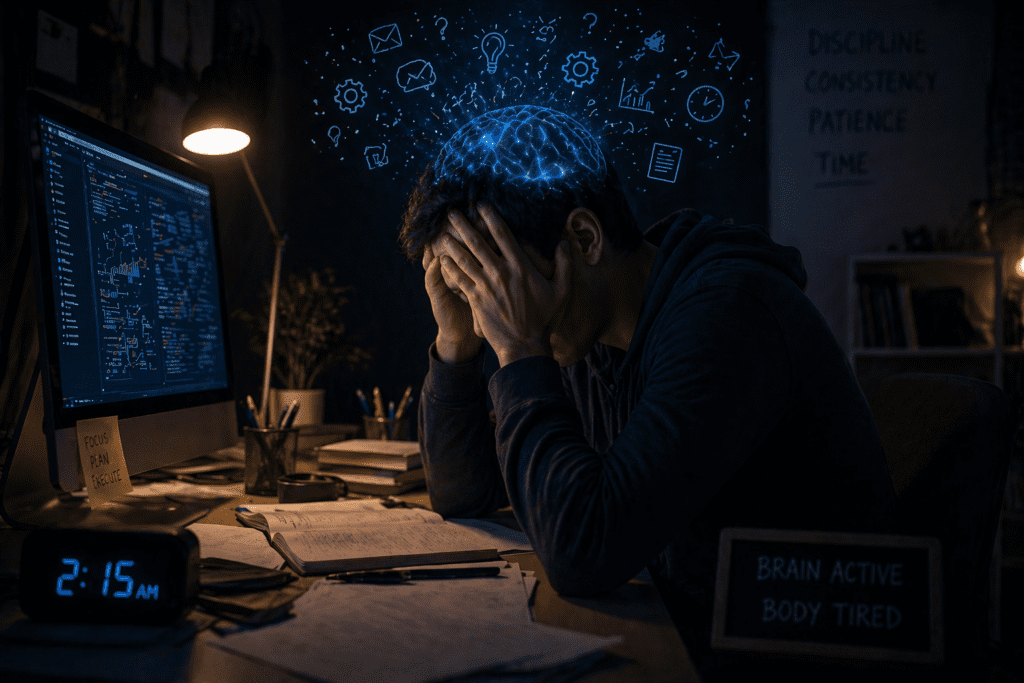
Your body tracks physical effort, recovery needs, movement, and general energy output. Your brain tracks stimulation, attention, unfinished mental load, and alertness. Your internal clock then helps decide when those systems should move toward wakefulness or sleep.
That means you can be physically drained and still mentally active.
This happens more often than people realize. A person may spend the day feeling worn down, sluggish, and unfocused, but not because the brain is ready for sleep. In some cases, the brain is under-recovered, overstimulated, or simply delayed. So even though the body feels done, the brain does not fully shift into sleep mode.
This is why why do I feel tired but can’t sleep is really a timing question as much as a fatigue question.
What makes this even more confusing is that mental activity at night does not always feel productive. You may not feel energetic in a good way. You may just feel “on.” Thoughts may drift, loop, or stay lightly active. You feel too tired to do much, but not sleepy enough to sleep.
That in-between state is a clue that synchronization has broken down.
The Hidden Mismatch Between Your Energy Levels and Your Sleep Signals
Energy is not just something you “have” or “do not have.” It follows a rhythm.
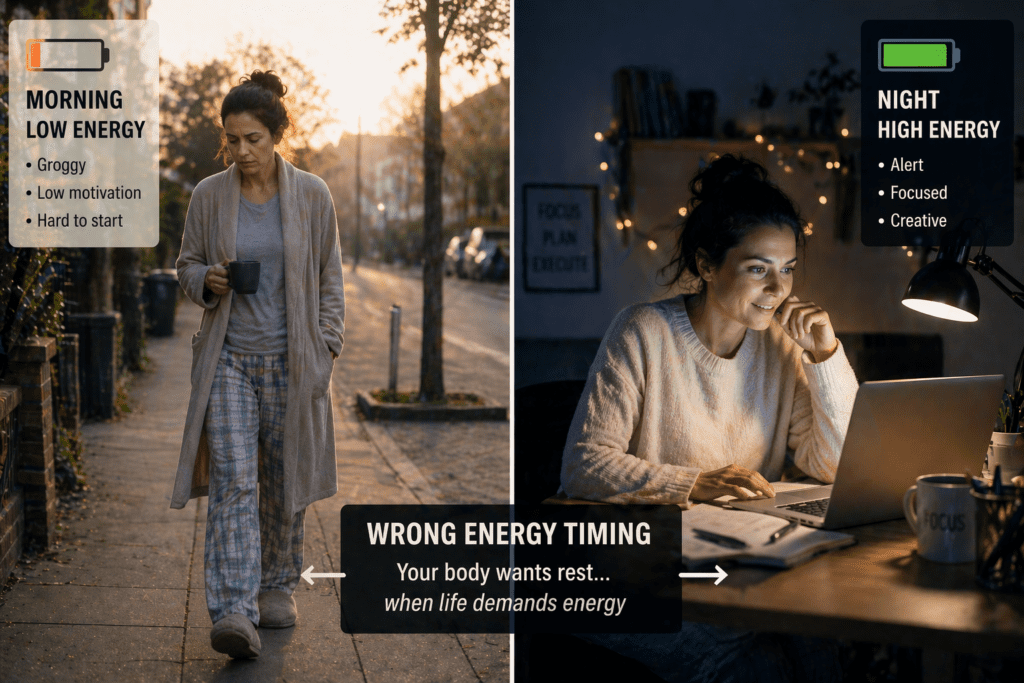
Across a healthy day, your body is supposed to move through a predictable pattern. Morning should bring a gradual rise in alertness. Daytime should support activity, concentration, and movement. Evening should bring a drop in activation and a stronger pull toward rest.
But when the pattern shifts, the whole experience changes.
Instead of:
- clearer energy in the morning
- steadier output during the day
- natural sleepiness at night
You may get:
- heavy mornings
- weak afternoons
- more mental alertness at night
This is the hidden mismatch behind the question, why do I feel tired but can’t sleep.
In simple terms, your fatigue and your sleep timing are no longer peaking together. Your body is feeling the cost of the day, but your sleep system is not arriving on time.
For some people, this mismatch is linked to weak daily rhythm cues, poor light timing, irregular wake times, long periods of inactivity, or a repeated cycle of low energy during the day followed by second-wind alertness at night. If your overall energy pattern already feels unstable, articles on afternoon energy crash prevention and mental fatigue after work can help you spot how daytime instability often carries into the evening.
When this mismatch develops, the difference between a normal rhythm and an out-of-sync rhythm becomes easier to understand when compared directly.
| Daily Phase | Normal Timing | Out-of-Sync Timing |
|---|---|---|
| Morning | Energy rises gradually | Energy feels low or delayed |
| Afternoon | Stable focus and output | Noticeable drop or crash |
| Evening | Calm transition begins | Mental activity increases |
| Night | Natural sleepiness | Alertness remains |
Once this shift happens, your entire day starts to feel uneven. Energy appears at the wrong times, and the natural transition into sleep becomes harder to achieve.
Why do I feel sleepy but can’t fall asleep?
Feeling sleepy but unable to fall asleep often means your sleep pressure and internal timing signals are not aligned, preventing a smooth transition into sleep.
The Hidden Triggers That Quietly Shift Your Energy Timing Throughout the Day
What makes this pattern even more difficult to notice is that it often develops without any single obvious cause.
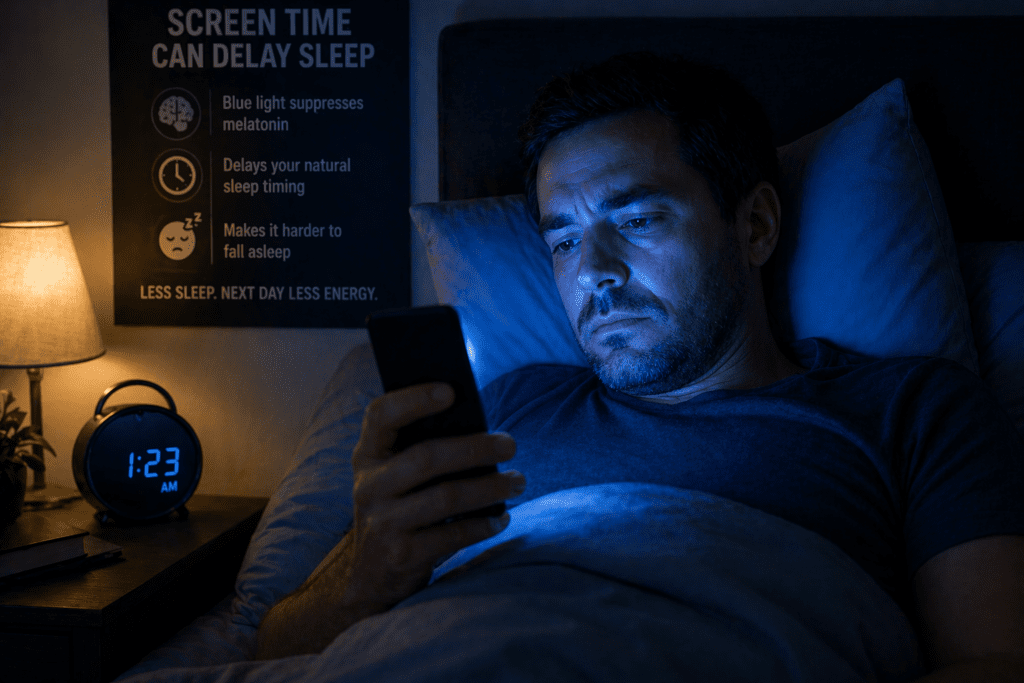
Instead of one big disruption, your timing can shift gradually through small, repeated signals that don’t feel important in the moment.
For example, exposure to bright screens late in the day doesn’t instantly keep you awake—but it subtly delays when your brain begins to slow down. A slightly inconsistent wake-up time may not feel like a problem, yet it weakens the clarity of your entire daily rhythm.
Even long periods of low activity can blur the difference between “active” and “rest” states. When your body doesn’t clearly experience both, it becomes less precise about when to transition between them.
None of these triggers seem strong on their own. But together, they quietly move your internal timing later and later, making it more likely that your body feels tired during the day while your brain stays active at night.
What Happens When Your Internal Clock Falls Out of Sync With Your Daily Rhythm
Your internal clock helps organize when your body expects activity and when it expects rest. This timing system is strongly shaped by light, routine, and repeated daily behavior. The CDC explains sleep as a core part of overall health, but the quality and timing of sleep matter just as much as total hours.
When your rhythm is aligned, your body gets clear signals:
morning means rise,
day means maintain,
night means slow down.
When your rhythm drifts, the signals become weaker or mistimed.
A few common examples:
- waking up at very different times across the week
- getting very little bright light early in the day
- spending long hours indoors under flat lighting
- experiencing long stretches of low movement
- keeping stimulation high late into the evening
Over time, this weakens the separation between “day mode” and “night mode.”
That matters because sleep does not happen just because you want it to. It happens when the body receives enough evidence that the day is truly ending.
If your system does not get that evidence clearly, the brain may continue acting as if it still needs to remain somewhat active. That makes why do I feel tired but can’t sleep less mysterious: your body feels the fatigue, but your internal schedule has not fully switched.
Why does my body feel tired but my mind stay awake?
Your body can feel tired while your mind stays awake when physical fatigue and alertness timing are out of sync. In that pattern, your muscles and energy systems may feel depleted, but your brain has not fully shifted into sleep mode yet.
The Real Cause-Effect Chain Behind Feeling Tired All Day but Awake at Night
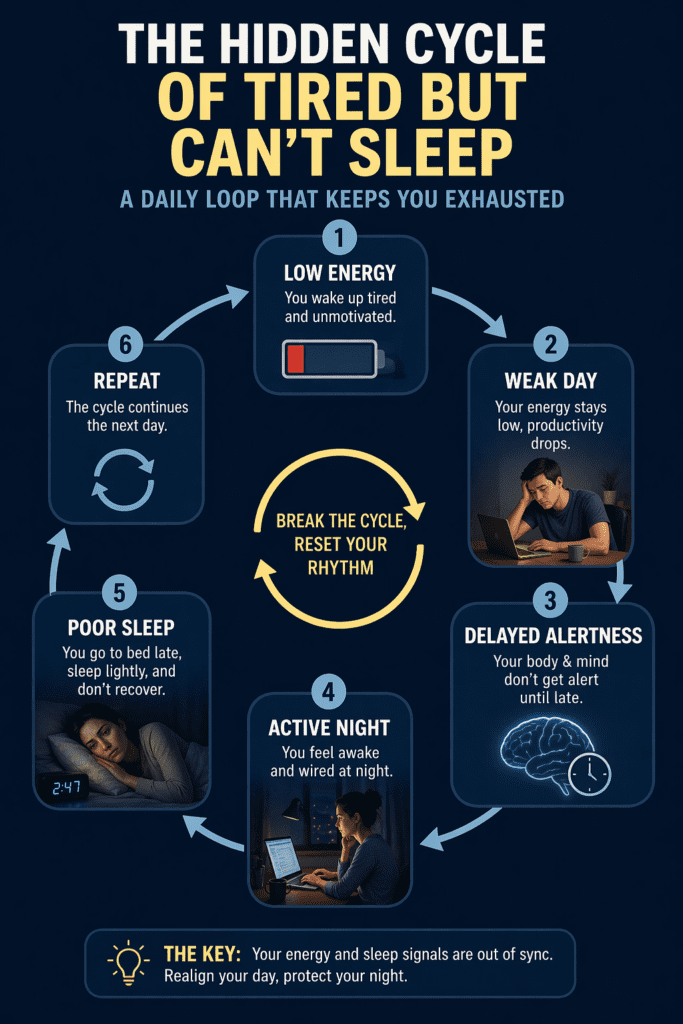
This pattern usually builds through a chain, not a single cause.
A realistic chain can look like this:
Low morning energy
→ slower start to the day
→ weaker daytime momentum
→ more passive energy use or inconsistent stimulation
→ delayed sleep readiness later on
→ more mental alertness at night
→ reduced sleep quality
→ even lower energy the next day
This is why the experience can become repetitive. Each day helps set up the next night, and each night affects the next day.
Here are the main steps that lead to feeling tired but unable to sleep:
- Low or unstable energy during the day
- Delayed recovery signals in the body
- Late activation of brain alertness
- Difficulty transitioning into sleep mode
- Poor sleep quality and next-day fatigue
This is also why a single fix at bedtime often does not solve the whole issue. The nighttime problem is usually being built earlier.
Why do I feel tired but not sleepy at night?
This usually happens when your body has low energy but your brain remains active due to delayed alertness signals.
Why You Feel Tired All Day but Suddenly More Awake Late at Night
This is one of the clearest signs that timing is off.
During the day, you may feel:
- slow to get going
- mentally dull
- physically low-energy
- less motivated than usual
But later, sometimes exactly when you want to rest, your mind becomes more active. Thoughts feel sharper. You may feel more capable of focusing than you did earlier. Or you may simply feel more mentally “present.”
That late activation can trick people into thinking they are getting energy back. In reality, they are often experiencing delayed alertness.
That delayed alertness may involve circadian rhythm timing, sleep pressure misalignment, and changes in how the brain is pacing stimulation across the day. The NIH describes sleep as part of a larger body system that includes rhythm and regulation, which is why this issue often feels broader than just “not being sleepy.”
And here is the counterintuitive part:
Sometimes the more tired you feel during the day, the easier it is for your system to become mistimed at night.
That seems backward, but it makes sense when you realize that low daytime energy can reduce clear daytime signaling. If the system never fully commits to strong daytime output, it may also fail to commit cleanly to nighttime shutdown.
Why This Problem Feels Worse on Some Days Than Others
You might notice that this problem isn’t always consistent. Some days feel manageable, while others feel significantly worse.
This variation is not random.
Your timing system responds to accumulation. When several small disruptions stack together—like inconsistent sleep, uneven energy use, or irregular daily patterns—the misalignment becomes stronger.
On days where your rhythm is slightly more stable, the mismatch may feel mild. On days where multiple signals are off, the gap between physical fatigue and mental alertness becomes more noticeable.
This is why the experience can feel unpredictable. You’re not dealing with a single cause—you’re experiencing the combined effect of multiple small timing shifts.
What Most People Miss About Why They Feel Tired but Cannot Fall Asleep Easily
Most people focus too narrowly on bedtime.
They try:
- sleeping earlier
- staying in bed longer
- forcing themselves to rest
- hoping that one calm night will fix everything
But when the real problem is timing, effort does not solve it.
That is what most people miss.
Trying harder to sleep does not automatically create sleepiness. In fact, it often increases awareness, frustration, and mental activity. That makes the mismatch feel even worse.
The more useful question is not, “How do I force sleep tonight?”
It is, “Why are my body and brain arriving at different states at the same time?”
That is the question behind why do I feel tired but can’t sleep.
This also separates your current topic from your existing article on wired but tired at night. That page leans more toward overstimulation and nervous system carryover. This article is narrower and more structural. It is about how timing itself becomes misaligned, causing your body to feel depleted while your brain still does not land in the right window for sleep.
How This Out-of-Sync Pattern Repeats and Becomes Your Daily Normal
Once this pattern appears a few times, it can start reinforcing itself.
You wake tired.
You drag through the first part of the day.
Your energy never feels stable.
The afternoon may feel especially weak.
Night arrives, and instead of feeling sleep-ready, you feel oddly awake.
Then you sleep poorly and repeat it again.
After a while, this can feel normal.
That is one of the biggest traps in this pattern. Because it develops gradually, people stop noticing how structured it has become. They assume they are “just bad at sleeping” or “not a morning person.” But often they are living inside a repeatable timing loop.
This loop can also overlap with other patterns on your site, such as feeling low after meals or feeling unstable after certain daily habits. For example, blood sugar swings and meal timing can add to a misaligned day if you already struggle with patterns like why do I feel tired after eating or why do I feel tired after drinking coffee. The point is not that one trigger causes everything. It is that several small disruptions can stack into one recognizable rhythm problem.
The One Daily Pattern That Confirms Your Body Is Running on the Wrong Schedule
There is a very specific pattern that shows up when your internal timing is off—and once you recognize it, it becomes hard to miss.
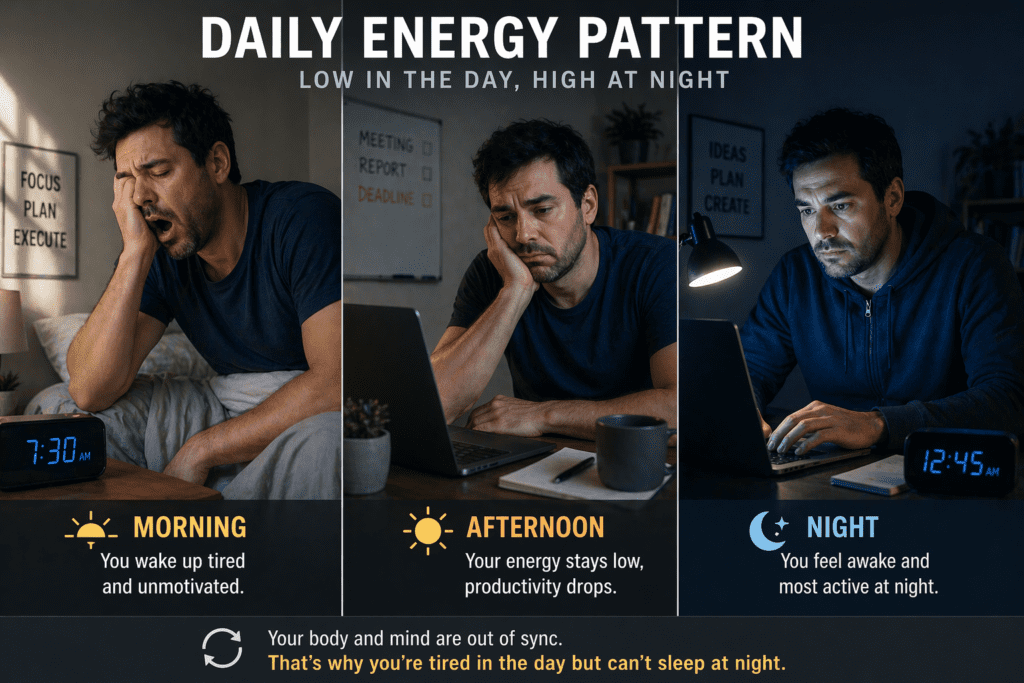
You wake up already feeling behind, as if your system hasn’t fully started. As the day continues, your energy doesn’t build the way it should. Instead, it dips or stays flat, especially in the afternoon.
Then, later in the evening, something shifts. Your body is still tired, but your mind becomes more present. You may not feel fully energized, but you are noticeably more awake than you were earlier in the day.
This pattern—slow morning, weak afternoon, alert night—is one of the clearest indicators that your system is not aligned with the natural rhythm it’s designed to follow.
Does this pattern sound familiar?
If your day follows the same pattern—slow morning, weak afternoon, and a more alert mind at night—the problem usually goes beyond bedtime. These next guides can help you pinpoint where your rhythm starts breaking down.
The Three Most Common Signs Your Body Is Running on the Wrong Schedule
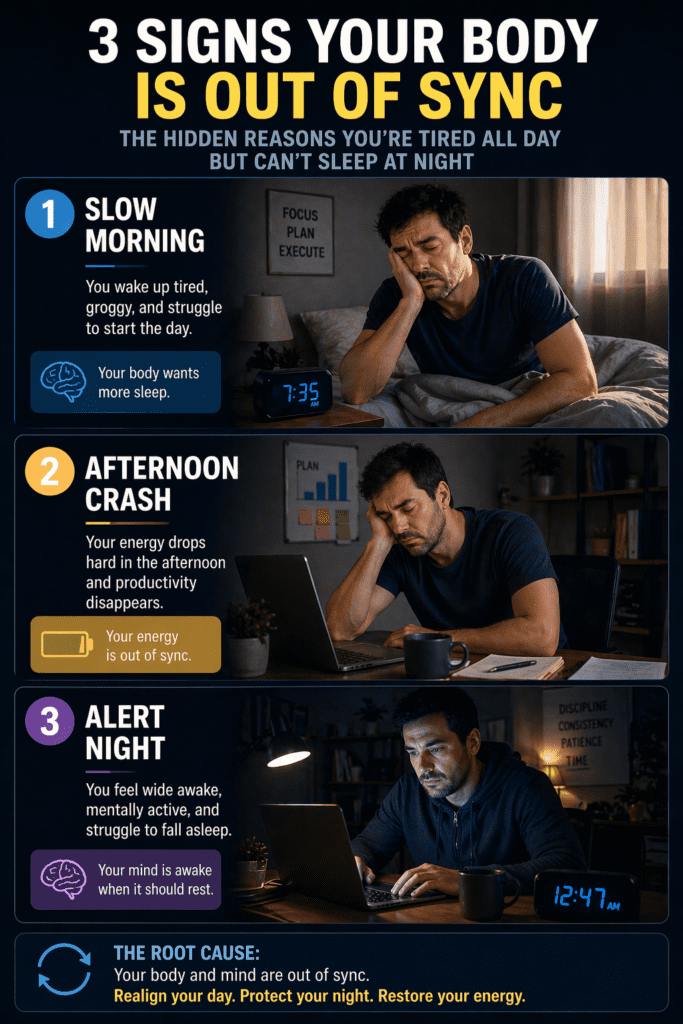
You do not need a wearable device to notice this pattern. Most people can spot it from the way their days feel.
1. Morning fatigue that does not lift quickly
You wake up heavy, foggy, or slow, and your system does not seem fully online for a while.
2. A noticeable afternoon energy drop
You feel like your body cannot maintain steady output. The afternoon may feel flatter than it should.
3. Increased mental alertness at night
Instead of gradually winding down, your mind feels more active later in the evening.
Common signs your body is out of sync include:
- feeling tired in the morning even after enough sleep
- experiencing an afternoon energy crash
- becoming more alert late at night
- struggling to fall asleep despite feeling exhausted
- having inconsistent energy levels throughout the day
When these signs cluster together, they usually point to timing mismatch more than simple tiredness.
Why am I tired all day but awake at night?
Feeling tired all day but awake at night often means your energy rhythm has shifted later than it should. Your body is struggling to produce strong daytime alertness, while your brain is holding onto activation too late into the evening.
The Science Behind Why Sleep Does Not Happen Even When You Feel Exhausted
Sleep does not happen from fatigue alone. It depends on at least two major forces working together:
- sleep pressure, which builds as you stay awake
- timing signals, which tell your body when sleep should occur
If sleep pressure is strong but timing signals are delayed, you can feel tired without becoming truly sleep-ready.
This is part of why why do I feel tired but can’t sleep is such a common question. People feel the sleep pressure, so the problem seems confusing. But the missing piece is timing.
You may be exhausted enough to want rest while still being mistimed enough to resist actual sleep.
This is also why people sometimes describe themselves as “sleepy but not sleepy.” They are tired, but the sensation does not convert into the smooth drowsiness that leads to sleep.
The Mayo Clinic’s overview of insomnia explains common causes like stress, schedule disruption, naps, and stimulation. Those factors matter, but structurally they all point back to the same core idea: the brain is not reaching sleep readiness at the right time.
Can circadian rhythm problems cause tiredness without sleep?
Yes. A disrupted circadian rhythm can cause you to feel tired during the day and alert at night.
Why Daytime Naps Can Sometimes Make It Harder to Fall Asleep at Night
It may seem logical that resting during the day would help you feel better at night. But in some cases, it can have the opposite effect.
Naps can reduce the buildup of sleep pressure that your body relies on to fall asleep later. When that pressure is lowered too early, your system may not reach a strong enough sleep signal at night.
This doesn’t mean naps are always harmful. But when your timing is already misaligned, they can make it harder for your body to create a clear separation between daytime and nighttime states.
Instead of helping recovery, they can unintentionally delay your natural transition into sleep.
How Energy Timing Affects When You Can Actually Fall Asleep at Night
Your body is supposed to have a clear daily arc.
Morning: rising output
Midday: stable performance
Evening: falling activation
Night: sleep readiness
When that arc gets blurred, the result is confusion in both directions:
you feel low when you should feel high,
and more active when you should feel lower.
That means falling asleep becomes less about “being tired enough” and more about whether your timing has landed where it should.
This is where people often notice that they are exhausted yet still restless. They may feel too tired to work, read, or think clearly—but still not able to drift into sleep. That is exactly what timing conflict feels like.
It can also overlap with visual fatigue from long stimulation-heavy days. If your days involve heavy screen exposure, related patterns like why do my eyes feel heavy can be part of the same broader daily overload and mistiming pattern.
Why do I feel exhausted but still awake?
This often reflects a mismatch between physical fatigue and mental alertness timing.
What Happens When You Ignore This Pattern Over Time
If the pattern continues, it often escalates gradually.
At first, it may show up as occasional nights where you feel oddly awake despite fatigue.
Then it becomes more regular:
- slower mornings
- heavier afternoons
- more mental activity at night
Later, it can shape your whole daily experience:
- less confidence in sleep
- more frustration at bedtime
- more inconsistent energy
- a growing sense that your body is unreliable
The biggest consequence is not just poor sleep. It is unstable rhythm.
And unstable rhythm affects everything else: focus, mood, momentum, and the ability to recover.
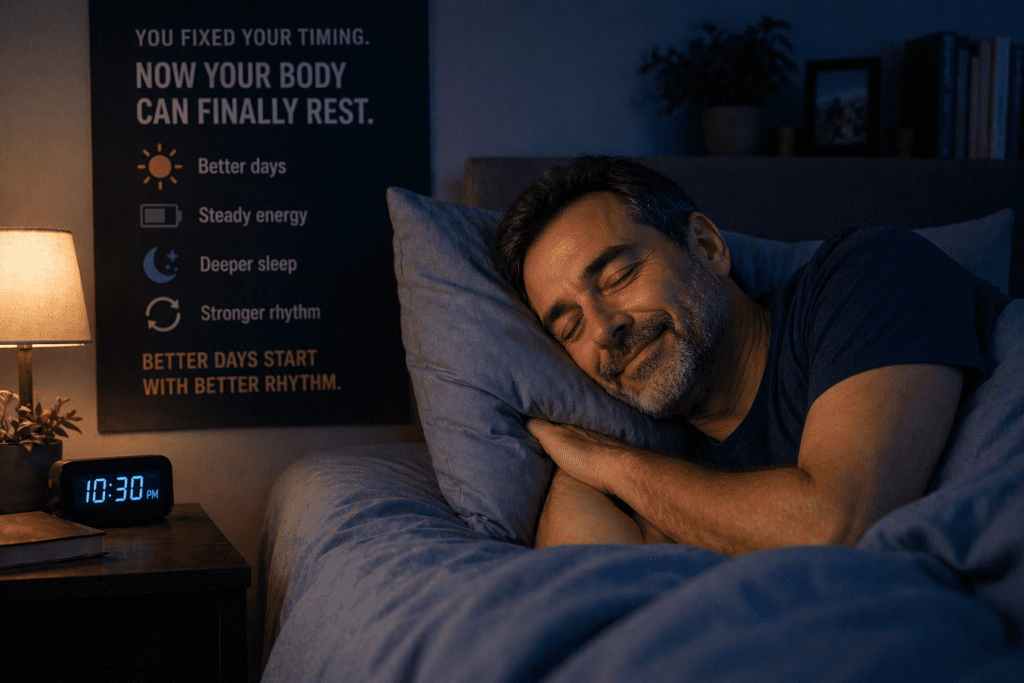
This is where your body can begin to settle again once the timing starts to realign.
How to Help Your Body Move Back Toward a Natural Energy Rhythm
The goal is not to force sleep. The goal is to rebuild alignment.
That means giving your body clearer timing cues:
- wake up at a consistent time
- get strong daylight exposure earlier in the day
- reduce long stretches of passive, low-energy drift
- avoid abrupt schedule swings across the week
- keep your day-night pattern clear and predictable
This is where simple routines matter. Even basic consistency can be more powerful than extreme sleep hacks. Regular wake timing, regular light exposure, and steady daily rhythm help your system separate day from night more effectively.
Hydration, meal timing, and movement can support that separation too. If your days are full of low, flat energy, it can help to review supportive habits like hydration routines for busy adults so your daytime physiology gives your brain a stronger “this is daytime” signal.
Why Small Timing Adjustments Have a Bigger Impact Than Major Changes
People often assume they need a full reset:
perfect sleep,
perfect habits,
perfect evenings.
But the body usually responds better to smaller repeated signals.
A stable wake time matters more than occasional catch-up sleep.
Regular light exposure matters more than random effort.
A clear day-night pattern matters more than dramatic changes for two days.
Why? Because your internal clock learns from repetition.
It does not need intensity as much as it needs consistency.
This is good news because it means progress does not require a total overhaul. It requires clearer timing, practiced often enough for the body to trust it again.
What Helps Realign Your Body Without Forcing Sleep
You don’t need to force sleep to fix this pattern.
What matters more is helping your body recognize the difference between active time and rest time again.

That usually starts earlier in the day. A consistent wake-up time gives your system a clear starting point. Exposure to natural light reinforces that signal, helping your brain understand when the day begins and when it should begin to slow down later.
As the day progresses, keeping your activity and energy patterns stable helps your system build a clearer transition into the evening. When stimulation stays high too late, that transition becomes weaker, making it harder for your brain to fully switch into rest mode.
These changes don’t act like quick fixes. Instead, they rebuild the timing signals your body depends on—so sleep stops feeling forced and starts happening more naturally.
The Bottom Line: Why You Feel Tired but Can’t Sleep
If you keep asking, why do I feel tired but can’t sleep, the answer is often not just that you are too stressed or not trying hard enough to relax.
It is usually a timing issue.
Your body feels the weight of fatigue, but your brain and internal clock are not arriving at sleep readiness at the same time. That mismatch leaves you exhausted without letting sleep happen easily.
Once your timing becomes clearer, sleep usually starts feeling less forced and more natural. The goal is not to push your body harder. The goal is to help it return to the rhythm it was built to follow.
Build a more stable energy rhythm
If this article helped you understand why you feel tired but can’t sleep, the next step is finding where your energy rhythm keeps breaking down. Start with the guide that matches your pattern most closely.
Wake up tired? Learn what may be delaying your morning activation.
Crash in the afternoon? See how unstable daytime energy can carry into the evening.
Feel worse after meals? Understand how food-related energy dips can affect your full day.
Running low all day? Support your rhythm with better hydration habits.
Common Questions About Feeling Tired but Unable to Sleep
Why do I feel physically drained but mentally alert at night?
This usually happens when your body’s energy systems are depleted, but your brain’s alertness signals are still active. The two systems don’t always shut down together, especially when your internal timing is delayed. As a result, your body feels tired while your mind stays active longer than expected.
Why does my energy feel low all day but improve slightly at night?
This pattern often reflects a delayed daily rhythm. Instead of building energy earlier in the day, your system shifts later. That can make mornings and afternoons feel weaker, while your brain becomes more active in the evening, even though your body still feels tired.
Why do I feel tired even after lying in bed for a long time?
Spending more time in bed doesn’t always create better sleep. If your body isn’t fully aligned with its natural timing, you may stay in a light, restless state instead of transitioning into deeper rest. This can leave you feeling tired even after enough time in bed.
Why does my body feel heavy but my mind won’t relax?
A heavy body usually reflects physical fatigue, while a restless mind reflects ongoing mental activity. When your internal timing is off, these two states don’t overlap properly. Your body slows down, but your brain doesn’t shift into a calm, sleep-ready state.
Why do I feel more awake after I try to fall asleep?
Focusing too much on falling asleep can increase awareness and mental activity. When your system is already out of sync, this added attention can make your brain more alert instead of less. That’s why sleep can feel harder the more you try to force it.
Why does my sleep feel light and unrefreshing even when I rest?
When your sleep timing is misaligned, your body may not reach deeper, restorative stages of sleep consistently. Even if you stay in bed long enough, the quality of sleep can feel shallow, leaving you tired the next day.
About This Content
This article is based on well-established concepts in sleep science, circadian rhythm regulation, and energy balance within the body. It explains how daily timing, internal signals, and energy patterns can affect when and how sleep happens.
The goal is to present these concepts in a simple, practical way that helps you understand your own experience without relying on overly technical language.
This content is intended for informational purposes only. It does not diagnose or treat any condition. If your symptoms are persistent, severe, or affecting your daily life, it is recommended to consult a qualified healthcare professional for proper evaluation.
