

You sit down for a quiet moment and expect your body to settle. Nothing major is happening. You are not exercising, not solving a hard problem, and not dealing with some obvious crisis. But your energy still feels low. Your body feels off. Your mind is not exactly sleepy, yet you do not feel fully powered on either. If that sounds familiar, you may have asked yourself a frustrating question: does anxiety make you tired?
It’s a confusing experience—and far more common than most people realize.
Many people describe this as feeling tired for no reason, even when nothing stressful is happening.
Yes, anxiety can make you feel tired—even when you’re not physically or mentally active. It does this by keeping your nervous system slightly activated in the background, which quietly drains energy throughout the day. Over time, this can lead to a persistent feeling of fatigue that doesn’t fully improve with rest or sleep.
In simple terms, anxiety can make you feel tired because your body never fully switches into recovery mode.
This is why the experience can feel confusing. You are not doing much, yet your energy feels lower than it should be. The reason is not always visible, but the effect is very real.
Instead of a clear burst of stress followed by recovery, your system stays slightly “on” in the background. That ongoing low-level activation uses energy continuously, which is why the fatigue can feel steady, subtle, and hard to explain.
Table of Contents
How anxiety can drain your energy
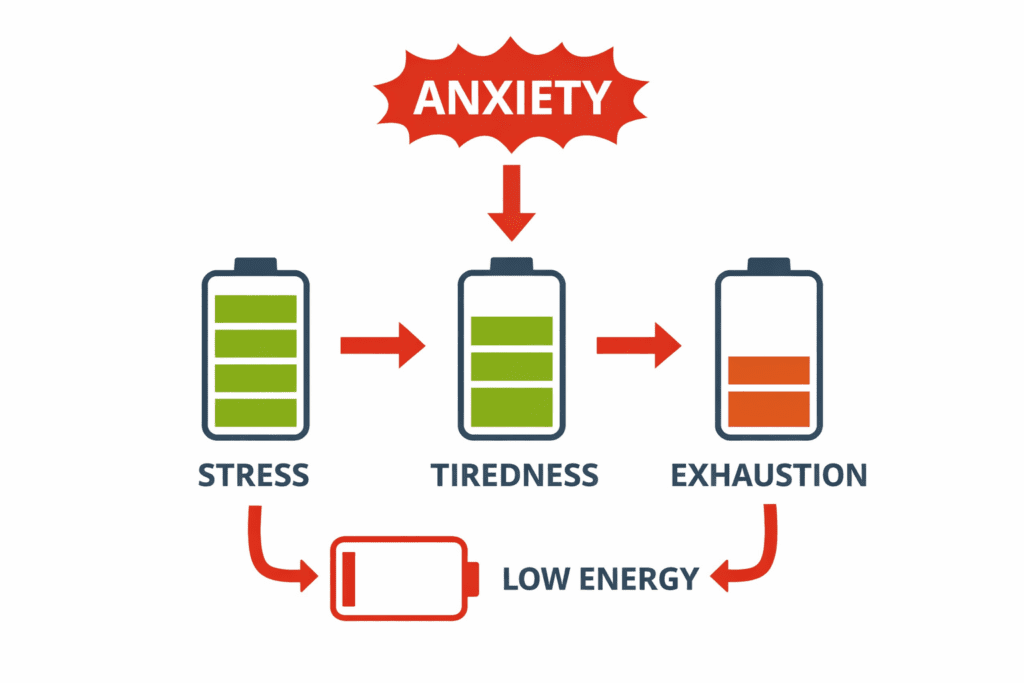
- It keeps your nervous system slightly activated.
- Your body uses energy in the background all day.
- Muscles and breathing may stay subtly tense.
- Recovery does not fully happen when your system stays on.
- Fatigue builds gradually, even without obvious effort.
- You end up feeling tired, heavy, or “off” for no clear reason.
Common signs anxiety-related fatigue may be affecting you
- You feel tired without doing much physically.
- Your energy feels low even after rest.
- Your body feels heavy or slow for no clear reason.
- You feel tired but not fully sleepy.
- You crash mentally after ordinary daily tasks.
- You have a hard time feeling fully relaxed.

Why Anxiety Fatigue Feels So Strange Compared With Normal Tiredness
Most fatigue makes sense. You stay active, work hard, sleep poorly, or deal with a demanding day, and later your body asks for rest. There is a clear line between what happened and how you feel.
Anxiety fatigue is different. It often shows up when that line is blurry.
That is why it can feel so unsettling. You may not have done anything intense, yet your energy feels low. You may even wonder whether you are imagining it, getting lazy, or missing something obvious. But anxiety-related fatigue often feels confusing precisely because the effort causing it is not always visible from the outside.
Your body does not only use energy when you are moving, lifting, or actively solving problems. It also uses energy when it is staying guarded, anticipating stress, adjusting to tension, and maintaining a low-level alert state. That internal effort is easy to miss in real time. What you notice later is the result: low energy, body heaviness, reduced mental clarity, and a sense that your battery is lower than it should be.
This is also why people who often feel tired for no reason can miss the connection at first. The fatigue does not feel tied to a workout, a bad meal, or a long commute. It feels vague. But vague is not the same as unreal.
Why Anxiety Fatigue Feels Different From Normal Tiredness
Not all fatigue feels the same, and this is where anxiety-related tiredness becomes easier to recognize.
With normal fatigue, the pattern is simple. You use energy, you feel tired, and rest usually helps you recover.
With anxiety fatigue, the pattern feels broken.
You may feel low on energy without a clear buildup. Rest might help a little, but not enough. And instead of feeling physically “spent,” you often feel slightly disconnected, slow, or heavy.
Another difference is predictability.
Normal tiredness is expected—you know why it’s happening. Anxiety fatigue feels less predictable because the cause is not tied to visible effort.
This mismatch is what makes it harder to trust your own energy levels.
Your body feels tired, but the reason doesn’t feel obvious.
Why does anxiety make you feel tired?
Because anxiety can keep your body and brain in a low-level state of readiness that uses energy steadily across the day. That background alertness makes full recovery harder, so fatigue builds even when you are not doing anything intense.
How Anxiety Fatigue Differs From Normal Tiredness
Fatigue doesn’t always follow the same pattern. To understand why anxiety-related tiredness feels so different, it helps to compare it directly with normal fatigue. The difference becomes clearer when you look at how each type uses and restores energy.
| Type of Fatigue | What Drives It | How It Feels in the Body | What Happens After Rest |
|---|---|---|---|
| Normal Fatigue | Physical or mental effort | Tired, sleepy, slowed down | Energy improves and returns to baseline |
| Anxiety Fatigue | Background nervous system activity | Heavy, low energy, “off” feeling without clear cause | Recovery feels incomplete and energy stays flat |
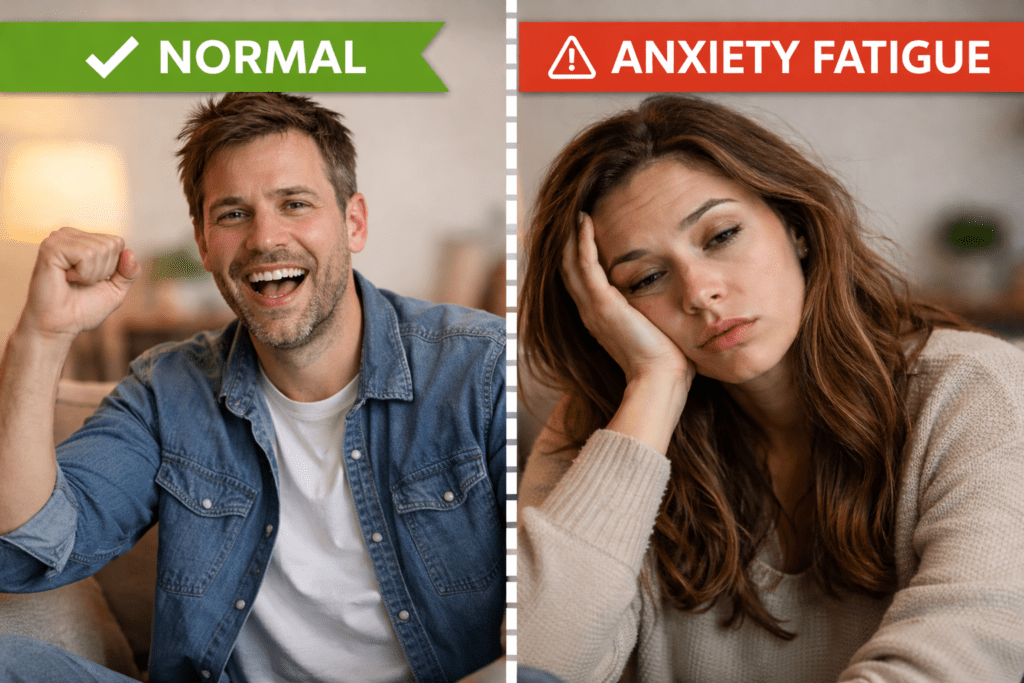
This is why anxiety fatigue can feel harder to understand. The effort isn’t always visible, and the recovery isn’t always complete. That mismatch is what makes the experience feel confusing and inconsistent.
Why Anxiety Fatigue Feels Like a Loss of Momentum
Another way this type of fatigue shows up is through a subtle loss of momentum.
It’s not just about feeling low on energy—it’s about how difficult it becomes to keep moving once you start something.
You may begin a task normally, but instead of building flow, your energy fades faster than expected.
This creates a stop-and-start pattern where it feels harder to stay engaged, even with simple activities.
The issue isn’t the task itself.
It’s that your system isn’t maintaining energy efficiently over time.
Instead of sustaining effort, your energy drops too quickly.
The Real Issue: Anxiety Keeps Your System From Fully Switching Off
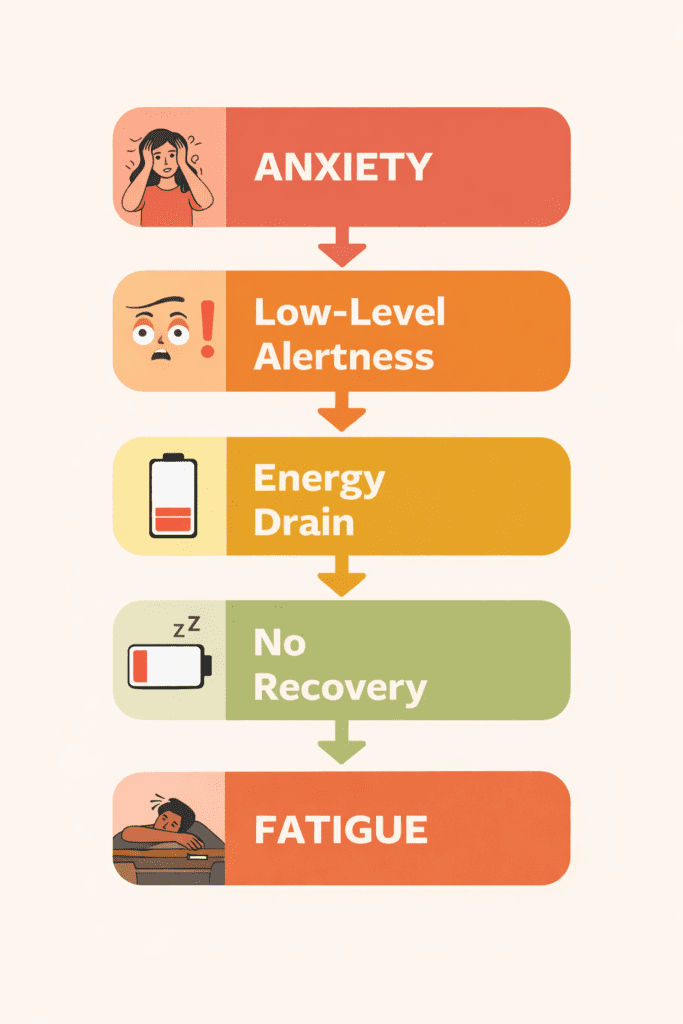
One of the biggest reasons anxiety can leave you feeling drained is that it interferes with your body’s ability to fully downshift.
A healthy system moves between activation and recovery. You need activation to focus, respond, work, drive, socialize, and handle normal life. You need recovery to restore energy, release tension, and reset mentally and physically.
Anxiety makes that switch less clean.
Even when you are not in full panic mode, your body may still be running a lighter version of alert mode in the background. Your nervous system may remain more watchful than restful. Your breathing may stay slightly shallow. Your muscles may hold mild tension. Your brain may keep scanning, predicting, checking, or bracing without you consciously deciding to do it.
That matters because recovery is not just about sitting still. Recovery requires safety signals. If your system does not fully receive those signals, it does not fully relax. If it does not fully relax, it does not fully restore energy.
This is one reason Cleveland Clinic’s stress overview is useful in understanding the article’s core mechanism: the body’s stress response is designed to help you deal with demands, but when that pattern keeps getting activated, it can affect tension, sleep, and exhaustion in a very real way.
Can anxiety make you tired all day?
Yes. If your system stays activated in the background and recovery stays incomplete, anxiety can contribute to low, flat, all-day energy rather than one short crash.
How Background Alertness Quietly Uses Energy All Day Long
Think of anxiety-related fatigue less like one big crash and more like a quiet leak.
A small leak can still drain a lot if it continues all day.

That is what low-level anxiety often does. It does not always hit like a sudden storm. Sometimes it works more like a hidden drain on your system. Your brain stays more alert than necessary. Your body stays a little more prepared than it needs to be. Your attention remains easier to trigger. Your internal systems keep using energy to maintain readiness, even when there is no visible emergency.
This is why anxiety can make you tired even during ordinary life. You may be answering emails, driving, walking through a store, or simply trying to relax on the couch, yet part of your system is still acting as if it should stay prepared.
That ongoing readiness takes energy.
The tricky part is that it does not always feel dramatic. Many people imagine anxiety as obvious worry, panic, or racing thoughts. But anxiety can also show up as background strain: always a little tense, always a little keyed up, always a little unable to settle. Over hours and days, that pattern becomes exhausting.
If your mind tends to stay active, you may also recognize overlap with feeling tired after thinking too much, but this article focuses on something slightly different. Overthinking is one pathway. Anxiety fatigue can still happen even when you are not sitting there consciously analyzing everything. Sometimes the drain comes from a body and brain that never fully stop scanning.
Why You Feel Tired Even When You’re Not Thinking About Anything
A common misconception is that anxiety only drains energy when you’re actively worrying.
But many people notice something confusing: they feel tired even when their mind seems quiet.

This happens because not all mental activity is conscious.
Your brain can remain in a monitoring state without producing obvious thoughts. It can stay ready, alert, and slightly reactive even when you’re not actively thinking about anything stressful.
In that state, your system is still doing work—it’s just not visible.
This is similar to how a computer can run multiple background processes without showing anything on the screen.
You don’t see the activity, but the system is still using power.
That’s why you can feel drained without feeling mentally busy.
Why You Can Feel Tired Even When You’re Resting
A lot of people assume rest should solve the problem quickly. You sit down. You lie in bed. You cancel plans. You try to take it easy. Yet you still feel drained.
That can happen because rest and recovery are not the same thing.
Rest is what you do on the outside. Recovery is what your system does on the inside.
If you are sitting still but your nervous system remains partially activated, recovery stays incomplete. You may be physically resting, but not fully restoring energy.
This is why anxiety-related fatigue can feel so unfair. You are trying to do the right thing, but your body does not seem to respond the way you expect. You may even feel worse when you stop moving because the contrast becomes more noticeable. Once the distractions drop, you become more aware of the heaviness, the low energy, or the tired-but-not-calm feeling.
That same mismatch helps explain why some people feel both depleted and restless. If that pattern sounds familiar, it overlaps with the kind of nervous-system imbalance explored in mentally drained but restless in the afternoon. In both cases, the problem is not simple laziness or a lack of motivation. It is a system that is using energy inefficiently while struggling to fully power down.
Why do I feel tired even when I am resting?
Because sitting still does not guarantee your nervous system has shifted into true recovery mode. If your body still feels internally alert, rest may not feel as restorative as it should.
If this experience feels familiar, there’s often a deeper reason behind it. Understanding why you feel tired for no reason can help you connect the pattern more clearly.
What Happens in Your Body When Anxiety Keeps Running in the Background
Anxiety-related fatigue becomes easier to understand when you stop thinking only in terms of emotions and start looking at body systems.
When anxiety stays active in the background, several things can happen at once.
Your breathing pattern may change. It may become more shallow or more chest-driven. Even a subtle change in breathing can influence how your body feels and how settled your nervous system becomes.
Your muscles may stay lightly engaged. Jaw tension, shoulders that do not fully drop, neck tightness, and a slight brace through the torso can all cost energy over time.
Your attention system may stay overly sensitive. Small noises, notifications, conversations, or daily demands may pull more from you than they should because your brain is already on a shorter fuse.
Your recovery signals may weaken. Instead of fully shifting into rest mode, your system stays somewhere in between.
This is where Harvard Health’s article on generalized anxiety disorder becomes directly relevant to the topic. It highlights how anxiety is not just a thought pattern. It can include fatigue, sleep disruption, trouble concentrating, and muscle tension, which all fit the exact experience many people describe when they say they feel tired but cannot fully explain why.
Can anxiety cause physical fatigue, not just mental fatigue?
Yes. Anxiety can affect body tension, movement effort, breathing patterns, and the overall sense of energy available to your body, which is why it often feels physical as well as mental.
Why Anxiety Can Make Your Body Feel Heavy and Slow
One of the most frustrating parts of anxiety fatigue is that it often feels physical, not just mental.

Your arms may feel less responsive. Your legs may feel heavier. Your body may feel slower starting simple tasks. It can create the strange impression that you are dragging yourself through normal parts of the day.
This does not always mean something dramatic is wrong. It can reflect how low-level stress, mild muscle tension, disrupted recovery, and ongoing internal energy use affect how movement feels.
When energy is being drained gradually in the background, your body has less available for ease, drive, and physical readiness. That can make ordinary movement feel more effortful than it should.
This is one reason anxiety fatigue can overlap with other body-heavy sensations on your site, like why do my legs feel heavy or why do my eyes feel heavy. The trigger is different, but the feeling can rhyme. Reduced recovery, ongoing low-level activation, and inefficient energy use can all translate into that “weighed down” sensation people often struggle to describe.
Why does my body feel heavy with anxiety?
Low-level tension, reduced recovery, and gradual background energy drain can make your body feel slower, heavier, or more effortful even without a clear physical cause.
Does Anxiety Make You Tired Even If You Sleep Enough?
Yes, it can.
This is a major reason anxiety fatigue feels so confusing. Many people assume that if they get enough hours in bed, they should wake up refreshed. But hours asleep and true recovery are not always identical.
Anxiety can affect how restorative sleep feels. You may technically sleep, but if your body has been carrying tension, staying internally alert, or cycling through worry and stress signals, the recovery effect may not feel complete. You wake up and still feel like your battery never got fully charged.
This does not mean every case of waking tired is caused by anxiety. But it does explain why some people sleep a decent number of hours and still feel drained. Their system may not have been fully at ease before sleep, during sleep, or after waking.
This is also why the question is not just “How many hours did I sleep?” but “Did my body and nervous system actually downshift enough to recover?”
Can anxiety make you tired even if you are not overthinking?
Yes. Overthinking is one pathway, but anxiety can still drain energy through nervous-system activation, body tension, and incomplete recovery even when you are not consciously stuck in intense thought loops.
Why Anxiety Fatigue Often Shows Up During Normal Daily Tasks
Anxiety fatigue is not always strongest during dramatic moments. It often becomes obvious during regular life.

You may notice it when replying to simple messages. Folding laundry feels harder than it should. Small errands seem heavier. Conversations take more out of you. A normal workday leaves you unexpectedly flat.
That happens because ordinary tasks still require energy, focus, and adjustment. If your baseline energy is already being drained by background alertness, you start those tasks with less reserve. So even simple things feel more expensive.
That is also why anxiety can make social situations more draining than expected. Socializing requires attention, response adjustment, and subtle nervous-system engagement. If you already feel low on internal reserves, you may notice overlap with why you feel tired after socializing. The social event is not always the whole problem. Sometimes it simply exposes how taxed your system already was.
Why Anxiety Fatigue Can Come and Go Suddenly
One of the most frustrating parts of this type of fatigue is how quickly it can appear.
You might feel fine, and then suddenly your energy drops.
This doesn’t mean the fatigue came out of nowhere.
What actually happens is that your system has been gradually using energy in the background. You just don’t notice it until it reaches a certain point.
Once your available energy drops below a threshold, the feeling becomes noticeable all at once.
That’s why it can feel sudden—even though the process behind it was gradual.
It’s not a sudden loss of energy, but a delayed awareness of it.
Why This Pattern Can Build Into All-Day Low Energy
The longer this pattern runs, the more likely it is to stop feeling like a temporary issue and start feeling like your normal baseline.
That is when people begin saying things like:
“I feel tired all the time.”
“I can’t remember what normal energy feels like.”
“I’m never fully on.”
“I’m not crashing from one thing. I just stay drained.”
That shift matters.
A one-time stressful event can leave you tired. But anxiety fatigue often becomes more persistent because the mechanism is not one isolated event. It is repeated low-level activation plus incomplete recovery. Over time, that combination can flatten energy across the day.
This is also why people sometimes confuse anxiety fatigue with pure sleepiness, weakness, laziness, or burnout. Parts of the feeling overlap, but the mechanism is its own pattern. It is not just that you need to “try harder.” It is that your system has been spending energy in hidden ways for longer than you realized.
Why This Fatigue Often Feels Subtle but Constant
One reason this type of fatigue is difficult to recognize is that it rarely feels extreme.
Instead, it tends to stay at a steady, low level.
You may not feel completely exhausted, but you also don’t feel fully energized.
This creates a middle state where your energy feels slightly reduced most of the time.
Because it’s not intense, it’s easy to ignore at first.
But over time, that constant low level becomes more noticeable.
It’s not the intensity that makes it difficult—it’s the persistence.
Why Anxiety Fatigue Feels Worse at Certain Times of Day
You might notice something interesting about this type of fatigue: it doesn’t always feel the same throughout the day.
Some people feel it more in the morning, others hit a wall in the afternoon, and many feel it most strongly in the evening when everything slows down.
This happens because your energy is not only affected by how much you use—it’s also affected by when your system is trying to recover.
In the morning, if your system didn’t fully relax overnight, you start the day already slightly depleted.
In the afternoon, your natural energy dip combines with ongoing background tension, making the fatigue feel heavier than expected.
By the evening, your body is finally slowing down, which makes you more aware of how drained you actually feel.
So the fatigue isn’t random.
It follows your body’s natural rhythm—but gets amplified when your system never fully resets.
Why Your Energy Feels Unstable Throughout the Day
Another pattern people notice is that their energy doesn’t feel stable.
Instead of a steady level, it rises and falls in ways that don’t always match what they’re doing.
You might feel slightly better for a short period, then suddenly drop again without a clear reason.
This happens because your energy is being influenced by internal shifts rather than external effort.
Small changes in attention, environment, or stimulation can affect how much energy your system is using at that moment.
This makes your energy feel unpredictable, even when your routine stays the same.
What Most People Miss About Anxiety and Fatigue
Most people look for one obvious cause.
They want the single answer:
“It’s because I slept badly.”
“It’s because I worried too much.”
“It’s because I skipped lunch.”
“It’s because I need more motivation.”
Sometimes those things matter. But anxiety fatigue is often a layered problem. The reason it is easy to miss is because the energy drain is spread across many subtle processes rather than one dramatic symptom.
Mild muscle tension here. Background stress there. A nervous system that never fully downshifts. A brain that keeps scanning. Sleep that does not feel fully restorative. More effort required for normal tasks. More stimulation sensitivity than usual.
Each piece may look small on its own.
Together, they create a fatigue pattern that feels very real.
The National Institute of Mental Health overview of anxiety disorders helps reinforce this bigger picture because anxiety is not only about fear or worry in the narrow sense. It can affect concentration, sleep, physical comfort, and daily functioning in ways that directly shape your energy.
Why Anxiety Fatigue Is Different From Just Being Mentally Tired
Mental fatigue and anxiety fatigue overlap, but they are not exactly the same.
Mental fatigue usually follows cognitive load. You focus hard, make decisions, solve problems, and eventually your brain feels overloaded.
Anxiety fatigue can include that, but it also reaches beyond it. It includes the body state underneath the thoughts. You may not be doing intense mental work at all. You may simply be living inside a system that does not feel fully safe enough to stop preparing.
That is why anxiety fatigue can feel more full-body. It is not just “my brain is tired.” It is “my whole system feels low.” Your mind may feel foggy, your body may feel heavy, and your energy may feel harder to access than usual.
How to Think About the Problem More Clearly
A useful shift is to stop asking only, “Why am I tired?” and start asking, “What is keeping my system from fully recovering?”
That question gets closer to the real mechanism.
It helps explain why:
- rest may feel incomplete
- energy may stay flat
- your body may feel heavy
- you may wake tired
- ordinary tasks may feel more draining than they should
It also helps you avoid one of the biggest mistakes in this topic: assuming the fatigue is random just because it is subtle.
It may be subtle, but it still follows a pattern.
What Most People Misinterpret About This Type of Fatigue
Because this fatigue doesn’t follow the usual rules, it’s easy to misunderstand it.
Many people assume they’re just unmotivated, out of shape, or not trying hard enough.
Others think they’re simply “tired all the time” without questioning why their energy behaves differently.
The problem is that this type of fatigue doesn’t respond to effort in the same way.
Pushing harder doesn’t always fix it, and resting more doesn’t always solve it either.
That’s because the issue is not a lack of effort or a lack of rest—it’s a mismatch in how your system is using and restoring energy.
Once you see that clearly, the experience starts to make more sense.
And when something makes sense, it becomes easier to handle.
Why It Feels Hard to “Push Through” This Type of Fatigue
With normal tiredness, pushing through for a short time often works.
You can rely on momentum, motivation, or a quick boost of effort.
With anxiety fatigue, this approach doesn’t feel the same.
Trying to push through can feel like you’re forcing energy that isn’t fully available.
Instead of gaining momentum, you may feel resistance building faster.
This is because your system isn’t lacking motivation—it’s managing energy differently.
Effort doesn’t convert into energy the same way, which is why pushing feels harder.
What Helps Reduce This Type of Fatigue (Without Overcomplicating It)
This type of fatigue is not always about doing more—it’s often about reducing what keeps your system active in the background.

Simple changes like allowing real downtime, lowering constant input, and giving your body time to fully slow down can make a noticeable difference over time.
The key is not forcing energy back, but allowing your system to recover properly.
At this point, the question is no longer ‘why am I tired?’ but ‘why is my system not fully recovering?’
The Bottom Line on Why Anxiety Can Leave You Feeling Drained
Yes, anxiety can make you tired, and it can do so in a way that feels surprisingly physical, steady, and hard to explain.
Not because you are weak.
Not because you are imagining it.
Not because you are doing life wrong.
It happens because anxiety can keep your body from fully switching into recovery mode. That leads to background energy use, subtle tension, incomplete restoration, and a drained feeling that can show up even during quiet, ordinary moments.
Once you understand that pattern, the experience starts making more sense. And when something makes more sense, it becomes easier to recognize, describe, and address instead of just feeling confused by it.
Want to understand your energy more clearly?
Anxiety fatigue is only one part of the bigger picture. If your energy feels low, flat, heavy, or unpredictable, these next guides will help you understand what may be happening from different angles.
Start with the guide that feels closest to your symptoms and build a clearer picture of what your body may be telling you.
Frequently Asked Questions About Anxiety Fatigue
Can anxiety make you feel tired even on days when you feel “fine”?
Yes, it can. Anxiety-related fatigue doesn’t always match how you feel emotionally. Your system can stay slightly activated even on calm days, which means energy may still be used in the background without obvious stress or worry.
Does anxiety tiredness feel different from normal sleepiness?
Yes. Instead of feeling ready to sleep, you may feel low on energy while still mentally alert. This creates a mixed state where your body feels tired, but your mind doesn’t fully switch into a relaxed or restful mode.
Can anxiety affect how quickly you recover your energy?
Yes, it can slow down how efficiently your body restores energy. Even after resting, your system may not fully shift into recovery mode, which can make your energy feel limited or inconsistent throughout the day.
Why does anxiety fatigue feel harder to notice at first?
Because it often builds gradually rather than appearing suddenly. You may feel slightly “off” or lower on energy without recognizing a clear pattern, which makes it easier to overlook until it becomes more noticeable over time.
Can anxiety make you feel physically weak without a clear reason?
Yes, anxiety can create a sense of physical weakness even without intense activity. This is usually linked to reduced available energy and ongoing background activation rather than a direct problem with muscle strength.
Is anxiety fatigue constant or does it come and go?
It can do both. Some people experience a steady low level of fatigue, while others notice fluctuations. These changes often depend on how active the nervous system is and how effectively the body is able to recover.
Why is anxiety-related fatigue difficult to explain to others?
Because the cause isn’t always visible. You may not look stressed or physically exhausted, which makes it harder for others to understand. The fatigue feels real, but it doesn’t always match what people expect tiredness to look like.
Can anxiety affect your energy even without overthinking?
Yes, because not all anxiety is conscious. Your system can remain slightly alert in the background even when your thoughts seem calm, which still uses energy and affects how you feel physically.
Does anxiety fatigue always mean something is seriously wrong?
Not necessarily. In many cases, it reflects how your body is managing energy under ongoing stress or activation. However, if fatigue is severe, persistent, or worsening, it’s important to consider other possible factors as well.
Important Note
This content is for informational purposes only and is not intended as medical advice. Anxiety and fatigue can have multiple causes, and individual experiences may vary. If your symptoms are persistent, severe, or affecting your daily life, consider speaking with a qualified healthcare professional for personalized guidance.
