

You’re doing something simple—holding your phone, typing on your laptop, or carrying a light grocery bag—and suddenly your arms feel heavy, weak, and harder to control.
There’s no obvious reason. You didn’t overwork your muscles. You didn’t lift anything heavy.
So why does it feel like your arms are giving out?
This sudden heaviness can feel confusing, and sometimes even a little alarming, especially when it shows up during normal daily activities.
If you’ve been wondering why your arms suddenly feel heavy and weak, you’re not alone. This sensation is more common than most people think—and in many cases, it has less to do with strength and more to do with how your body is functioning in that moment.
This feeling is usually temporary, but understanding why it happens can help you respond to it more effectively—and avoid it happening as often.
What Causes Arms to Suddenly Feel Heavy and Weak
Arm heaviness and sudden weakness usually happen when muscles stay tense, blood flow slows, and the nervous system amplifies effort signals, creating a temporary feeling of fatigue even without real muscle weakness.
Common Reasons Your Arms Suddenly Feel Heavy and Weak
- Static muscle tension that lasts too long
- Temporary drops in efficient blood flow
- Nervous system amplification of effort signals
- Poor posture and raised shoulder tension
- Repetitive low-effort movements without recovery
- Mental stress that makes normal tension feel heavier
The Real Reason Why Arms Suddenly Feel Heavy and Weak During Simple Tasks
Most people assume this feeling means something is wrong with their muscles.
But in reality, the issue is rarely about strength itself.
Instead, it’s about how efficiently your body is working in that moment.
Your muscles, blood flow, and nervous system are constantly working together. When one part becomes slightly inefficient—even temporarily—you start to feel it.
This kind of fatigue is more about coordination and efficiency than actual muscle weakness.
The Science Behind Why Your Arms Fatigue Faster During Static Positions
Your arms are not designed for long periods of stillness under tension.
Unlike your legs, which are built for movement like walking and standing, your arms are often used for holding, lifting, or stabilizing.
These are static tasks.
When your muscles stay contracted without relaxing, something important happens inside your body.
- Muscle fibers stay engaged continuously
- Blood vessels inside the muscle get compressed
- Oxygen delivery becomes less efficient
- Waste products begin to build up
- Muscle tension increases
- The nervous system detects stress
- The brain sends fatigue signals
That’s when you feel heaviness and weakness.
Why do my arms suddenly feel weak after simple tasks?
Because static muscle contraction reduces circulation and increases internal pressure, making your body think the effort is higher than it actually is.
How Blood Flow Changes Can Make Your Arms Feel Heavy All of a Sudden
Blood flow is one of the most important factors in how your muscles feel.
Your muscles need a steady supply of oxygen and nutrients to function properly.
When your arms are held in one position, raised for a period of time, or under constant tension, blood flow can temporarily decrease.
This doesn’t mean something is blocked. It simply means the body hasn’t optimized circulation for that position yet.
When blood flow drops, oxygen delivery decreases, energy production slows, and fatigue signals increase.
This is one of the main reasons the sensation can appear quickly, even during low-effort tasks.
Why do my arms suddenly feel heavy and weak even when I haven’t done much?
Because even small changes in circulation can create noticeable sensations, especially when combined with muscle tension.
This relationship between circulation and muscle performance is supported by trusted medical sources like MedlinePlus.
The Energy Distribution Shift That Happens Inside Your Muscles
When your arms stay under tension, your muscles begin to change how they use energy.
Instead of distributing effort evenly across different muscle fibers, the body starts relying more heavily on smaller, less efficient fibers.
This uneven load increases fatigue signals faster.
At the same time, reduced circulation limits how quickly energy can be replenished.
The combination of uneven activation and slower recovery creates a feeling of heaviness that builds more quickly than expected.
This is why the sensation can appear even during low-effort tasks.
The Hidden Reason Your Brain Amplifies Sudden Arm Weakness Signals
Your brain is constantly monitoring how hard your body is working.
But it doesn’t just measure effort—it interprets it.
If something feels less balanced, your brain increases the signal.
Why do my arms suddenly feel heavy and weak?
Because your brain detects that something is off—like reduced efficiency or increased tension—and responds by amplifying the sensation of fatigue.
Even if your muscles are still capable, your brain may signal you to stop or slow down.
This aligns with how the nervous system processes signals, as explained by National Institute of Neurological Disorders and Stroke.
What Happens When Muscle Activation Is Inefficient At The Beginning
Every time you start a movement, your body goes through an adjustment phase.
This phase includes activating the right muscle fibers, stabilizing joints, and coordinating movement.
At the beginning, this system is not fully optimized.
That’s why the first few moments of activity often feel harder.
Why do my arms feel weak suddenly at the beginning?
Because your body hasn’t reached an efficient state yet, so energy use is higher and fatigue signals appear faster.
As your body adapts, the sensation usually improves.
Why Your Grip Strength Drops Before You Feel Actual Fatigue
One subtle sign that your arms are becoming strained is a slight drop in grip strength.
You may notice that holding objects feels less stable, even before you feel fully tired.
This happens because your nervous system prioritizes safety over performance. When it detects a less balanced state, it reduces output to prevent strain.
As a result, your grip becomes weaker before your muscles are truly fatigued.
This early adjustment is often mistaken for sudden weakness, even though it starts as a quiet performance reduction rather than true loss of strength.
The Link Between Static Muscle Load and Rapid Arm Fatigue Development
Static load is one of the biggest reasons your arms feel heavy.
When muscles stay under tension, circulation remains limited, pressure builds inside the muscle, and recovery between contractions disappears.
This creates a fast buildup of fatigue.
Common triggers include holding objects too long, using your phone for extended periods, typing without breaks, poor posture, and mental stress.
These patterns are closely related to daily posture habits, similar to what is discussed in desk breathing exercises for office workers.
The Role of Micro-Recovery Gaps Your Body Isn’t Getting
Your muscles are designed to work in cycles of effort and recovery, even during light activity.
These tiny recovery moments—called micro-recovery gaps—happen when muscles briefly relax between movements. They allow blood to flow back in, oxygen to replenish, and tension to reset.
But during static tasks, these gaps disappear.
When your arms stay slightly active without interruption, your muscles don’t get the chance to reset. Over time, this creates a continuous buildup of internal stress, even if the effort feels small.
That’s why your arms can feel heavy during simple tasks—not because of intensity, but because of uninterrupted activation.
Why Sudden Arm Weakness Often Feels Worse Than It Actually Is
The feeling of weakness is often stronger than the reality.
Is it normal for arms to feel weak after simple tasks?
Yes. In many cases, it’s a normal response to temporary inefficiency, not actual muscle failure.
This difference between what you feel and what your muscles can actually do is what makes the sensation feel more intense than it really is.
The Difference Between Real Muscle Weakness And Perceived Weakness
Not all weakness is the same.
Real muscle weakness means your muscles physically cannot generate enough force to perform a task. This is usually consistent and doesn’t improve quickly with rest or movement.
But what most people experience is perceived weakness.
This happens when your muscles are still capable, but your brain reduces output because something feels less balanced. The system detects increased effort, reduced circulation, or unstable activation—and responds by limiting performance.
The result is a strong sensation of weakness, even though your actual strength hasn’t significantly changed.
This is why the feeling can come and go quickly, and why it often improves once your body adjusts.
To make this difference easier to understand, here’s a clear comparison:
| Type of Weakness | What’s Actually Happening | How It Feels | What Changes It |
|---|---|---|---|
| Real Muscle Weakness | Muscles cannot produce enough force due to physical limitation or damage | Constant weakness, difficulty lifting or holding objects | Does not improve quickly with posture changes or short rest |
| Perceived Weakness | Muscles are capable, but the nervous system reduces output due to inefficiency or tension | Sudden heaviness, unstable grip, fatigue during simple tasks | Improves with movement, posture adjustment, and reduced tension |
This distinction is important because most sudden heaviness falls into the second category, which explains why it often appears quickly and fades just as fast.
The Impact Of Nervous System Signaling On Perceived Arm Fatigue
Your nervous system increases fatigue signals when movement feels inefficient, unstable, or unnecessarily tense. This is why the sensation can feel intense even when the muscles themselves are still capable.
Why Your Body Chooses Efficiency Over Strength In These Moments
Your body is not always trying to use maximum strength.
Instead, it prioritizes coordination.
When your system detects that a movement is becoming strained—due to tension, poor positioning, or reduced circulation—it reduces output rather than pushing harder.
This is a protective strategy.
Using full strength in a less balanced state would increase strain and risk of injury, so your body intentionally limits performance.
That’s why your arms can feel weak even when they still have the capacity to generate force.
The sensation is not a failure—it’s a controlled adjustment.
Why Your Arms Feel Heavy Even When You Haven’t Done Much Activity
Fatigue is not just about how much you do.
It’s about how efficiently your body performs the task.
Even small tasks can feel exhausting when posture is poor, circulation is reduced, or muscles are under constant tension.
That’s why your arms can feel heavy even when you haven’t done much.
Why This Sensation Becomes More Noticeable At The End Of The Day
Many people notice that this feeling becomes stronger later in the day.
After hours of repeated use, even light activity starts to accumulate. Your muscles become slightly less efficient, circulation is not as responsive, and your nervous system becomes more sensitive to effort signals.
At the same time, mental fatigue plays a role. When your brain is tired, it interprets physical effort as more demanding than it actually is.
This combination makes even simple movements feel heavier than they did earlier in the day.
That’s why something that feels easy in the morning can suddenly feel difficult in the evening.
What Most People Miss About Sudden Arm Heaviness And Weakness
Most people assume the problem starts in the muscles alone.
But the real experience is created by several systems at once, including circulation, coordination, muscle activation, and nervous system response.
That is why the sensation can feel dramatic even when the underlying issue is temporary and functional.
But obvious effort is only part of the picture.
The Counterintuitive Reason Short Effort Feels Harder Than Longer Activity
This may seem surprising, but short tasks can feel harder than longer ones.

Because your body hasn’t reached coordination yet.
During longer activity, blood flow improves, coordination stabilizes, and muscles adapt.
During short tasks, inefficiency is higher and fatigue signals appear faster.
Why Repetitive Low-Effort Movements Can Be More Draining Than Heavy Lifting
It may seem logical that heavier effort would cause more fatigue, but that’s not always the case.
Repetitive low-effort movements can actually be more draining over time.
This is because they keep muscles engaged without allowing full recovery, while also failing to trigger strong circulation increases that come with more intense movement.
As a result, your body stays in a state of mild inefficiency for longer periods.
This creates a slow buildup of fatigue signals that eventually feel sudden, even though they have been developing gradually.
Why Your Arms Feel Heavy But Your Legs Don’t Experience The Same Effect
One of the most confusing aspects of this sensation is why it happens in your arms but rarely in your legs.
The difference comes down to function and design.
Your legs are built for continuous movement. They rely on rhythmic contraction and relaxation, which helps maintain steady blood flow and efficient oxygen delivery.
Your arms, on the other hand, are often used for positioning and holding. This creates longer periods of static tension, where muscles stay slightly contracted without enough relaxation.
Because of this, circulation becomes less efficient in your arms much faster, and fatigue signals build more quickly.
That’s why your arms can feel heavy after simple tasks, while your legs feel completely normal.
How Everyday Situations Trigger Sudden Heavy And Weak Arm Sensations
This sensation often happens in everyday situations like carrying groceries, typing on a laptop, holding your phone, or lifting light objects repeatedly.

Why do both of my arms suddenly feel heavy and weak?
Because these conditions affect both arms equally through posture, circulation, and static tension.
But obvious effort is only part of what’s actually happening.
These everyday situations may seem harmless, but each one affects your body in a specific way:
| Everyday Situation | What Happens Inside Your Body |
|---|---|
| Holding your phone for long periods | Continuous low-level muscle tension reduces circulation efficiency and builds fatigue signals |
| Typing or using a laptop for extended time | Repetitive movement without full recovery prevents proper muscle reset |
| Sitting with poor posture | Shoulder tension increases pressure and reduces efficient blood flow to the arms |
| Carrying light objects for too long | Static contraction limits oxygen delivery and increases internal pressure |
| Mentally stressful tasks | Nervous system amplifies effort signals, making small tasks feel heavier |
This is why the sensation often appears during normal daily activities rather than intense physical effort.
The Hidden Trigger Most People Never Notice Behind Sudden Arm Fatigue
Most people focus on obvious effort, but the real trigger is often much more subtle.
Low-level muscle tension that lasts for long periods without interruption is one of the biggest hidden causes.
This can happen when you:
- hold your phone for extended periods
- rest your arms on a desk while working
- keep your shoulders slightly raised without noticing
The tension is not strong enough to feel immediately, but it builds gradually over time.
By the time you notice the heaviness, your muscles have already been under continuous strain, and your nervous system has started to amplify fatigue signals.
This delayed awareness is what makes the sensation feel sudden, even though it has been developing quietly in the background.
The Real Cause Effect Chain Behind Sudden Arm Fatigue Sensations
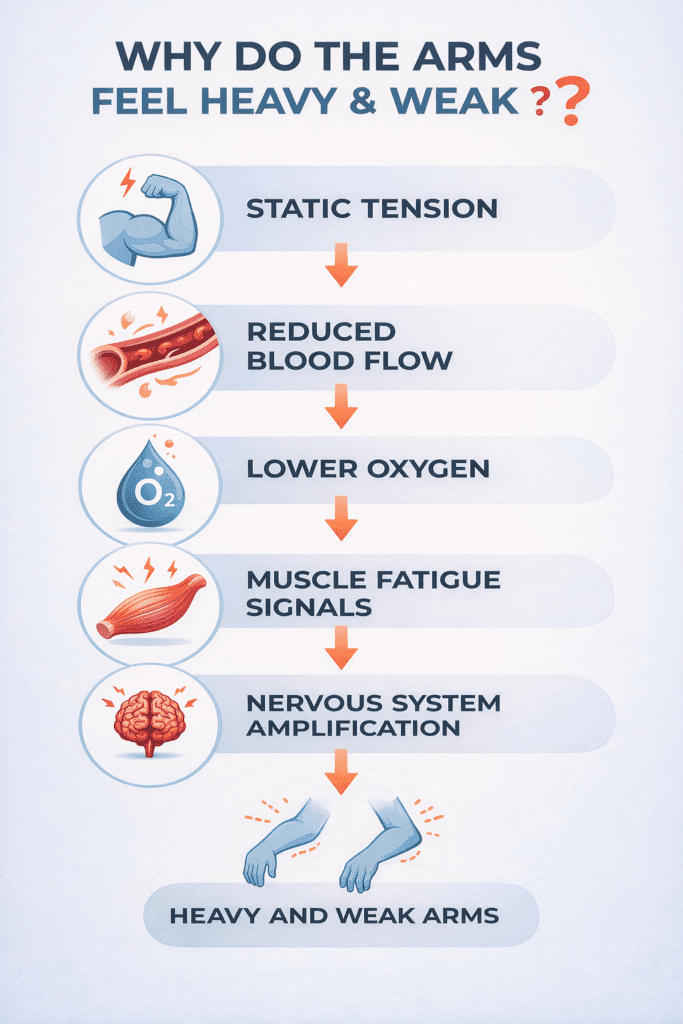
The entire sensation can be reduced to one simple chain:
Static position → reduced blood flow → lower oxygen → increased tension → nervous system alert → heaviness and weakness
Why The Feeling Seems Sudden Even When It Builds Gradually
The process is not actually sudden.
It builds gradually over time.
Why does my arm feel weak suddenly with no warning?
Because your awareness happens at a threshold, even though the process started earlier.
The Sensory Mismatch That Makes the Feeling So Noticeable
One of the reasons this sensation stands out so strongly is due to a mismatch between expectation and reality.
Your brain expects simple tasks to feel easy. When they suddenly feel harder, even slightly, the difference becomes more noticeable.
In other words, it’s not just the sensation itself—it’s the difference between what you expect to feel and what you actually feel.
This is why the same level of fatigue can feel much more intense in everyday situations compared to exercise.
Why This Sensation Often Feels Stronger When You Focus On It
Attention plays a powerful role in how physical sensations are experienced.
When you start focusing on your arms, your brain increases the sensitivity of incoming signals.
This makes normal levels of tension feel more intense.
In contrast, when your attention is elsewhere, the same signals may go almost unnoticed.
This is why the heaviness can seem to increase the more you think about it.
The sensation itself may not be changing significantly—but your perception of it is.
The Link Between Stress Mental Load And Arm Fatigue Perception
Stress plays a major role in how your body feels.

It increases sensitivity and amplifies fatigue signals.
This is why your arms may feel heavier during stressful days, similar to patterns explained in daily rituals to reduce stress and improve mood and energy.
How Posture And Positioning Directly Influence Arm Heaviness
Posture has a direct impact on muscle coordination and circulation.

Poor posture compresses blood vessels, increases muscle tension, and reduces coordination.
Improving posture reduces unnecessary tension and can quickly make arm movement feel lighter and more efficient, similar to strategies in healthy daily routines for busy adults.
The Overlooked Connection Between Shoulder Position and Arm Heaviness
Your shoulders play a major role in how your arms feel, even if the sensation seems to come from your arms directly.
When your shoulders are slightly elevated or tense, it increases pressure on surrounding muscles and reduces the coordination of blood flow to your arms.
This creates a chain reaction where small tension at the shoulder level leads to increased fatigue signals in your arms.
Because this tension is often subtle, many people don’t realize it’s contributing to the heaviness they feel.
Relaxing your shoulders can sometimes reduce the sensation almost immediately.

Why Your Body Recovers Faster Than You Expect In These Situations
One reassuring aspect of this sensation is how quickly it can improve.
Because the underlying cause is often functional rather than structural, your body can restore balance rapidly once conditions change.
When you move your arms, improve posture, or reduce tension, circulation improves and muscle activation becomes more efficient.
This allows fatigue signals to decrease quickly.
That’s why the heaviness can fade within minutes, even if it felt intense just before.
Why This Heavy And Weak Arm Feeling Usually Resolves On Its Own
In most cases, this sensation improves when you move your arms, circulation resets, and tension decreases.
Your body naturally corrects the imbalance.

Supporting recovery habits like 5 minute evening reset for busy adults can reduce how often it happens.
Want to reduce this heavy-arm feeling more often?
Small recovery habits can make a big difference when your body feels tense, overworked, or less efficient by the end of the day.
Read the 5-Minute Evening ResetWhy This Feeling Can Shift Quickly From One Moment To The Next
Unlike true muscle fatigue, this sensation can change very quickly.
One moment your arms feel heavy, and shortly after, they feel normal again.
This happens because the underlying factors—like circulation, tension, and nervous system signaling—can adjust rapidly.
A small change in position, movement, or focus can restore coordination and reduce the sensation.
This is why the feeling can seem unpredictable even when the underlying pattern is consistent.
What Happens If You Keep Ignoring This Heavy And Weak Arm Feeling
Occasional heaviness is usually harmless, but ignoring the pattern repeatedly can lead to longer-term issues.
When your body is constantly operating under strained conditions, it begins to adapt in ways that are not optimal.
Muscle coordination becomes less precise, posture gradually worsens, and your nervous system becomes more sensitive to fatigue signals.
Over time, the sensation may start appearing more frequently and with less effort.
What once felt occasional can become something you notice daily.
It usually does not signal serious damage, but it does mean the pattern is worth correcting.
The Transition Point Where Temporary Fatigue Starts Becoming Frequent
There is a point where occasional heaviness begins to happen more regularly.
This doesn’t happen suddenly, but through repeated exposure to the same strained patterns.
At first, the sensation appears occasionally.
Then it becomes easier to trigger.
Eventually, it may start showing up during smaller and smaller tasks.
This transition happens because your nervous system becomes more sensitive, and your muscles operate under slightly reduced efficiency more often.
Recognizing this shift early allows you to correct it before it becomes a frequent pattern.
Simple Reset Actions That Can Reduce The Heavy And Weak Feeling Quickly
In many cases, the sensation improves when you reduce tension and restore movement. A simple reset can help:
- lower your arms and let them relax fully
- gently shake your hands and forearms
- roll your shoulders to release built-up tension
- take slow, deep breaths to reset nervous system signals
These small actions help your body shift from a static, strained state to a more balanced and responsive one.
The Bottom Line Why Your Arms Suddenly Feel Heavy and Weak
When your arms suddenly feel heavy and weak, the problem is usually not true muscle failure. It is more often the result of static muscle tension, temporary circulation changes, inefficient activation, and a nervous system that amplifies effort when movement feels less efficient than expected.
That is why the sensation can feel sudden, strong, and confusing even during simple tasks.
In many cases, the feeling improves once tension drops, circulation resets, and your body returns to a more efficient state.
Keep exploring what your body may be trying to tell you
If this kind of heaviness shows up along with low energy, stress, or end-of-day fatigue, these next articles can help you understand the bigger pattern.
People Also Ask Questions
Why do my arms feel heavy even when I wake up in the morning?
Arm heaviness in the morning can happen when muscles stay slightly tense during sleep or when circulation is slower after long periods of stillness. When you start moving again, your body may need a few minutes to restore normal blood flow and coordination, which can create a temporary feeling of heaviness.
Can dehydration make your arms feel weak and heavy?
Yes, even mild dehydration can affect how efficiently your muscles work. When your body lacks enough fluids, circulation and electrolyte balance can be slightly disrupted, which may increase fatigue signals and make your arms feel heavier than usual.
Why do my arms feel heavy after using my phone for a long time?
Holding your phone for extended periods keeps your arm muscles in a low-level static contraction. This reduces circulation efficiency and prevents proper muscle recovery, leading to a gradual buildup of tension that eventually feels like heaviness or weakness.
Can anxiety cause your arms to feel weak or heavy?
Yes, anxiety can increase nervous system sensitivity and muscle tension. This can amplify normal physical sensations, making your arms feel heavier or more fatigued even without significant physical effort.
Why do my arms feel heavy after sitting for too long?
Sitting for long periods reduces overall movement and can slow circulation. It also encourages poor posture, which increases tension in the shoulders and arms, making them feel heavier when you start using them again.
Is it normal for arm heaviness to come and go quickly?
Yes, this is common when the cause is related to temporary factors like posture, circulation, or muscle tension. Because these factors can change quickly, the sensation may appear and disappear within a short period.
Why do my arms feel heavy during stressful situations?
Stress increases muscle tension and makes the nervous system more reactive. This can cause your body to interpret even small physical efforts as more demanding, which makes your arms feel heavier than they normally would.
Can poor sleep affect how my arms feel during the day?
Yes, poor sleep can reduce muscle recovery and increase nervous system sensitivity. This makes your body less efficient during the day, which can lead to earlier and stronger feelings of heaviness in your arms.
About This Information
This article is based on current understanding of how muscle activity, circulation, and nervous system signaling influence how the body responds to everyday movement. It focuses on common, non-emergency causes of temporary arm heaviness and weakness.
If symptoms are sudden, severe, or do not improve, it is important to seek evaluation from a qualified healthcare professional.
