

You wake up on a Saturday with no plans. No work, no errands, no pressure. You expect to feel relaxed, maybe even energized. But by midday, something feels off. Your body feels heavy. Your mind is foggy. You feel just as tired—or even more tired—than on your busiest days.
If you’ve ever asked yourself why am I so tired after doing nothing all day, you’re not imagining it. This isn’t laziness, and it’s not just boredom. There’s a real biological reason why doing less can sometimes drain your energy more than doing too much.
Feeling tired after doing nothing all day is usually caused by reduced stimulation in the brain and body. When you stay inactive for long periods, dopamine drops, blood flow slows, and oxygen delivery decreases. This combination signals your body to reduce energy output, which creates fatigue even without physical effort.
The answer lies in how your brain, blood flow, hormones, and nervous system respond to low-activity environments.
What Happens When Your Brain Receives Too Little Stimulation Throughout the Day
Your brain isn’t designed for inactivity. It’s designed for engagement, movement, and feedback. When you remove those inputs, your internal systems start shifting in subtle but powerful ways.
One of the first things that drops is dopamine, the neurotransmitter responsible for motivation, alertness, and drive. Dopamine isn’t just about pleasure—it’s about activation. It helps your brain stay engaged with the world around you.
When your day consists of:
- Scrolling on your phone
- Sitting for long periods
- Watching passive content
- Minimal physical movement
your brain receives low-quality input instead of meaningful engagement. Over time, dopamine output decreases.
At the same time, your brain increases adenosine, a chemical that builds up when your body isn’t actively using energy. Adenosine is what makes you feel sleepy and sluggish.
So even though you haven’t “done anything,” your brain is already shifting toward an energy-saving state.
You can see a similar effect explained in how inactivity affects the body in this CDC overview on physical activity basics.
Can doing nothing make you tired?
Yes. When your brain and body receive too little stimulation, energy systems slow down instead of recharging.

The Science Behind Dopamine Drop and Reduced Motivation Without Daily Activity
Dopamine follows a simple rule:
The less meaningful activity you engage in, the lower your baseline motivation becomes.
When you’re active—walking, solving problems, interacting with people—dopamine stays balanced. But when your environment lacks stimulation, your brain starts reducing its activity level.
This creates a feedback loop:
- Low activity reduces dopamine
- Lower dopamine reduces motivation
- Lower motivation leads to even less activity
- Less activity deepens fatigue
Why does doing nothing make me feel more tired than being busy?
Because your brain is designed to stay active. When stimulation drops, it shifts into energy-saving mode, which feels like fatigue.
A key factor here is the difference between:
- Active rest (restorative)
- Passive rest (draining)
Passive rest reduces stimulation without recharging your systems.
The Hidden Role Of Adenosine Buildup When You Stay Inactive Too Long
Adenosine is a chemical that naturally builds up in your brain throughout the day as you use energy.
Normally, movement and activity help regulate its levels. But when you remain inactive for long periods, adenosine can accumulate faster than expected, creating a premature “sleep pressure” effect.
This makes you feel tired even if you haven’t physically exerted yourself.
This is also why inactivity can feel similar to the fatigue described in why do I feel tired after taking a nap, where the brain misinterprets rest signals. You can learn more about how fatigue signals build in the body from MedlinePlus fatigue overview.
How Reduced Muscle Activation Lowers Your Energy Levels During Inactivity
Another major factor behind feeling tired after doing nothing is circulation.
Your body depends on movement to keep blood flowing efficiently. When you sit or lie down for long periods, especially in one position, your circulation slows down.
This affects:
- Oxygen delivery to the brain
- Nutrient transport to muscles
- Waste removal from cells
Reduced circulation means your brain receives less oxygen, which directly impacts alertness and focus.
You might notice:
- Brain fog
- Heavy eyelids
- Slower thinking
- Lack of clarity
Even small movement improves circulation and energy levels, as explained in this CDC guide on physical activity benefits.
This connects strongly with related patterns like why sitting too long makes you tired.
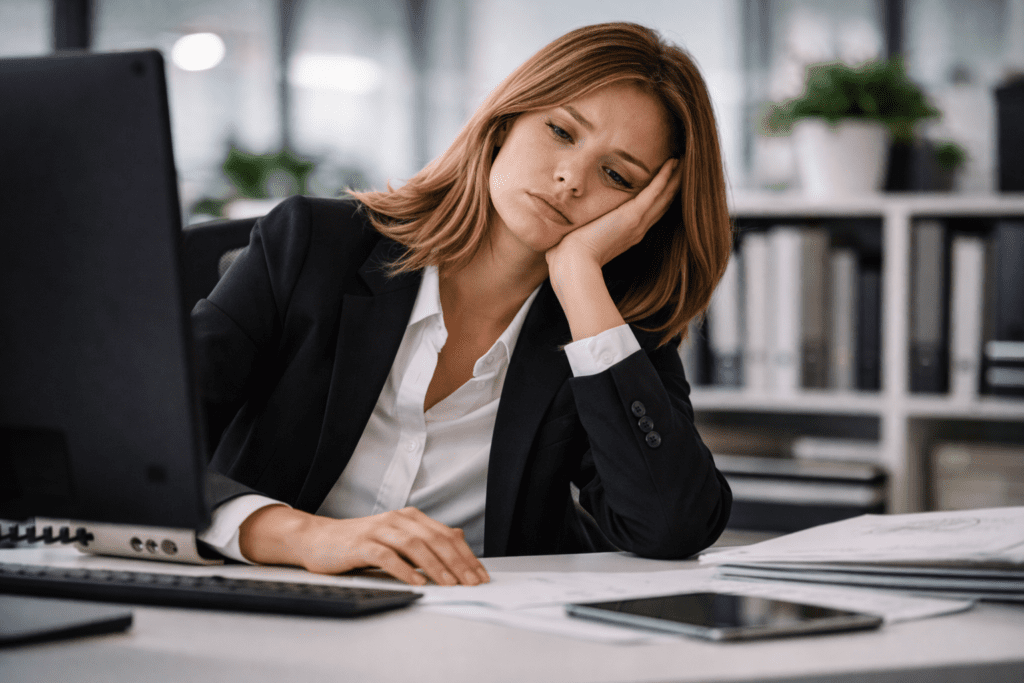
How Circulation Efficiency Changes When Your Body Stays Inactive for Hours
Even when you’re completely still, your circulation doesn’t stop—but it becomes less efficient over time. Blood flow becomes slower and less responsive, especially in the lower body and core. At the same time, reduced muscle activity lowers glucose use and weakens signals that normally keep your brain alert. But when you stay still for hours, muscle activity drops significantly.
This reduces metabolic signaling, which tells your body that less energy is needed. Over time, this creates a low-energy baseline that feels like fatigue.
This is closely related to patterns seen in tired after walking, where inefficient muscle use can also affect energy levels. The CDC also explains how muscle activity supports energy in this physical activity guide.
Why Your Body Burns Less Energy but Feels More Tired During Inactive Days
This seems contradictory, but it’s real:
When you do less, your body actually produces less usable energy.
Here’s why:
- Mitochondrial activity decreases
- Metabolic rate slightly drops
- Energy production becomes less efficient
Instead of generating steady energy, your body shifts into conservation mode, which feels like fatigue.
So even though you’re not “using energy,” you’re also not producing it efficiently.
This is similar to patterns discussed in simple daily health routine that sticks, where consistency maintains energy systems.
How Poor Posture and Shallow Breathing Reduce Your Energy Without Movement
Your brain uses a significant amount of oxygen to function. When oxygen delivery drops, even slightly, your brain shifts into an energy-saving mode.
This leads to:
- Slower processing
- Reduced alertness
- Increased fatigue signals
When you combine:
- Low movement
- Shallow breathing
- Poor posture
You create conditions for reduced oxygen efficiency.
Can lack of movement lower your energy levels even if you rest?
Yes. Without movement, oxygen delivery becomes less efficient, which directly lowers brain energy.
Many people experiencing this also report similar symptoms discussed in tired after sitting too long.
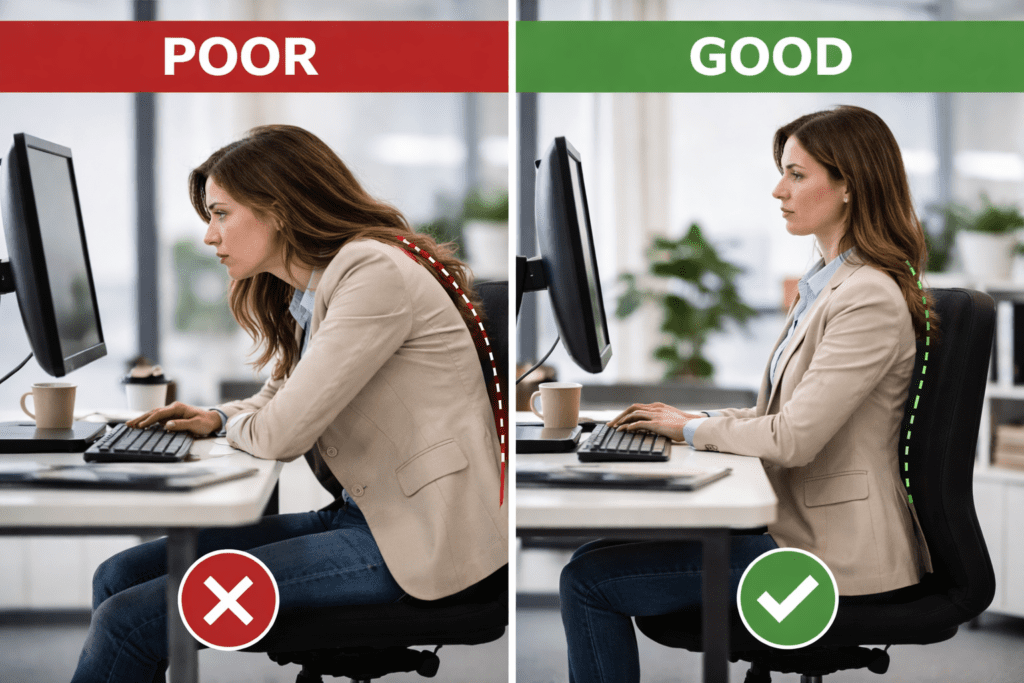
How Low Movement Disrupts Oxygen Delivery and Brain Energy Levels
When you sit for long periods, your posture often collapses, and your breathing becomes shallow.
This reduces oxygen intake and increases carbon dioxide retention, which can make you feel sluggish and mentally foggy.
Over time, this subtle change in breathing efficiency lowers your overall energy. This is similar to patterns seen in 3 minute posture reset desk workers, where posture directly affects alertness and energy.
The Role Of Reduced Sensory Input In Lowering Your Brain’s Activation Levels
Your brain relies on sensory input to stay alert—movement, light, sound, and interaction all help regulate your awareness.
When you stay in the same environment all day:
- Same lighting
- Same posture
- Same screen
- Same room
Your sensory input becomes limited.
This reduces activation in parts of your brain responsible for alertness and attention. Over time, this creates a “dimmed” mental state that feels like fatigue.
This is why even small environmental changes—like going outside or changing rooms—can quickly improve how you feel.
This mechanism overlaps with patterns explained in 5 minute morning rituals boost energy, where environmental input resets alertness.
The Impact Of Circadian Rhythm Disruption During Unstructured Days At Home
Your body runs on a circadian rhythm that controls energy and alertness.
When your day lacks structure—no clear wake time, no sunlight, no activity—your rhythm weakens.
This affects hormones like:
- Cortisol
- Melatonin
Without proper signals, your body may:
- Delay alertness
- Increase sleepiness during the day
Why do I feel tired even when I rested all day?
Because rest without structure disrupts your internal clock, leading to low energy signals.
You can see how lifestyle factors contribute to fatigue in this Mayo Clinic fatigue overview.
The Hidden Impact Of Decision Fatigue When You Have Too Much Unstructured Time
When your day has no structure, your brain doesn’t rest—it actually works harder in a different way. Instead of following a routine, your brain constantly evaluates small decisions:
What should I do next?
Should I get up?
Should I eat?
Should I rest more?
This ongoing internal questioning creates decision fatigue, even when you’re not physically active.
Over time, this drains mental energy and reduces motivation, making you feel tired without doing anything meaningful. Unlike structured days where decisions are automated, unstructured days force your brain to stay in a low-level processing loop.
This is closely related to patterns seen in why healthy habits fail and how to build ones that stick, where lack of structure increases cognitive load.
The Link Between Low Sunlight Exposure And Sudden Drops In Daily Energy Levels
Sunlight plays a major role in regulating your energy through circadian rhythm alignment and vitamin D production.
When you stay indoors all day without exposure to natural light, your body receives weaker signals about when to be alert.
This can reduce daytime energy and increase sleepiness. Even short exposure to daylight can significantly improve alertness.
This is why environmental factors, like those explained in does cold weather make you tired, can influence your energy levels more than you expect.

The Link Between Passive Screen Time, Mental Fatigue, and Energy Drain
Spending hours on your phone or watching videos may feel like rest, but it creates mental fatigue.
This happens because:
- Your brain processes constant information
- There is no meaningful engagement
- Attention becomes fragmented
This type of fatigue lowers dopamine and increases exhaustion.
It’s similar to what happens in why eyes feel tired after looking at screens.

How Low-Level Stress Can Drain Your Energy Even When You Feel Relaxed
You might think you’re relaxed, but your body may still be under subtle stress.
Low-level stress can come from:
- Overthinking
- Background anxiety
- Unfinished tasks
- Digital overload
Even when you’re sitting still, your body may release cortisol, a stress hormone that affects energy regulation.
Instead of feeling alert, this creates a strange mix of:
- Mental fatigue
- Physical sluggishness
- Low motivation
This explains why you can feel tired even on “easy” days.
This pattern is also seen in daily rituals to reduce stress improve mood energy, where stress quietly drains energy without obvious effort.

The Hidden Energy Cost Of Switching Between Passive Activities Throughout The Day
Even though passive activities seem effortless, constantly switching between them—scrolling, watching, checking apps—creates mental switching fatigue.
Your brain has to repeatedly adjust focus, which uses energy without providing meaningful engagement.
This leads to a gradual energy drain that feels like unexplained tiredness. This pattern is similar to digital fatigue discussed in computer eye fatigue relief, where screen-based behavior impacts energy levels.
The Impact Of Irregular Eating Patterns During Low-Activity Days On Energy Stability
On days when you’re inactive, your eating patterns often become irregular. You might snack more, skip meals, or eat out of boredom.
These habits can disrupt blood sugar stability, leading to energy fluctuations and fatigue. Even without physical activity, your body still depends on stable glucose levels to maintain energy.
This connects closely with patterns discussed in why do I feel tired after eating, where blood sugar fluctuations directly influence energy levels throughout the day.
The Real Cause Of Mental Stagnation When Your Brain Lacks Meaningful Engagement
Mental energy depends heavily on purposeful engagement. When your brain is exposed to repetitive, low-value inputs—like endless scrolling—it becomes cognitively under-stimulated but mentally cluttered.
This combination creates a state called mental stagnation, where your brain feels both overloaded and disengaged.
This reduces focus and increases fatigue signals. You can see similar effects in mentally drained but restless in the afternoon, where lack of meaningful engagement leads to exhaustion without effort.
The Link Between Lack Of Goal-Oriented Activity And Decreased Mental Energy
Your brain is highly responsive to purpose.
When you work toward a goal—even a small one—your brain releases dopamine and maintains engagement.
But when your day lacks direction:
- No tasks
- No progress
- No outcomes
Your brain reduces activation.
This creates a feeling of:
- Low drive
- Reduced focus
- Mental fatigue
That’s why even simple goals—like organizing a space or taking a walk—can quickly improve your energy.
This connects strongly with habit stacking for busy adults, where small structured actions rebuild momentum.
What Happens When Your Nervous System Shifts Into Low Activation Mode All Day
Your nervous system constantly adjusts between activation and recovery states.
When you stay inactive, it can shift too far into a low-activation mode, reducing alertness and responsiveness.
This doesn’t mean you’re relaxed—it means your system is under-engaged. Over time, this lowers your baseline energy and makes it harder to feel motivated.
This imbalance is also linked to patterns like wired but tired at night, where the nervous system struggles to regulate energy properly.
How Prolonged Stillness Affects Your Body’s Natural Energy Regulation Signals
Your body constantly sends signals to regulate energy levels.
Movement helps:
- Activate muscles
- Signal alertness
- Maintain metabolic balance
When you stay still too long, these signals weaken.
Your body begins to interpret inactivity as a sign that:
👉 Less energy is needed
So it reduces output accordingly.
This leads to:
- Lower alertness
- Slower reactions
- Increased fatigue
This is closely related to patterns discussed in tired after sitting too long, where prolonged stillness affects energy signaling.
What Most People Miss About Rest Days and Energy Recovery Patterns
Here’s the counterintuitive truth:
Doing nothing is not the same as recovering.
True recovery includes:
- Light movement
- Sunlight
- Engagement
- Social interaction
Without these, your body doesn’t restore energy. It reduces output instead.
This explains why:
- Lazy days feel draining
- Active days can feel energizing
Many people try to fix this with quick solutions like midday energy boost without coffee, but the root cause is under-stimulation.
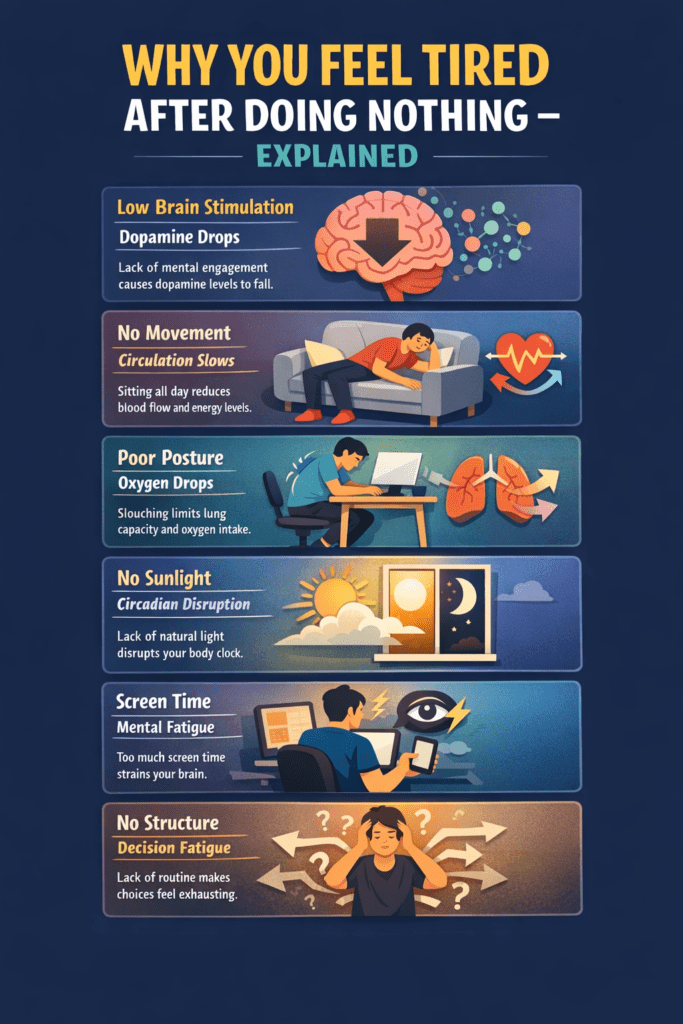
The Real Cause Of Feeling Tired After Doing Nothing All Day Explained
Let’s break it down clearly.
Key Reasons You Feel Tired After Doing Nothing
- Dopamine drops due to lack of engagement
- Blood circulation slows from inactivity
- Oxygen delivery to the brain decreases
- Circadian rhythm becomes unstable
- Mental fatigue builds from passive activity
This combination creates a multi-system energy drop.
You may also notice overlap with patterns like afternoon energy crash prevention.
Here’s a simple breakdown of why your energy drops when you do nothing—and what actually fixes it:
| Factor | What Happens in Your Body | How It Feels | Simple Fix |
|---|---|---|---|
| 🧠 Low Brain Stimulation | Dopamine levels decrease, reducing motivation signals | Lack of drive, mental fog | Do one small task (walk, organize, talk) |
| 🔄 Reduced Movement | Blood flow slows, less oxygen reaches the brain | Heavy body, low alertness | Move every 30–60 minutes |
| 🌬️ Shallow Breathing | Oxygen intake drops, CO₂ builds up | Sluggish thinking, fatigue | Deep breathing + posture reset |
| ⏱️ Circadian Disruption | Hormones like cortisol become unbalanced | Sleepy during the day | Get sunlight early in the day |
| 📱 Passive Screen Time | Brain overstimulation without engagement | Mental exhaustion | Limit scrolling, switch to active tasks |
| 🍽️ Irregular Eating | Blood sugar becomes unstable | Energy crashes, weakness | Eat balanced meals consistently |
| 🌤️ Low Sunlight Exposure | Weak internal clock signals | Low daytime energy | Spend 10–20 minutes outside |
| ⚡ Low-Level Stress | Cortisol subtly drains energy | Tired but restless feeling | Reduce mental clutter, write tasks down |
If your energy drops easily, these next reads can help you find the real trigger
Low-stimulation fatigue is only one part of the picture. If your tiredness also shows up after sitting, in the afternoon, or without a clear reason, these articles can help you connect the pattern.
A Simple System to Identify Why You Feel Tired on Low-Activity Days
Signs You’re Experiencing Low-Stimulation Fatigue
- You feel sluggish after inactivity
- You have brain fog without effort
- You feel unmotivated despite resting
- Your energy drops more on off-days
- You need more caffeine than usual
If most of these apply, your fatigue is likely caused by under-stimulation.
You can improve your baseline using systems from daily habits for energy and micro habits that boost afternoon energy.
The Counterintuitive Insight: Why Doing Less Can Make You Feel Worse
Most people believe less effort equals more energy.
But your body is designed for:
- Movement
- Interaction
- Engagement
When those are missing, your body shifts into a lower-output mode.
That’s why doing nothing can make you feel worse.
This is also connected to patterns in mental fatigue after work.
Instead of trying to “rest more,” your body needs a structured reset. Here’s a simple daily protocol that restores energy by reactivating your brain and body systems:
| Time Block | Action | What It Does in Your Body | Expected Result |
|---|---|---|---|
| 🌅 Morning (First 30–60 min) | Get sunlight + light movement (walk/stretch) | Resets circadian rhythm, boosts cortisol naturally | Faster wake-up, improved alertness |
| 🍳 Morning Routine | Eat a balanced meal (protein + carbs) | Stabilizes blood sugar and energy production | Steady energy, fewer crashes |
| 🧠 Mid-Morning | Do one meaningful task (focused work or goal) | Increases dopamine and mental engagement | Higher motivation, better focus |
| 🚶 Late Morning | Move for 5–10 minutes (walk, stretch) | Improves circulation and oxygen delivery | Reduced brain fog |
| 🍽️ Lunch | Eat balanced meal, avoid heavy processed foods | Maintains stable glucose levels | Prevents afternoon crash |
| 🌤️ Early Afternoon | Get light exposure + short movement break | Reinforces circadian signals | Sustained daytime energy |
| 🔄 Mid-Afternoon Reset | Switch tasks or do a short active break | Reduces mental fatigue and restores focus | Mental refresh, less exhaustion |
| 🌆 Evening Wind-Down | Reduce screen time + light activity | Supports melatonin production | Better sleep quality |
| 🌙 Night Routine | Consistent sleep time (7–8 hours) | Restores energy systems overnight | Stronger next-day energy |

How This Fatigue Builds Over Time Without You Noticing It
This type of fatigue builds gradually.
At first:
- Slight sluggishness
Then:
- Reduced motivation
- Lower engagement
Eventually:
- Persistent tiredness
Even without effort.
People often confuse this with random fatigue, but it follows patterns similar to why am I so tired in the afternoon.
What Happens When This Pattern Repeats Over Multiple Days
When repeated:
- Dopamine baseline drops
- Circulation habits weaken
- Energy levels decline
This creates a cycle:
- Less activity leads to more fatigue
- More fatigue leads to even less activity
Breaking this cycle requires reintroducing stimulation, not just resting more.
The Link Between Low-Stimulation Days and Long-Term Energy Decline
Over time, frequent low-activity days can:
- Lower your natural energy baseline
- Reduce motivation
- Increase dependence on stimulation
This is not because something is wrong with your body, but because your systems adapted to low demand.
Why Low-Activity Days Can Disrupt Your Sleep Quality Later That Night
When you don’t move enough during the day, your body doesn’t build enough physical sleep pressure.
This can lead to lighter, less restorative sleep at night, even if you spend enough time in bed.
Poor sleep then carries over into the next day as fatigue.
This creates a cycle where inactivity leads to worse sleep, which leads to lower energy. You can see how evening behavior affects next-day energy in evening habits for next day energy.
The Real Reason Motivation Feels Lower After Completely Unproductive Days At Home
Motivation is not just psychological—it’s biological.
When you go through a day without accomplishing tasks or engaging meaningfully, your brain reduces dopamine signaling tied to reward and progress.
This makes the next day feel harder to start, even if you rested. Over time, this lowers your baseline drive and increases fatigue perception.
This pattern is also addressed in habit stacking for busy adults, where small actions rebuild motivation and energy.
Conclusion: Why You Feel Tired After Doing Nothing and What It Really Means
If you’ve been asking why am I so tired after doing nothing all day, the answer is not lack of rest. It’s lack of meaningful stimulation.
Your body needs:
- Movement for circulation
- Engagement for dopamine
- Structure for hormones
- Environment for rhythm
Without these, your systems reduce their activity, and that feels like fatigue.
Is it normal to feel exhausted after doing nothing all day?
Yes. It’s a natural response to low stimulation, reduced movement, and decreased system activation.
Understanding this helps you shift from simply resting more to creating the right balance between rest and activation.
Build a stronger energy routine with the next best reads
If this article helped you understand why doing nothing all day can still leave you exhausted, the next step is finding the daily habits and hidden triggers that affect your energy the most.
Read one now and start building a more stable energy pattern throughout the day.
People Also Ask
Can doing nothing all day really make you tired?
Yes. Long periods of inactivity can reduce stimulation in the brain and body, which lowers dopamine, slows circulation, and decreases oxygen delivery. Instead of feeling restored, you may end up feeling sluggish, mentally foggy, and physically drained.
Why do I feel more tired on lazy days than on busy days?
Busy days usually give your brain more structure, movement, and purpose. Lazy days often do the opposite. When stimulation drops too low, your body shifts into a lower-output mode, which can make you feel more tired even though you did less.
Does lying around all day lower your energy levels?
It can. Too much stillness reduces muscle activation, weakens circulation efficiency, and lowers the body’s energy signaling. Over time, that can make your alertness drop and increase feelings of fatigue.
Why do I feel sleepy after resting all day?
Resting all day can disrupt your normal activity cues, especially if you also get less sunlight, less movement, and less structure. That combination can weaken circadian rhythm signals and make daytime sleepiness more noticeable.
Can boredom and low stimulation cause real fatigue?
Yes. Boredom is not always harmless. When your brain gets low-value, repetitive input without meaningful engagement, mental activation drops. That can reduce motivation, lower focus, and create a real sense of tiredness.
Why does scrolling all day make me feel exhausted?
Passive screen time keeps your brain busy without giving it meaningful reward or recovery. Constant input, attention switching, and low engagement can create mental fatigue, especially when paired with sitting still for hours.
How do I stop feeling tired after doing nothing all day?
The most effective fix is usually not more rest, but better reactivation. Light movement, daylight exposure, one meaningful task, better posture, and a small amount of structure can help restore alertness and improve energy regulation.
Our Research & Content Standards
Why You Can Trust This Article
This article is built around well-established principles related to dopamine regulation, circulation, oxygen delivery, circadian rhythm, and behavioral fatigue patterns. It is designed to explain a common real-life energy problem in clear, practical language without exaggeration or unsupported claims. The recommendations focus on everyday lifestyle patterns such as movement, light exposure, structure, and engagement, which are commonly recognized as important factors in energy regulation and daytime alertness.
