

You wake up in a bedroom at 6:15 a.m., do the math. Midnight to 5:15. A little scrolling before bed. Maybe 5 hours of sleep total. The question sounds reasonable: is 5 hours of sleep enough if you can still get through work, school drop-off, errands, and dinner?
For most adults, 5 hours of sleep is usually not enough. One short night may be manageable, but regularly sleeping only 5 hours can leave your body under-recovered. The real test is not whether you can function after coffee. It is whether your focus, mood, cravings, reaction time, caffeine need, and afternoon energy stay steady all week.
Definition snippet: Five hours of sleep is usually considered short sleep for adults because it falls below the commonly recommended minimum of 7 hours per night. One 5-hour night may be manageable, but regularly sleeping only 5 hours can affect focus, mood, reaction time, cravings, immune function, and daytime energy.
Why Five Hours of Sleep Usually Falls Short for Most Adults
Most adults are not built to use 5 hours as a normal sleep schedule. The CDC’s adult sleep guidance lists 7 or more hours for adults, and the American Academy of Sleep Medicine and Sleep Research Society consensus statement also recommends 7 or more hours on a regular basis for adult health.

That does not mean every adult needs exactly 8 hours. It means 5 hours sits well below the usual adult starting point. If you are trying to understand your full sleep range, compare this with the guide on how much sleep you need.
The problem is that 5 hours can look “close enough” when life is busy. You may still wake up, drive, answer emails, cook dinner, and finish the day. But sleep is not only about staying awake. Sleep is when your brain resets attention, your body regulates hormones, your immune system supports repair, and your nervous system lowers pressure from the day.
Five hours gives that system less room to work. It cuts the night short before your body has enough time to move through several full sleep cycles. Deep sleep, REM sleep, lighter sleep, and brief awakenings all compete for a smaller window.
Is 5 hours of sleep enough for adults?
For most adults, 5 hours of sleep is not enough as a regular schedule. It may be survivable for one night, but many adults need at least 7 hours to support steady focus, mood, reaction time, physical recovery, and daytime energy.
The Hidden Reason Five Hours of Sleep Can Still Feel Normal
The confusing part is that 5 hours does not always feel terrible. Some people wake after 5 hours and say, “I’m fine.” They drink coffee, move quickly, and feel alert by the time work starts.

Your body has emergency systems for short sleep. Morning light, cortisol, deadlines, noise, messages, and caffeine can all push alertness upward. A packed schedule may leave no quiet moment to notice how tired you really are.
This is the hidden reason 5 hours can feel normal: your brain can adjust to the feeling of being under-rested. After repeated short nights, tired may become your baseline. You stop comparing today with a truly rested version of yourself and start comparing it with yesterday’s tired version.
That is why the question “Do I feel okay?” is not enough. A better question is: do you feel clear, patient, steady, and focused without needing constant stimulation?
What Most People Miss About Functioning Versus Fully Recovering
What most people miss is the difference between functioning and recovering.
Functioning means you can complete the day. Recovering means your brain and body had enough sleep to restore the systems that help you think, regulate mood, control appetite, react quickly, and handle stress.
You can function on short sleep for a while. Parents do it. Nurses do it. Students do it. Business owners do it. People working two jobs do it. That does not mean the schedule is fully supporting them.
The counterintuitive insight is that five hours can feel productive while quietly making normal tasks more expensive. Emails take more effort. Meetings feel more irritating. Food cravings get louder. Workouts feel heavier. Driving requires more attention. By evening, you may feel like you survived the day but did not really own it.
The cause-effect chain is simple: five-hour nights reduce recovery time. Reduced recovery leaves more sleep pressure behind. More sleep pressure weakens attention and mood control. Weaker attention makes normal work feel harder. Harder work drains energy faster. By afternoon, caffeine starts to feel less optional.
That is the real difference. Functioning gets you through today. Recovery protects tomorrow.
Can I function on 5 hours of sleep?
Yes, you may be able to function on 5 hours of sleep, especially if caffeine, stress, or a busy schedule keeps you moving. But functioning is not the same as recovering. If you feel foggy, reactive, hungry, or drained later, 5 hours is probably not enough.
Do not measure sleep by survival only
If five hours gets you through the morning but leaves you foggy, irritable, snacky, or caffeine-dependent later, your body may be asking for more recovery time.
Find your real sleep rangeWhat Happens When One Five-Hour Night Disrupts Your Day
One five-hour night is not the same as months of five-hour nights. Life happens. A late flight, a sick child, a work deadline, a noisy neighbor, or one restless night can shorten sleep.
The next day may still be manageable, but you may notice small changes.
You may need coffee sooner. You may reread a message twice. You may feel less patient in traffic. You may crave something sweet at 3 p.m. You may skip a workout or choose easier food because your energy feels thin.
The biggest risk after one short night is not panic. It is overconfidence.
A tired person does not always feel tired in a clear way. Sometimes short sleep shows up as confidence without accuracy, speed without judgment, or busyness without focus.
If you slept only 5 hours once, keep the next day realistic. Do the most important work when you feel sharpest. Avoid stacking too many hard decisions late in the day. Be careful with long drives. Keep caffeine earlier instead of pushing it into the evening and hurting the next night.
Is 5 hours of sleep bad for one night?
One night of 5 hours of sleep is usually not the same as chronic short sleep. It may leave you tired, foggy, moody, or more caffeine-dependent the next day. The bigger concern is when 5 hours becomes your normal sleep pattern.
What Happens When Five Hours of Sleep Becomes Your Pattern
When 5 hours becomes your regular pattern, the body gets less recovery almost every night. That is when short sleep can start shaping your week instead of just one morning.
You may feel awake but not sharp. You may finish tasks, but they take longer. You may answer messages, but with less patience. You may work out, but recovery feels slower. You may eat normally at breakfast, then feel cravings build by afternoon.
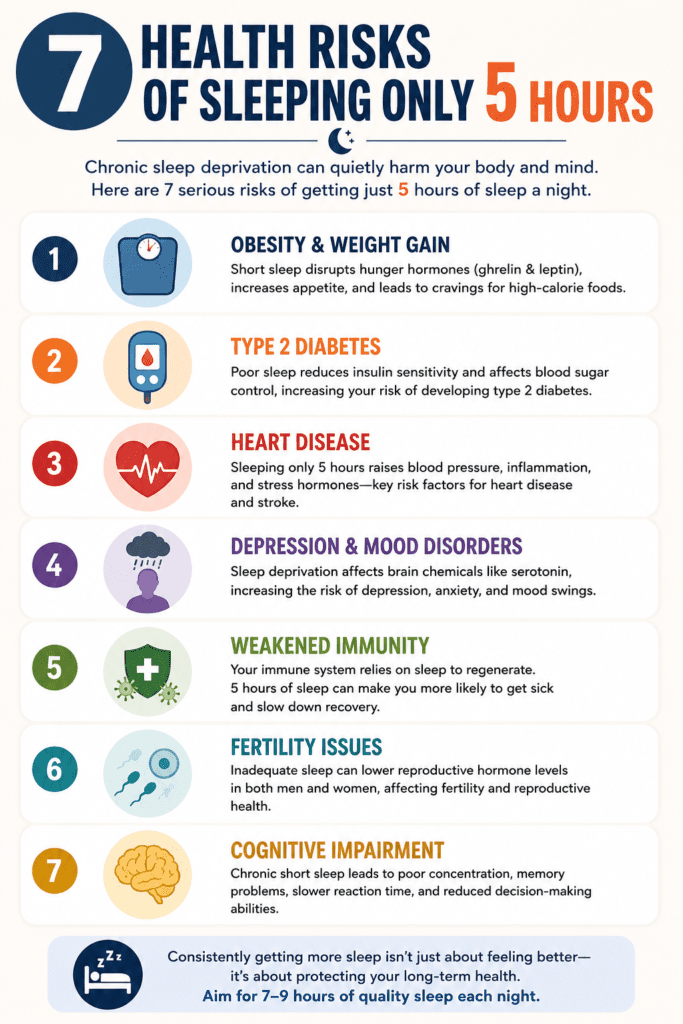
Short sleep can also affect appetite signals. Leptin, a hormone connected with fullness, may become less helpful when sleep is restricted. Ghrelin, a hunger-related hormone, may rise. Cortisol, the body’s stress hormone, can also stay more elevated when sleep is short or stressful.
The Mayo Clinic’s sleep guidance notes that regularly getting less than seven hours a night has been linked with poor health outcomes in adults. For someone sleeping 5 hours most nights, the gap is not small. It is a repeated shortage.
What happens if I sleep 5 hours every night?
If you sleep 5 hours every night, sleep debt can build. Over time, you may notice slower thinking, more irritability, stronger cravings, heavier caffeine dependence, weaker recovery, and harder afternoon crashes. You may still function, but your body may not be fully restored.
How Five-Hour Sleep Builds Pressure Across the Whole Week
Sleep pressure builds while you are awake. During a full night of sleep, that pressure should drop enough for the next day. When sleep is too short, some pressure can carry forward.
Imagine your body needs about 8 hours, but you sleep 5. That is a 3-hour gap. One night may be manageable. Five worknights in a row can create a very different feeling.
| Night pattern | If your body needs 8 hours | Possible sleep gap |
|---|---|---|
| 1 night at 5 hours | 8 hours needed | 3 hours short |
| 3 nights at 5 hours | 24 hours needed | 9 hours short |
| 5 nights at 5 hours | 40 hours needed | 15 hours short |
| 7 nights at 5 hours | 56 hours needed | 21 hours short |
Many people notice the pattern by Friday. They feel emotionally thinner, mentally slower, and more likely to crash after work. Then they sleep much longer on Saturday and call it normal.
The Science Behind Caffeine Masking Five-Hour Sleep Loss
Caffeine blocks some sleepiness signals. It can help you feel more alert, especially in the morning. For many adults, coffee is part of normal life. The problem starts when caffeine becomes the reason five hours feels possible.
If you need coffee before you can think, another cup before lunch, and something sweet in the afternoon, your body may not be proving that 5 hours is enough. It may be showing that you are borrowing alertness.
Caffeine does not remove sleep debt. It does not replace deep sleep. It does not complete REM sleep. It does not repair the recovery window that got cut short. It mainly changes how tiredness feels for a while.
This matters because caffeine can also push bedtime later when used too late in the day. Then the next night gets shorter, the next morning needs more caffeine, and the loop repeats.
If short sleep keeps feeding afternoon crashes, compare your daytime habits with this guide on how to stay energized all day. Energy is not only a sleep issue, but sleep is often the base layer.
The Link Between Five-Hour Sleep, Cravings, Mood, and Focus
Five-hour sleep often shows up in ordinary daily behavior before it shows up as a dramatic health warning.
You may feel snackier. You may choose higher-calorie foods because the brain wants fast energy. You may have less patience for meal prep. You may scroll later because you feel too tired to start your bedtime routine but not calm enough to sleep.
Mood can shift too. The same comment from a coworker may feel sharper. A normal family problem may feel heavier. Your frustration may rise faster and settle slower.
Focus becomes more fragile. You may still complete your job, but deep work feels harder. Reading, planning, writing, studying, and problem-solving may take more effort. If your main symptom is slow thinking, this guide explains how lack of sleep can cause brain fog and tiredness.
This is why five hours is not just a number. It changes the way the whole day feels. Your brain starts looking for shortcuts: more caffeine, more snacks, less movement, easier decisions, and more screen time. Those choices can then make the next night worse.
How Five Hours Compares With Six and Seven Hours
A simple comparison can help clarify the difference between 5, 6, and 7 hours.
| Sleep amount | What it usually means for adults | Common next-day signal |
|---|---|---|
| 5 hours | Usually too little | Foggy, reactive, caffeine-dependent |
| 6 hours | Borderline short | Functional early, crash later |
| 7 hours | Adult minimum range | Can work if quality is strong |
Five hours is usually the clearest warning zone for adults. It may happen once, but it is not a strong long-term target.
Six hours can feel more confusing because it is closer to normal life. Many people can function on it, but it is still often short for adults. If your schedule is closer to that range, compare this with is 6 hours of sleep enough.
Seven hours is different because it reaches the lower edge of common adult guidance. It can work well for some adults when sleep quality is strong and actual sleep time is close to the full window. If you are trying to move from 5 hours toward the adult minimum, this guide explains whether 7 hours of sleep is enough.
Why Your Body May Seem Used to Five Hours
Your body may seem used to 5 hours because humans are good at adapting to repeated stress. That adaptation is useful in emergencies. It is not always proof that the situation is healthy.
Think about a person who works late every night, sleeps from 1 a.m. to 6 a.m., and says they are fine. They may not feel sleepy at breakfast because the day starts fast. They may not notice the problem until a quiet meeting, a long drive, a boring task, or a weekend morning.
The body can normalize a lower-energy state. You may forget what better sleep feels like. Your normal may include a 3 p.m. crash, a second coffee, a short temper, and low motivation after dinner.
That is why a short experiment can be powerful. Add 30 to 60 minutes of sleep opportunity for one week. Keep your wake time steady if possible. Watch what changes in mood, cravings, patience, and focus.
Can your body get used to 5 hours of sleep?
Your body can get used to feeling tired, but that does not mean 5 hours became enough. Short sleep may start to feel normal while attention, reaction time, emotional control, and recovery still suffer. Feeling adapted is not the same as being restored.
How to Tell When Five Hours Is Not Enough
The clearest test is not how proud you are of pushing through. It is how your day behaves.
To tell if 5 hours of sleep is not enough:
- Notice whether you need caffeine to feel normal.
- Watch for brain fog during simple work.
- Track mood changes and irritability.
- Check for afternoon energy crashes.
- Compare weekday sleep with weekend catch-up sleep.
- Notice cravings and low motivation.
- Add 15 to 30 minutes of sleep for one week and compare your day.
Five hours of sleep may not be enough if you often notice:
- Heavy mornings
- Brain fog before lunch
- Strong caffeine dependence
- Irritability or mood swings
- Sugar or snack cravings
- Slower reaction time
- Afternoon energy crashes
- Longer sleep on weekends
- Feeling better whenever you sleep 6.5 to 7.5 hours
Is 5 hours of sleep better than no sleep?
Yes, 5 hours of sleep is better than no sleep. But better than nothing does not mean enough. If you only slept 5 hours, keep the next day safer and simpler when possible, then try to return to a fuller sleep window the next night.
How to Move From Five Hours Toward Better Sleep
If 5 hours has become your normal, do not try to fix everything in one night. A realistic step-up plan works better.
Start by adding 15 to 30 minutes of sleep opportunity. That may mean moving bedtime earlier, not sleeping later. Keep your wake time steady when possible, because a consistent wake time helps your body organize its rhythm.

Next, protect the final hour before bed. This is where many busy adults lose sleep without noticing it. One episode turns into three. One email becomes twenty minutes. One quick scroll becomes midnight. This is often called revenge bedtime procrastination: staying up late to reclaim personal time after a demanding day.
A calmer evening does not need to be complicated. Dim lights. Stop work earlier when possible. Charge your phone away from the bed. Keep caffeine earlier in the day. Make the bedroom cool, dark, and quiet. If your main issue is the evening transition, these evening habits to improve sleep quality can support a stronger night.
Sleep quality still matters. Broken sleep can make even longer nights feel weak. If your hours look adequate later but you still wake drained, compare this with why people wake up tired even after 8 hours of sleep.
How can I sleep longer than 5 hours?
To sleep longer than 5 hours, add 15 to 30 minutes of sleep opportunity for one week. Set a wind-down alarm, protect a steady wake time, stop caffeine earlier, reduce late-night scrolling, and keep your bedroom cool, dark, and quiet.
The Real Cause Short Sleep May Need Medical Attention
There is a difference between choosing to sleep 5 hours and being unable to sleep longer. If you give yourself 7 to 8 hours in bed but keep waking after 5 hours, something else may be affecting your sleep.
Possible issues include insomnia, sleep apnea, restless legs, chronic pain, anxiety, depression, medication effects, alcohol timing, or a schedule that keeps shifting. Loud snoring, gasping during sleep, morning headaches, and strong daytime sleepiness are especially important signals.
Also pay attention to safety. If you feel sleepy while driving, nod off during quiet moments, or struggle to stay awake at work, do not treat it as normal. Sleepiness can affect reaction time and judgment.
Should I see a doctor if I only sleep 5 hours?
Consider talking with a healthcare professional if you give yourself 7 to 8 hours in bed but still wake after 5 hours, feel very sleepy during the day, snore loudly, wake gasping, or feel unsafe while driving.

This article is written for adults trying to understand whether five hours of sleep is enough for everyday energy, focus, mood, and recovery. It is educational and does not replace personal medical care. If short sleep is frequent, sudden, or paired with strong daytime sleepiness, loud snoring, gasping, or unsafe driving, it is worth discussing with a qualified healthcare professional.
Final Answer: Why Five Hours Is Usually Not Enough
So, is 5 hours of sleep enough? For most adults, no. Five hours may be enough to survive one busy day, but it is usually not enough to use as a regular sleep pattern.
The real issue is not whether you can wake up and complete tasks. The real issue is whether your body and brain are getting enough time to recover.
Five-hour sleep can hide behind coffee, stress, deadlines, and habit. It can make tired feel normal. It can turn focus, mood, cravings, reaction time, and afternoon energy into daily struggles that seem unrelated to sleep.
If five hours happened once, do not panic. Make the next day simpler and protect the next night. If five hours happens most nights, treat it as useful feedback. Your body may be asking for a larger recovery window.
Start small. Add 15 to 30 minutes. Watch your daytime pattern. Compare 5 hours with 6 or 7. Notice whether your mornings feel lighter, your mood feels steadier, and your afternoon energy stops crashing so hard.
Five hours is not a badge of discipline. It is usually a sign that your recovery window is too tight. The stronger goal is not just to function. It is to wake up restored enough to think clearly, handle stress, and move through the day without constantly borrowing energy from tomorrow.
Build a day that does not depend on borrowed energy
Five hours may help you push through once, but steadier energy usually starts with enough sleep opportunity, calmer evenings, earlier caffeine timing, and a routine that protects recovery before tomorrow begins.
Build steadier energy all day