
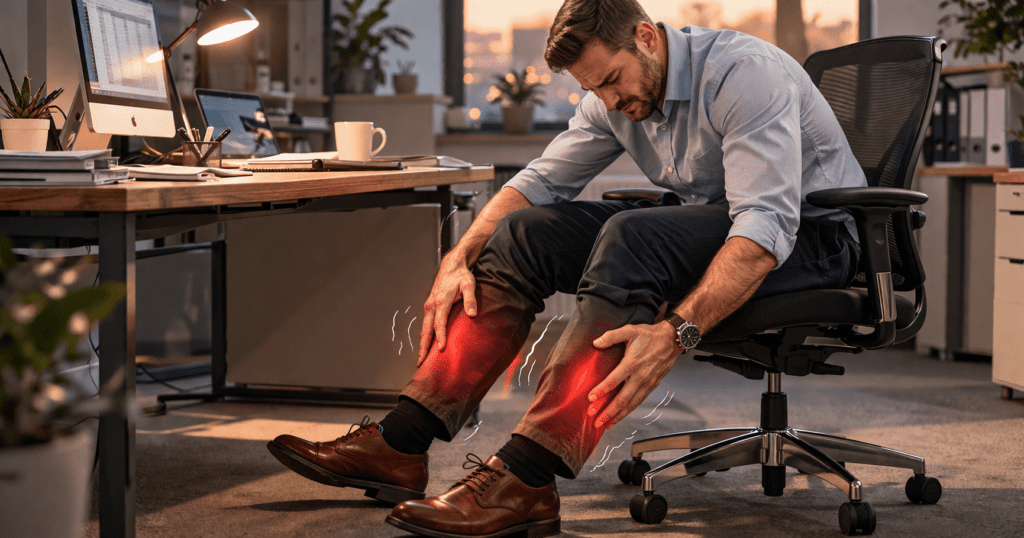
You’re sitting at your desk after a long workday, standing in line, or even just starting to walk—and suddenly your legs feel heavy, slow, or harder to move than usual.
It’s not pain. It’s not weakness. But something clearly feels off.
If you’ve ever wondered why your legs feel heavy, the answer usually comes down to how blood flow, gravity, and movement interact inside your lower body.
Heavy legs usually happen when blood flow slows down and pressure builds up in the lower legs, often due to prolonged sitting, standing, or reduced movement. This makes the legs feel weighted, tight, and harder to move.
Heavy legs is a common sensation where the lower limbs feel weighed down, tight, or less responsive due to changes in circulation and increased pressure in the veins, especially during periods of inactivity or prolonged upright posture.

Table of Contents
Why Do My Legs Feel Heavy All the Time and What It Means for Circulation
When your legs feel heavy frequently, the cause is usually linked to how blood moves through your lower body over time. Your legs are the lowest point in your body when you’re upright, so gravity constantly pulls blood downward.
To keep circulation balanced, your body relies on veins and muscle activity to push blood back up toward your heart. When this system slows down—because of inactivity, posture, or daily habits—you begin to feel that persistent heaviness.
The Real Cause Behind Heavy Legs and Why Blood Flow Slows Down in Daily Life
The main issue behind heavy legs is not weakness or injury—it’s circulation efficiency.
When circulation slows down, blood doesn’t move back up efficiently, which gradually increases pressure and creates that heavy, weighted feeling in your legs.
This causes blood to pool in the lower body, making your legs feel weighted, full, and harder to move.
Your body depends on:
- Veins with one-way valves
- Calf muscles acting as a pump
These systems work together to return blood upward. But when they’re not supported by movement, blood flow becomes slower and less effective.
The Difference Between Surface Triggers and the Real Cause of Heavy Legs
Most people focus on what they were doing when the heaviness started—like sitting, standing, or walking.
But these are only surface triggers, not the root cause.
The real cause lies deeper in how your circulation responds to those activities. Sitting or standing doesn’t directly cause heaviness—it’s the way these actions slow down blood flow and increase pressure in your lower body.
Understanding this difference helps you see that the sensation is not about the activity itself, but about how your body reacts internally to it.
What Happens When Blood Starts Pooling in Your Lower Legs and Increases Pressure
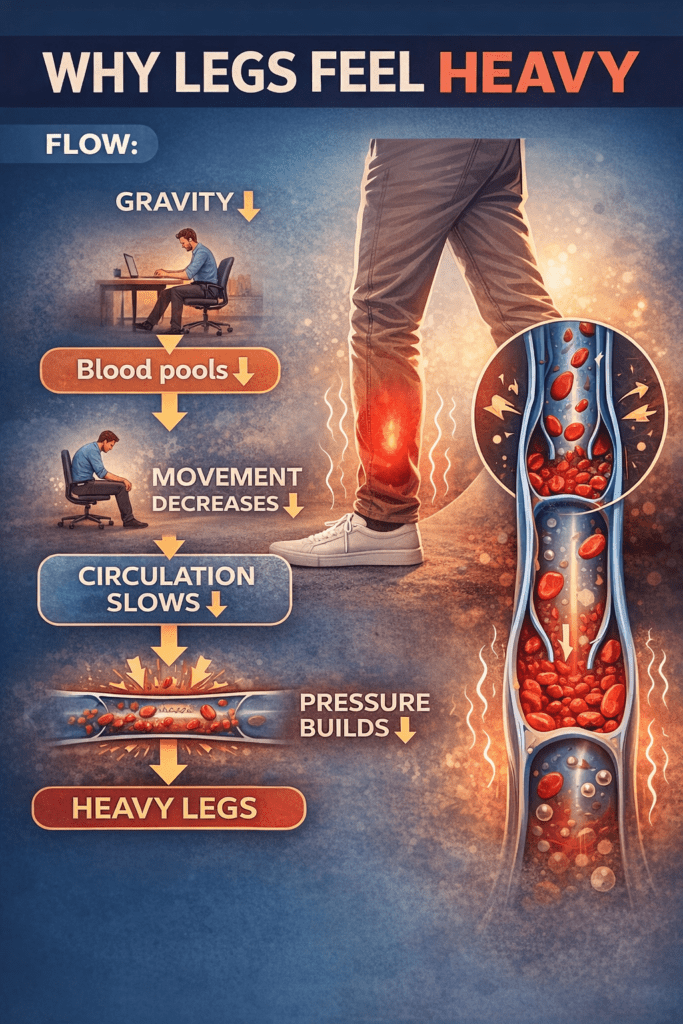
Here’s exactly how the sensation builds:
- Gravity pulls blood into your lower legs
- Movement decreases
- Muscle pump becomes inactive
- Blood return slows
- Pressure builds
- Your legs feel heavy
This step-by-step process explains why the sensation feels physical and consistent.
The Science Behind Gravity, Veins, and That Heavy Feeling in Your Legs
Gravity plays a bigger role than most people realize. While your heart pushes blood downward easily, getting it back up requires assistance.
Your calf muscles act like a second pump. When you move, they help push blood upward. When you don’t move, that system weakens.
This leads to:
- Slower circulation
- Increased pressure
- A full or tight sensation
Your brain interprets this as heaviness.
Is It Normal for Legs to Feel Heavy After Sitting Too Long
Yes, it’s completely normal. Sitting for long periods slows circulation and reduces muscle activity, especially in your calves.
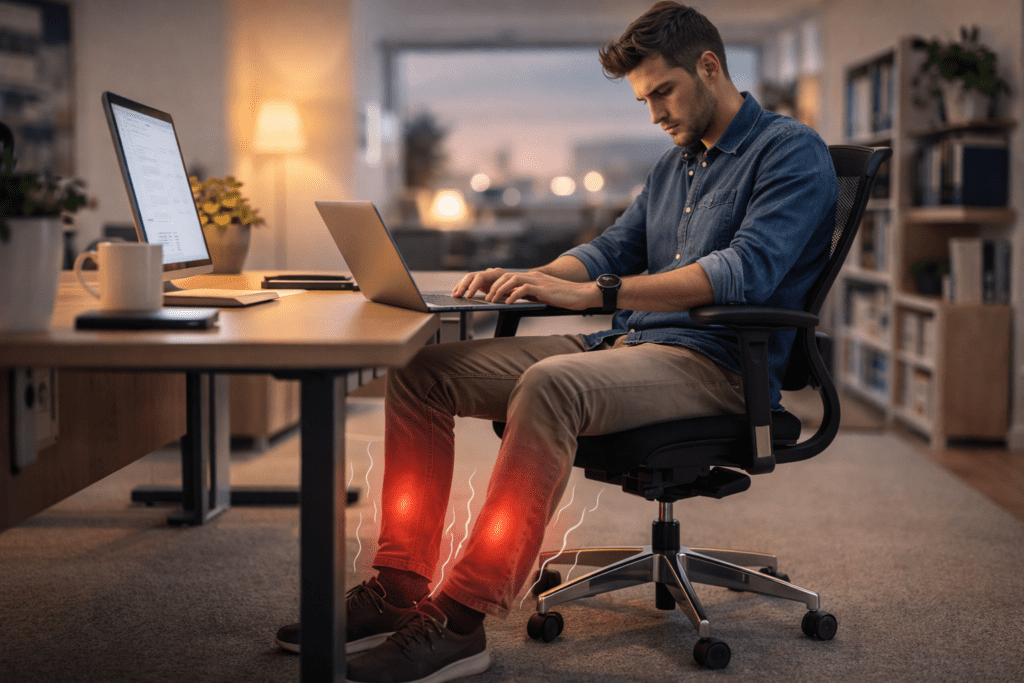
When you sit:
- Blood flow becomes restricted
- Muscles stay inactive
- Circulation becomes sluggish
Over time, pressure builds in your lower legs.
Sitting for extended periods reduces circulation efficiency and highlights the importance of movement, as explained by the Centers for Disease Control and Prevention.
This is closely related to why you feel tired after sitting too long, where inactivity affects both energy and blood flow.
Why Do My Legs Feel Heavy When I Stand for Long Periods Without Moving
Standing still without movement can create the same problem as sitting.

When you stand in one place:
- Muscles aren’t actively contracting
- Blood continues to move downward
- Veins must work harder without support
This leads to blood pooling and increased pressure in your lower legs.
This pattern is similar to why standing all day makes you feel tired, where prolonged pressure affects circulation and energy.
Noticing Similar Body Signals in Other Daily Situations?
Heavy legs are often part of a bigger pattern involving circulation, pressure, and how your body responds to inactivity. If this article sounds familiar, these related guides can help you connect the dots.
Why Do My Legs Feel Heavy When I Walk Even After Resting
Even when you start walking, your legs may still feel heavy if circulation hasn’t fully recovered from previous inactivity.
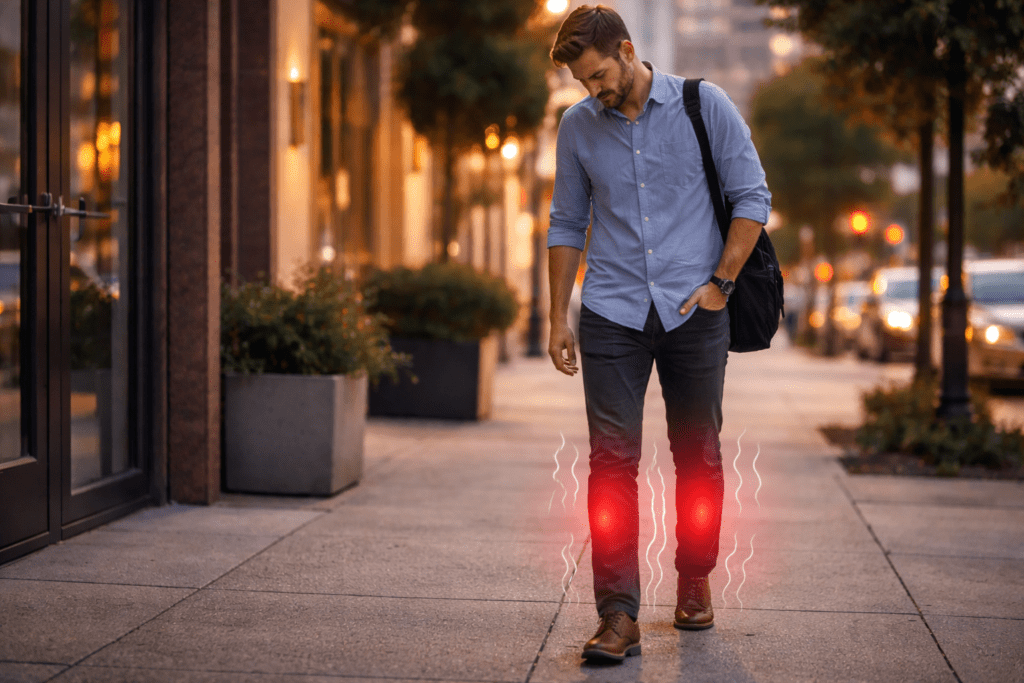
After sitting or standing for long periods:
- Blood remains pooled in the lower legs
- Muscle activity hasn’t fully reactivated
- Circulation is still catching up
So when you begin walking, your muscles suddenly demand more oxygen and blood flow—but the system isn’t fully ready yet.
This temporary mismatch can make your legs feel heavy, slow, or harder to move, even though you’re technically active.
Over time, as movement continues, circulation improves and the heaviness usually fades.
How Tight Clothing and External Pressure Can Make Your Legs Feel Heavier
External pressure on your legs can quietly affect circulation without you noticing.

Tight jeans, compression from socks, or restrictive clothing around your waist and thighs can limit how easily blood flows through your veins. While the effect is usually mild, it becomes more noticeable when combined with long periods of sitting or standing.
This added resistance makes it harder for blood to return upward, increasing pressure in the lower legs. Over time, this can amplify the sensation of heaviness, especially if circulation is already slowed by inactivity.
The Hidden Reason Your Legs Feel Heavier at the End of the Day Over Time
Heavy legs often feel worse at night because the effect builds gradually throughout the day.
You spend hours:
- Sitting
- Standing
- Remaining upright
Each of these contributes to circulation stress. By evening, your veins have been working continuously, and blood return becomes less efficient.
This buildup leads to that familiar heavy feeling at the end of the day.

Why Do My Legs Feel Heavier at Night Compared to the Morning
In the morning, your body starts fresh after lying down, which allows blood to redistribute evenly.
By night:
- Gravity has been acting on your body for hours
- Circulation has slowed in certain positions
- Pressure has accumulated in your lower legs
That’s why heaviness is more noticeable later in the day.
The Hidden Role of Hormones and Body Rhythms in Evening Leg Heaviness
Your body doesn’t regulate circulation the same way all day. Hormones like cortisol and melatonin follow a daily rhythm that affects blood vessel tone and energy levels.
In the morning, higher cortisol levels help maintain alertness and support vascular tension, which keeps circulation more responsive. As the day progresses, cortisol drops and melatonin begins to rise, especially in the evening.
This shift can make blood vessels more relaxed and slightly less responsive, which slows down how efficiently blood moves back from your legs. Combined with hours of gravity and reduced movement, this creates a stronger sensation of heaviness at night—even if your activity level hasn’t changed.
What Most People Miss About Muscle Activity and Circulation in the Lower Body
Here’s something many people overlook:
Your legs don’t just need rest—they need movement.
Movement activates the muscle pump and helps push blood upward. Without it, blood lingers in your lower legs.
Even small movements like walking, stretching, or shifting your position can significantly improve how your legs feel.
Can Dehydration Cause Heavy Legs and Affect Blood Flow Efficiency
Yes, dehydration can make the sensation worse.
When your body lacks fluids:
- Blood volume slightly decreases
- Circulation becomes less efficient
- Muscles receive less support
This combination can increase the feeling of heaviness, especially when paired with inactivity.
The Link Between Nerve Sensitivity and How Your Brain Interprets Leg Heaviness
The sensation of heavy legs is not only physical—it’s also neurological.
Your body constantly sends signals from your legs to your brain about pressure, movement, and internal tension. When circulation slows and pressure builds, sensory nerves in your legs detect these subtle changes.
Your brain then interprets these signals as resistance or weight, even though there is no actual increase in mass. This is why heaviness feels so real—it’s a combined effect of physical pressure and how your nervous system processes that pressure.
This also explains why the sensation can feel stronger at certain times, even if nothing visibly changes in your legs.
How Attention and Body Awareness Can Make Heavy Legs Feel Stronger
Your perception of heaviness can change depending on how much attention you give it.
When you focus on the sensation, your brain amplifies the signals coming from your legs, making the feeling more noticeable and sometimes more intense.
On the other hand, when you’re distracted or moving, the sensation often fades into the background.
This doesn’t mean the feeling isn’t real—it means your brain is adjusting how strongly you experience it based on awareness and attention.
How Heat Exposure Impacts Circulation and Makes Your Legs Feel Heavier
Heat causes blood vessels to expand, a process known as vasodilation.
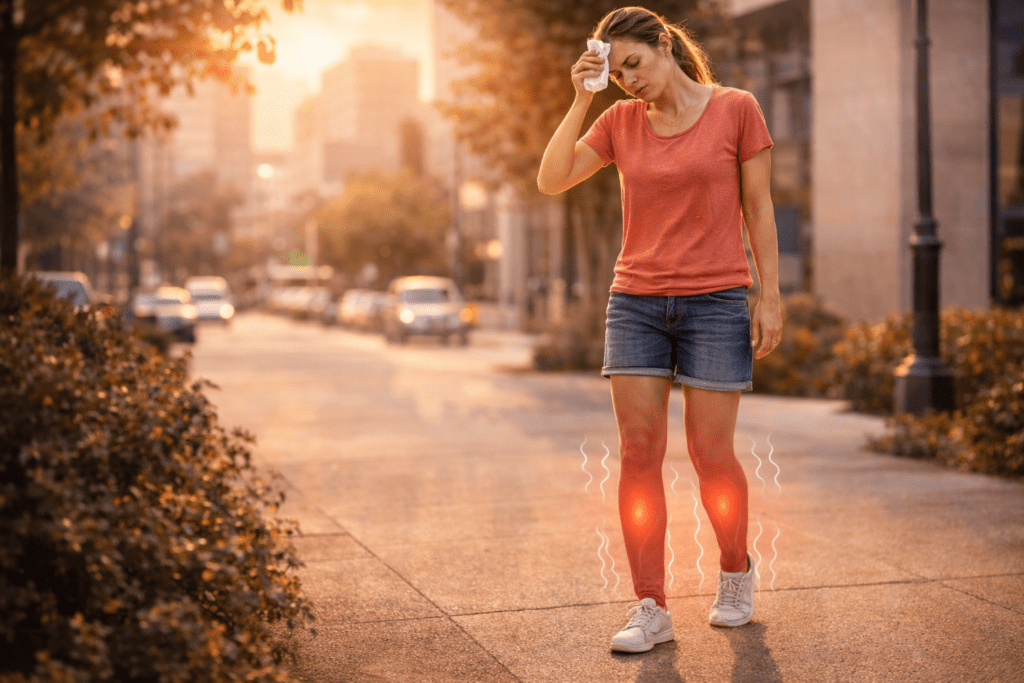
This helps regulate body temperature but also affects circulation:
- Blood moves closer to the skin
- Return flow from your legs slows down
- Pressure increases in the lower body
That’s why heavy legs are more noticeable in hot weather or after heat exposure, similar to why you feel dizzy after a hot shower or why hot showers make you sleepy.
The Difference Between Indoor and Outdoor Environments on Leg Circulation
Your environment plays a bigger role than you might expect.
Outdoor heat, humidity, and prolonged sun exposure can increase blood vessel expansion, making circulation slower and more diffuse. But even indoor environments—like heated offices or poorly ventilated spaces—can have a similar effect.
When your body is slightly overheated, it prioritizes cooling by shifting blood toward the skin. This reduces the efficiency of blood returning from your legs and increases pressure in the lower body.
This is why heavy legs can happen even when you’re not physically active, simply due to environmental conditions.
Why Your Legs Feel Heaviest During the Transition From Rest to Movement
One of the most overlooked moments is the transition between inactivity and movement.
When you go from sitting or standing still to walking, your muscles suddenly require more oxygen and blood flow. However, your circulation system doesn’t instantly adjust to this change.
There is a short delay where blood flow is still catching up to the new demand. During this phase, your legs may feel heavier, slower, or less responsive.
As movement continues, circulation improves and the sensation usually fades. This is why heaviness is often temporary at the start of activity.
What Happens When Your Body Struggles to Restore Blood Flow Balance
When multiple factors combine—like sitting too long, standing still, heat, and dehydration—your body takes longer to restore balance.
Blood return remains slow, pressure stays elevated, and heaviness lasts longer.
According to the Mayo Clinic, fluid buildup and circulation issues in the lower body can contribute to sensations like heaviness and pressure.
This is also why many people notice the sensation during simple activities like walking, especially after long periods of inactivity.
What Helps Reduce the Heavy Feeling in Your Legs Without Changing Your Routine
If your legs feel heavy, small changes can help your body restore circulation more efficiently without requiring major adjustments.
Simple actions like standing up briefly, shifting your weight, or taking short walks can reactivate the muscle pump and improve blood flow.
Even subtle movements—like flexing your ankles or adjusting your posture—can reduce pressure in your lower legs and make the sensation less noticeable.
These small adjustments don’t “fix” the issue instantly, but they support your body’s natural ability to rebalance circulation throughout the day.
A Simple Breakdown of Why Your Legs Feel Heavy Step by Step
The most common everyday triggers include:
- Sitting for long periods (desk work, driving)
- Standing still without movement
- Hot weather or heat exposure
- Dehydration
- Reduced physical activity
- End-of-day accumulation
All of these affect circulation and pressure in your lower body.
To better understand what your body is signaling, it helps to compare heavy legs with similar sensations people often confuse it with:
| Trigger | What Happens in Your Body | What Helps Immediately |
|---|---|---|
| Sitting too long | Blood flow slows, pressure builds | Stand up and move |
| Standing still | Blood pools in lower legs | Shift weight or walk |
| Dehydration | Reduced blood volume | Drink water |
| Heat exposure | Blood vessels expand | Cool down and rest |
| Inactivity | Muscle pump inactive | Light movement |
This comparison makes it easier to recognize whether you’re dealing with pressure, fatigue, or actual muscle weakness.
What Causes a Heavy Feeling in the Legs Without Pain or Weakness
Heavy legs are often confused with weakness or fatigue, but they are different.
- Weakness relates to strength
- Fatigue relates to energy
- Pain signals discomfort or injury
- Heaviness is linked to pressure and circulation
Understanding this difference helps you identify what your body is actually experiencing.
To better understand what your body is signaling, it helps to compare heavy legs with similar sensations people often confuse it with:
| Sensation | Main Cause | What It Feels Like | When It Happens |
|---|---|---|---|
| Heavy Legs | Blood pooling & circulation slow | Weighted, full, hard to move | After sitting, standing, end of day |
| Weakness | Muscle strength reduction | Lack of power, difficulty lifting or moving | After exertion or low energy |
| Fatigue | Energy depletion | Overall tiredness, low motivation | After long activity or poor sleep |
| Pain | Injury or inflammation | Sharp, aching, or throbbing discomfort | During movement or at rest |
Why Does Only One Leg Feel Heavy Instead of Both
In some cases, heaviness may affect only one leg rather than both. This often happens when pressure or circulation is slightly uneven in the body.

For example, standing with more weight on one side, crossing your legs, or maintaining the same posture for long periods can create imbalance in how blood flows through each leg.
Even small differences in movement or positioning can cause one leg to experience more pressure buildup than the other.
This doesn’t always indicate a serious issue—it can simply reflect how your body distributes weight and movement throughout the day.
How Repeated Daily Habits Gradually Increase the Frequency of Heavy Legs
Heavy legs don’t always come from a single event—they often develop from repeated patterns.
If your daily routine includes long periods of sitting, limited movement, or consistent standing, your circulation system adapts to that pattern over time.
This doesn’t mean damage—it means your body becomes more sensitive to those triggers. As a result, the sensation of heaviness may start appearing more often or earlier in the day.
Recognizing this pattern is important because it shows that heaviness is not random—it’s a predictable response to repeated daily behaviors.

So, why do your legs feel heavy?
In most everyday situations, it comes down to a simple but powerful chain: gravity pulls blood downward, movement slows, circulation becomes less efficient, and pressure builds up in your lower legs.
That pressure is what creates the heavy, slow, and weighted sensation you feel.
The important thing to understand is that this isn’t random—and it’s not just “tired legs.” It’s your body responding in real time to how you move, sit, stand, and go through your day.
Once you recognize the pattern, the sensation becomes predictable. You’ll start to notice when it happens, why it happens, and what changes it.
And that’s what makes the difference—not just knowing that your legs feel heavy, but understanding exactly what your body is trying to tell you.
Keep Exploring the Real Reasons Your Body Feels Off
If heavy legs tend to happen alongside fatigue, dizziness, or energy crashes, you may be dealing with the same circulation and body-response patterns in different situations. These reader favorites can help you understand what your body is trying to tell you next.
Frequently Asked Questions
Why do my legs feel heavy after long flights or travel?
Long periods of immobility—like sitting on a plane or in a car—reduce muscle activity in your calves, which slows blood return from your legs. This leads to temporary fluid buildup and a heavier feeling until movement resumes and circulation improves.
Can anxiety or stress make your legs feel heavy?
Yes, stress can change how your body perceives physical sensations. It may increase muscle tension and heighten awareness of pressure signals, making your legs feel heavier even without a major circulation change.
Why do my legs feel heavy during or after exercise?
During intense activity, your muscles demand more oxygen and blood flow. If recovery is delayed or hydration is low, your legs may feel heavy due to temporary fatigue and slower circulation recovery.
Can sleeping position affect how your legs feel the next day?
Yes. Sleeping in positions that restrict blood flow or keep your legs compressed for long periods can slightly affect circulation. When you wake up, your legs may feel stiff or heavy until normal movement restores flow.
Do shoes or foot support affect leg heaviness?
They can. Poorly supportive shoes may change how your weight is distributed, which affects how your leg muscles engage. Over time, this can influence circulation efficiency and contribute to a heavier sensation.
Is it normal for legs to feel heavy during hot weather but not in winter?
Yes. Heat causes blood vessels to expand, which can slow the return of blood from your legs. In cooler temperatures, circulation is more efficient, so the heaviness is usually less noticeable.
Can weight distribution or posture affect leg heaviness?
Absolutely. Standing unevenly, leaning to one side, or locking your knees can change how pressure builds in each leg. This can lead to localized heaviness even if your overall circulation is normal.
Why do my legs feel heavy even when I’m resting?
If circulation was already slowed earlier in the day, your body may take time to rebalance even at rest. Without movement, the muscle pump remains inactive, so the sensation can persist until you move again.
