

You stand up from the couch, your desk chair, or the edge of your bed and feel fine for one second. Then you take a few steps, and suddenly your head feels light, your balance feels delayed, and the room feels harder to move through than it should.
Quick Answer: If “dizzy when I stand up and walk” describes what happens to you, the most common reason is that your body is trying to stabilize blood flow, balance, leg movement, and brain coordination at the same time. Standing shifts circulation, but walking adds motion before everything fully syncs.
That is why the first few steps can feel stranger than standing still. Your body is not only trying to stay upright. It is also trying to move, steer, balance, and keep oxygen-rich blood flowing to your brain.
This article focuses on that exact moment: standing, taking your first steps, and feeling briefly lightheaded, wobbly, or off balance.
What Happens When Standing Turns Into Walking Too Quickly
Dizziness when you stand up and walk often happens when your body is still stabilizing after a position change. Standing shifts blood flow, while walking adds balance, leg movement, and brain coordination. If these systems do not sync quickly, the first steps may feel lightheaded or unsteady.
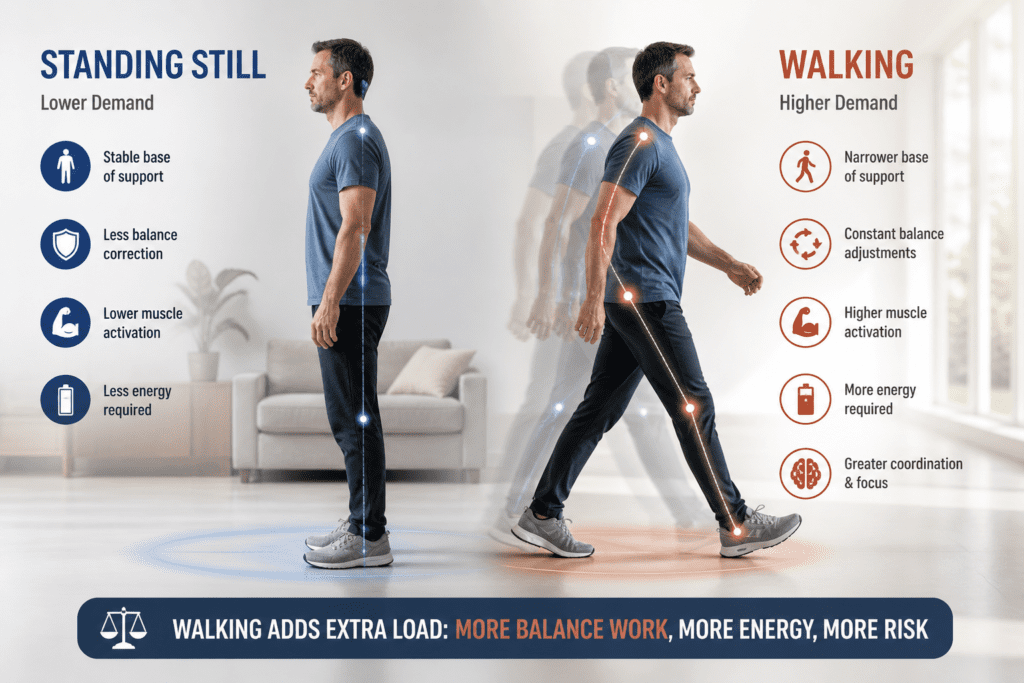
Standing and walking are not the same body task.
When you stand, your body has to adjust to gravity. Blood shifts downward, your blood vessels respond, and your heart helps keep blood moving upward toward your brain.
When you walk, the job changes again.
Your legs start moving. Your eyes scan the room. Your inner ear helps track motion. Your brain updates where your body is in space. Your muscles help control balance. Your circulation system has to support movement, not just posture.
That is a lot to coordinate in a few seconds.
If you stand and immediately walk, your body may still be catching up from the standing transition while you are already asking it to move forward. That overlap can create a short window where you feel lightheaded, wobbly, or slightly disconnected from your steps.
If the dizziness happens before you begin walking, this guide on dizzy after standing explains the quick blood pressure drop pattern in more detail.
The Hidden Reason First Steps Can Make Dizziness Feel Stronger
The first few steps after standing are important because they expose whether your body has stabilized yet.
If you stand still for a moment, you may give your circulation time to adjust. But if you stand and walk right away, your body has less time to finish that correction.
Walking also gives your brain more information to process. Your feet touch the floor. Your head moves. Your eyes track objects. Your inner ear senses motion. Your leg muscles start contracting. Your brain has to turn all of that into smooth movement.
First steps after standing may feel dizzy or unstable because:
- Blood flow is still adjusting after standing
- Your leg muscles have not fully activated yet
- Walking adds movement before balance feels steady
- Your eyes, inner ear, and feet send new motion signals
- Turning or rushing increases the coordination demand
- Low fluids or low energy can make the feeling stronger
- A short pause may give your body time to stabilize
The hidden reason is not always that walking itself is the problem. Often, walking simply reveals that your body was not fully steady yet after standing.
Why do I feel dizzy when I stand up and start walking?
You may feel dizzy when you stand up and start walking because your body is handling two transitions at once. Standing shifts blood flow, while walking adds balance, leg movement, and motion signals. If circulation and coordination are still catching up, the first steps can feel lightheaded or unsteady.
The Real Cause Behind Feeling Dizzy When I Stand Up and Walk
The real cause is usually a timing mismatch between circulation, balance, and movement.
Standing starts the first adjustment. Walking starts the second.
Your circulation needs to keep enough oxygen-rich blood moving to your brain. Your balance system needs to update your body position. Your muscles need to support posture and movement. Your nervous system needs to coordinate it all automatically.
If one part is slightly late, the whole moment can feel unstable.
This is why dizziness after standing and walking can feel more complex than a simple head rush. A head rush may be mostly about a brief blood pressure dip. But walking after standing can add a second layer: movement control.
The Mayo Clinic explains that orthostatic hypotension is a sudden drop in blood pressure when standing after sitting or lying down, which can help explain brief dizziness during position changes.
Your brain is not only asking, “Do I have enough blood flow?” It is also asking, “Where is my body, where are my feet, and am I moving safely?”
When those signals do not line up smoothly, you may feel briefly dizzy, unsteady, or unsure of your first steps.
How Blood Flow and Balance Signals Compete During First Steps
Your brain depends on steady blood flow, but it also depends on accurate balance signals.
When you stand, blood flow has to adjust. When you walk, balance signals have to update.
These systems usually work together quietly. You do not notice them when everything is smooth.
But when you stand quickly and walk immediately, both systems may need attention at once.
Your circulation system is trying to stabilize pressure. Your balance system is processing movement. Your leg muscles are activating. Your eyes are helping you steer. Your brain is trying to make the movement feel normal.
If blood flow briefly dips, your brain may process balance signals less smoothly. That can make the first steps feel more uncertain.
This does not mean your brain is failing. It means the transition is crowded.
Too many adjustments are happening in the same short window.
What Most People Miss About Dizziness That Starts While Walking
Most people focus on the standing part.
They say, “I got dizzy when I stood up.” But sometimes the more important clue is what happens next.
Did the dizziness fade while standing still? Did it appear when you started walking? Did it get worse when you turned? Did it feel like faintness or like imbalance? Did it improve when you paused?
These details matter because they show whether the main issue is pressure, balance, motion, or a mix.
What most people miss is that walking changes the symptom.
Standing mainly tests blood pressure and upright posture. Walking tests pressure, leg strength, balance, direction, and coordination.
That is why this article cannot be exactly the same as a general standing dizziness article. The walking phase is the clue.
If the sensation becomes more noticeable during your first steps, the body may be handling two transitions at once: getting upright and getting moving.
The Science Behind Why Leg Muscles Matter After Standing
Your legs are part of your circulation system during movement.
When your calf muscles contract, they help push blood upward from your lower body toward your heart. This matters because blood has to move against gravity when you are upright.
After sitting or lying down, your leg muscles may be quiet. They have not been helping circulation much. Then you stand and walk.
At first, your muscles may not be fully active yet. Your first few steps are like a restart.
UCLA Health notes that squeezing the leg muscles when standing may help keep blood moving, which supports the idea that the legs play a role in the adjustment.
Once your calves and thighs begin moving, they may help circulation improve. That is why some people feel weird for the first few steps, then better after walking slowly for a short time.
The key is that walking is not always bad. Walking may actually help once your body has adjusted. The problem is walking too quickly before the adjustment is complete.
Why Long Sitting Makes Walking After Standing Feel Unsteady
Long sitting can make this pattern stronger.
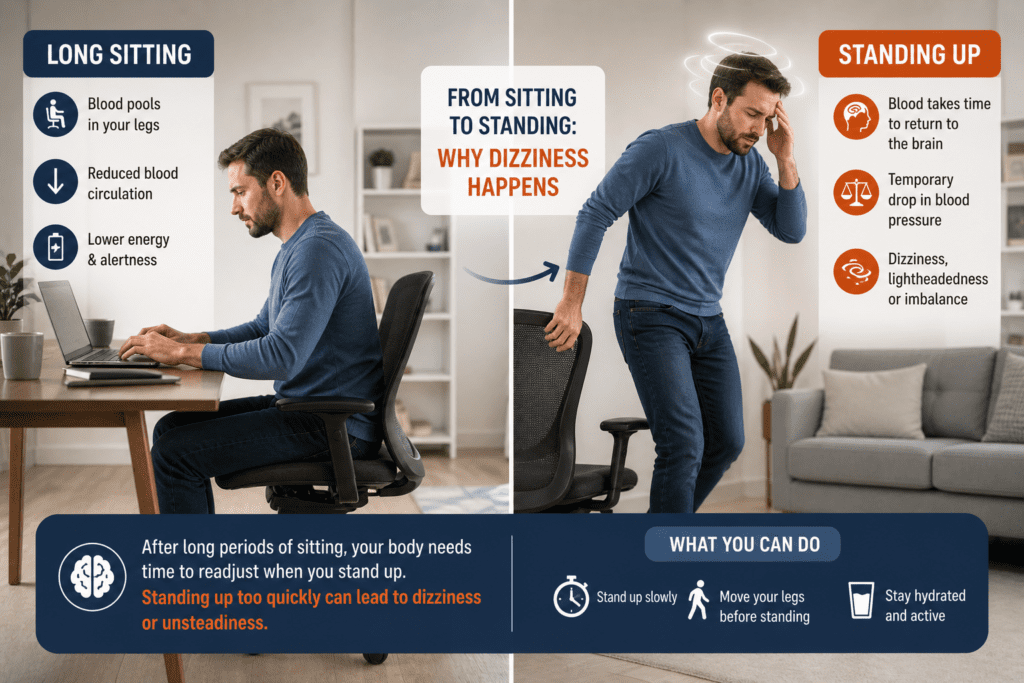
Think about a normal workday. You sit through emails, video calls, a long drive, or a movie. Your legs are bent. Your hips are still. Your calf muscles are quiet. Your breathing may be shallow. Your posture may be compressed.
Then you stand and start walking.
Your body has to restart movement from a still position. Blood flow has to adjust. Leg muscles need to switch on. Balance signals need to update. Your brain has to move from desk mode to walking mode.
That is why the first few steps may feel strange after long sitting.
Long sitting can also connect with why sitting too long makes you tired, especially when your legs and circulation have been inactive for a while.
The longer you sit, the more noticeable the transition can feel. This is common after desk work, long meetings, gaming, studying, flying, watching TV, or scrolling on your phone for a long time.
The body likes gradual transitions. Long sitting followed by quick walking is not gradual.
What Happens When You Turn or Walk Fast Right After Standing
Turning can make dizziness after standing and walking feel worse.
Walking straight is one thing. Turning your head, changing direction, stepping around furniture, or rushing down a hallway adds more balance demand.
Your inner ear helps detect head motion. Your eyes track the room. Your feet send information from the floor. Your brain combines those signals to keep you steady.
If you are already lightheaded from standing, quick turning can make the moment feel stronger.
That is why someone may stand up, feel only slightly off, then feel much worse when turning toward the kitchen, bathroom, hallway, or stairs.
Fast walking can do the same thing.
Speed gives your body less time to stabilize. It also increases movement input. If blood flow and balance signals are still settling, fast movement can feel uncomfortable.
The simple rule is this: the more movement you add immediately after standing, the more coordination your body needs before it feels steady.
The Link Between Lightheadedness and Feeling Off Balance
Lightheadedness and off-balance feelings are related, but they are not always the same.
Lightheadedness often feels like you might faint, float, or lose energy for a second. It is commonly linked with blood pressure, hydration, circulation, or a brief dip in brain blood flow.
Feeling off balance is different. It may feel like your steps are not smooth, your body is leaning, or the floor feels less stable. This can involve balance signals, muscles, vision, inner ear input, or movement coordination.
MedlinePlus explains that dizziness can feel like lightheadedness, wooziness, or disorientation, while vertigo often feels like spinning.
When you stand up and walk, you can feel both at once.
You may say “dizzy,” but what you really feel may be partly lightheaded and partly unsteady.
If the sensation is mostly faintness, circulation may be the main clue. If it feels like wobbling, swaying, spinning, or trouble walking straight, balance signals may be more involved.
Understanding why dizziness occurs can be broken down into four key systems that are involved in standing and walking. These systems need time to synchronize, and if they don’t, you may feel lightheaded.
| System | Role | Effect on Standing + Walking |
|---|---|---|
| Blood Circulation | Moves blood from legs to the brain | Blood is temporarily pooled in the lower body after standing, reducing the supply to the brain during movement. |
| Leg Muscles | Support and stabilize posture | Muscles need to activate to pump blood back up; quick movement may hinder muscle activation. |
| Vestibular System | Regulates balance and motion (inner ear) | Affects your ability to feel stable while moving, as balance signals are delayed. |
| Cognitive Processing | Guides your movements by combining sensory info | The brain may need extra time to process the movement, causing delays in your steps. |
As seen, your body is under pressure to coordinate circulation, balance, and muscle movement all at once. If these signals don’t sync immediately, dizziness can occur during the first few steps after standing.
Why do I feel off balance after standing up?
You may feel off balance after standing up because your brain is updating posture, blood flow, vision, inner ear signals, and leg movement at the same time. If those signals do not sync smoothly, your first steps may feel delayed, wobbly, or less stable than normal.
The Impact Of Dehydration on Walking After Standing
Dehydration can make the transition harder because fluid balance affects blood volume.

If your body has less fluid available, pressure changes may feel stronger when you stand. Then, when you immediately walk, your body has to manage movement with a slightly less stable circulation base.
That can make the first steps feel more noticeable.
This may happen after sweating, hot weather, too much time without water, illness, alcohol, a warm bedroom, or a long day of coffee without enough fluids.
If low fluid intake seems to make the feeling stronger, these simple daily hydration habits for energy may help you understand the hydration side of the pattern.
Hydration does not explain every case. It should not become the whole article. But it is an important background factor.
Think of it as one layer in the stack.
Standing creates a circulation shift. Walking adds movement. Low fluids make the system less steady. Long sitting makes the legs slower to help. Poor sleep may make your response feel slower.
How Low Energy Can Make First Steps Feel Less Stable
Low energy can make first steps feel harder, especially if you skipped meals, slept poorly, or started moving before your body felt ready.
Your brain and muscles need steady energy to coordinate movement. If you already feel shaky, drained, or under-fueled, the walking transition may feel less stable.
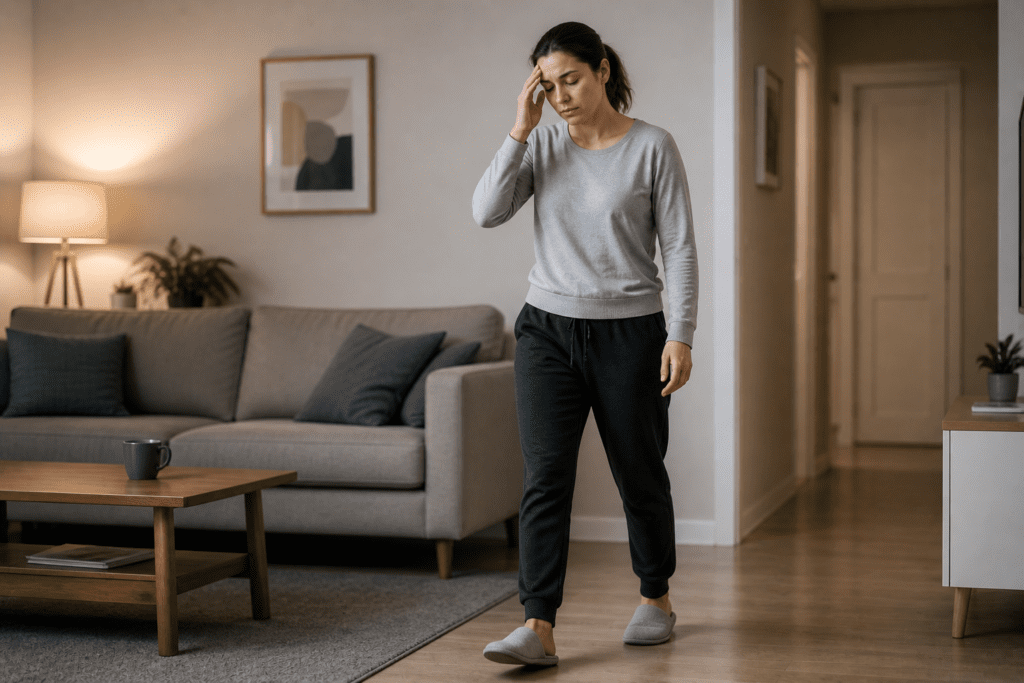
This does not mean every dizzy feeling is caused by blood sugar. It means low energy can make the same position change feel more intense.
A common example is standing up after sitting for hours with only coffee and no real meal. You may feel okay while sitting because sitting does not demand much from your body. But once you stand and walk, your body has to coordinate pressure, movement, and energy all at once.
If the dizziness comes with shakiness or a drained feeling, read why blood sugar crash symptoms happen for more context.
Again, the main idea is stacking.
A small circulation delay plus low energy plus fast walking can feel stronger than any one factor by itself.
How long should dizziness after standing and walking last?
Dizziness after standing and walking often fades within a few seconds once your body stabilizes blood flow, balance, and movement. If it lasts longer, happens often, causes falls, or comes with chest pain, shortness of breath, severe weakness, confusion, or new vision changes, it should be checked by a healthcare professional.
What Happens When Dizziness Continues After The First Few Steps
Many people feel better after a few seconds. That often means the body corrected the transition.
But if dizziness continues after the first few steps, pay closer attention to the pattern.
Does it keep going even after you stop walking? Does it happen every time? Does it feel like spinning? Does it come with weakness, chest discomfort, shortness of breath, confusion, or trouble speaking? Does it make you feel like you may fall?
Persistent or severe symptoms deserve more caution because they may involve more than a brief transition delay.
If the feeling also comes with sudden weakness, this guide on why you suddenly feel weak and tired may help you compare related symptoms.
If the feeling appears only for a few seconds after standing and improves when you pause, the transition itself may be the main clue. If it continues, worsens, or affects normal movement, it should not be ignored.
The Real Cause-Effect Chain Behind Dizziness During First Steps
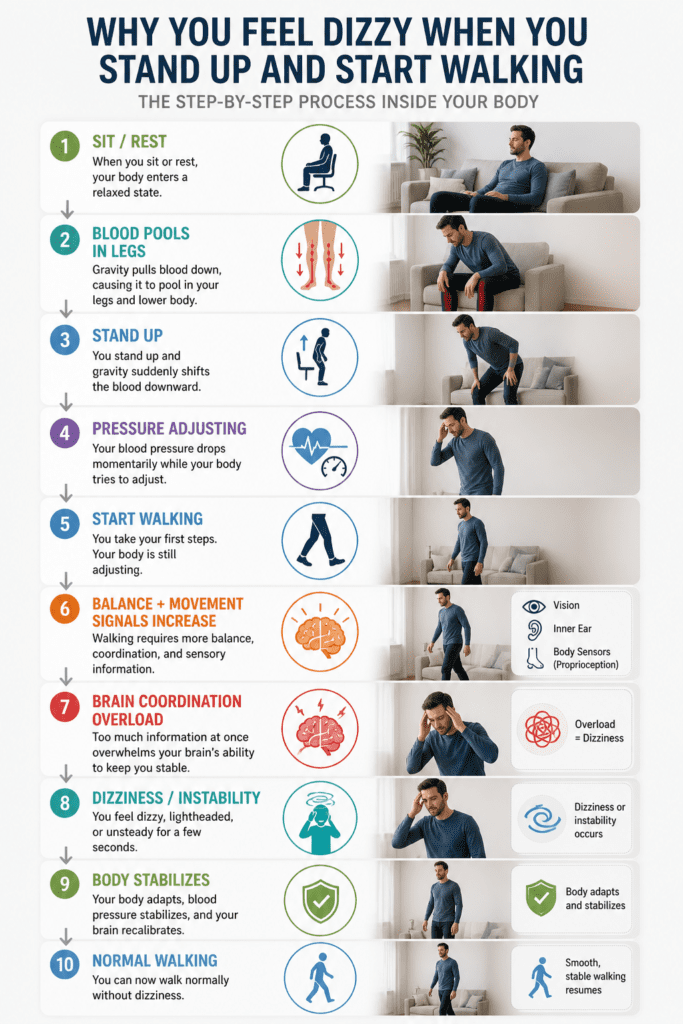
Here is the simple chain:
What happens when you feel dizzy after standing and walking:
- You sit or lie still
- Your leg muscles stay quiet
- You stand up
- Blood shifts downward
- Your circulation starts correcting
- You begin walking immediately
- Balance signals and leg movement increase
- Your brain manages motion and blood flow together
- If timing lags, you feel dizzy or unsteady
- Your body catches up and the feeling fades
This sequence shows why the symptom can feel more obvious after walking begins. Standing starts the adjustment. Walking adds another demand before the first one is fully complete.
That is the key difference.
You are not only asking your body to stand. You are asking it to stand and move before all systems have fully synchronized.
How to Stand, Pause, and Walk Without Triggering Dizziness
The best fix is to create a short bridge between standing and walking. When you pause, move your calves, and take slower first steps, you give your blood flow, leg muscles, and balance signals a few seconds to sync before your body has to move across the room.

Try this simple sequence:
- Sit upright first
- Place both feet flat on the floor
- Move your ankles or calves
- Stand slowly
- Pause for a few seconds
- Check whether your head feels steady
- Take the first few steps slowly
- Avoid sharp turns right away
- Hold a stable surface if needed
This routine works because it gives your body a short bridge between sitting and walking.
The pause matters. It lets circulation stabilize before movement begins.
The ankle or calf movement matters too. It wakes up the leg muscle pump before you fully depend on your legs for walking.
The slow first steps matter because they reduce balance demand while your body is still adjusting.
This is not a complicated routine. It is a smoother handoff from stillness to movement.
Want steadier first steps after standing?
If walking after standing makes you feel lightheaded, your body may also be reacting to sitting too long, low fluids, or sudden energy dips. Start with these guides on why sitting too long makes you tired, simple daily hydration habits for energy, and why blood sugar crash symptoms happen.
What Most People Miss About Pushing Through The Feeling
Many people try to push through dizziness.
They stand up, feel strange, and keep walking because they do not want to stop. But pushing through may make the moment feel worse, especially if the body is still trying to stabilize.
The counterintuitive insight is that pausing can be more effective than powering through.
A pause is not weakness. It is information. It tells your body, “Finish stabilizing before we add more movement.”
This is especially important near stairs, bathrooms, dark hallways, parking lots, or busy rooms where a small balance mistake can matter more.
If stress makes the sensation feel more intense, this guide on whether anxiety can make you tired explains how background tension can change how your body feels.
You do not need to become fearful of walking. But you should respect the first few seconds after standing if your body often feels delayed.
What Happens When You Track The Walking Pattern
Tracking the walking pattern can help you understand the trigger.
Do not only ask, “Did I feel dizzy?” Ask what happened around it.
Did it happen after long sitting?
Did it happen after getting out of bed?
Did it happen when you turned quickly?
Did it happen in a warm room?
Did it happen after poor hydration?
Did it happen before breakfast?
Did it fade after a pause?
Did it continue while walking?
If this mostly happens when getting out of bed or after resting, this article on why you feel dizzy when you get up explains the rest-to-movement transition more clearly.
These questions help separate a short transition issue from a broader pattern.
If it mostly happens after sitting still, inactivity may be part of the stack. If it mostly happens after heat or sweating, hydration may matter. If it happens with spinning, the balance system may need more attention. If it continues or causes falls, it should not be ignored.

Why Feeling Dizzy When You Stand Up and Walk Comes Down to Coordination
If dizzy when I stand up and walk describes your experience, the main idea is coordination.
Your body has to stabilize blood flow, activate leg muscles, update balance signals, and guide movement at the same time. If you start walking before those systems are fully synced, the first few steps may feel light, wobbly, or unstable.
That is why the walking part matters.
Standing may trigger the shift, but walking can reveal it.
Once you understand that, the symptom becomes easier to interpret. You are not just standing. You are moving through space while your circulation and balance systems are still catching up.
A short pause, slower first steps, leg movement, hydration awareness, and pattern tracking can make the transition feel more controlled.
The goal is not to fear the symptom. The goal is to understand the first few seconds better.
When your body has a little more time to stabilize, walking can feel steadier again.
Frequently Asked Questions About Feeling Dizzy When Standing and Walking
Can standing up and walking too quickly make you dizzy?
Yes, standing up and walking too quickly can make dizziness more noticeable because your body has to stabilize blood flow and movement at the same time. A short pause before walking may give circulation, leg muscles, and balance signals time to catch up.
Why do I feel dizzy after sitting and then walking?
After long sitting, your leg muscles have been inactive and circulation may respond more slowly. When you stand and walk right away, your body has to restart movement, stabilize blood flow, and coordinate balance at the same time.
Can dehydration cause dizziness when standing and walking?
Yes, dehydration can make dizziness more noticeable because lower fluid levels may reduce blood volume. When you stand and walk, your body may have a harder time keeping blood pressure and brain blood flow steady.
Why do I feel dizzy when I turn after standing up?
Turning after standing can make dizziness feel stronger because your balance system has to process head movement, direction change, and body position at once. If circulation is still stabilizing, quick turns may feel more disorienting.
Is feeling dizzy while walking after standing the same as vertigo?
Not always. Dizziness after standing and walking often feels like lightheadedness, delayed balance, or brief unsteadiness. Vertigo usually feels more like the room is spinning or tilting, even when you stop moving.
Can low energy make dizziness worse when I start walking?
Yes, low energy can make the first steps feel less stable, especially if you skipped meals, slept poorly, or had little water. Your brain and muscles need steady energy to coordinate movement after standing.
Why do I feel better after pausing before walking?
Pausing before walking gives your body a few seconds to stabilize blood flow, activate leg muscles, and update balance signals. That short delay can make the first steps feel steadier and less rushed.
When should dizziness while walking be taken seriously?
Dizziness while walking should be taken more seriously if it causes falls, fainting, chest pain, shortness of breath, severe weakness, confusion, trouble speaking, new vision changes, or ongoing trouble walking normally.
Keep learning what your body is trying to tell you.
If dizziness happens during different movement moments, explore related guides on dizzy after standing, feeling dizzy when you get up, and why sitting too long makes you tired.
This content is for informational purposes only and focuses on common everyday causes of dizziness related to standing, walking, posture, circulation, hydration, and balance. It is not intended as medical advice or a diagnosis. If dizziness is frequent, severe, worsening, causes falls or fainting, or appears with chest pain, shortness of breath, confusion, trouble speaking, severe weakness, or new vision changes, seek professional medical evaluation.
