

You stand up—and for a split second, it feels like the room drops out from under you. Your vision fades slightly, your head feels light, and your body pauses as if it needs to reboot. It’s fast, unexpected, and just enough to make you stop.
If you feel dizzy when you stand up, it’s usually because your blood pressure drops briefly, reducing blood flow to your brain for a few seconds. This happens when blood shifts toward your lower body and your circulation system hasn’t caught up yet. That short delay is what creates the sudden lightheaded feeling.
What makes this confusing is how quickly it comes and goes. One moment you’re completely fine, the next you’re steadying yourself against a wall. But in most everyday situations, this isn’t random—it’s your body reacting to a rapid position change faster than it can adjust.

When you stand suddenly, your body has to push blood back upward against gravity while also stabilizing pressure. During that brief window, your brain receives slightly less oxygen-rich blood, which is why everything can feel off for a second before returning to normal.
What Happens When You Stand Up Too Fast and Your Blood Pressure Drops Suddenly
When you move from sitting or lying down to standing, your body is not just changing posture. It is also fighting gravity.
While you are sitting, blood flow is relatively stable. Your heart is pumping, your brain is getting oxygen, and your legs are resting. Then you stand, and gravity pulls some blood downward toward your legs and lower body.
Less blood returns to your heart for a moment. Because less blood returns to the heart, slightly less blood may be pumped upward toward your brain. That brief change can make your blood pressure dip.
The Mayo Clinic explains orthostatic hypotension as a form of low blood pressure that happens when standing after sitting or lying down, and notes that it may cause dizziness or lightheadedness.
What happens when you feel dizzy after standing up:
- You stand up quickly
- Blood shifts toward your lower body
- Blood pressure temporarily drops
- Less oxygen-rich blood reaches your brain
- Your brain slows briefly
- Your body corrects the imbalance
- Dizziness fades within seconds
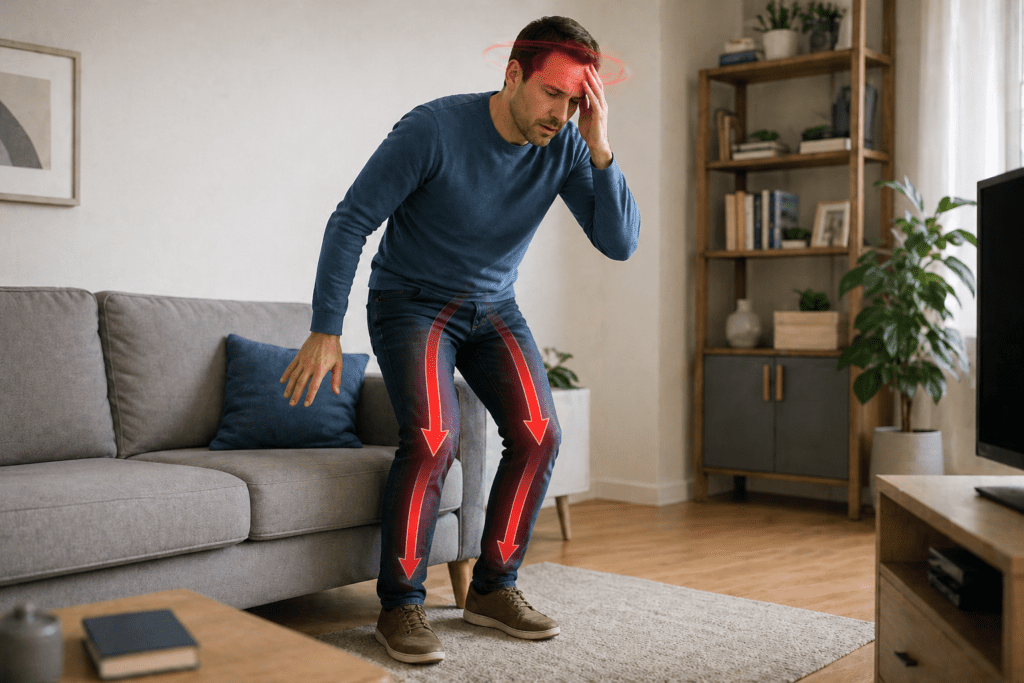
The Hidden Reason Your Brain Feels Dizzy Before Blood Flow Fully Recovers
The most important detail is not just that pressure temporarily decreases. It is that your correction system needs a moment to respond.
Your body has built-in pressure sensors that help protect blood flow to the brain. These sensors are part of a fast response system involving your heart, blood vessels, and autonomic nervous system. This system controls automatic functions you do not have to think about, including heart rate, vessel tightening, and blood pressure balance.
When you stand up quickly, these sensors detect that blood pressure has changed. Then your body sends signals to increase heart activity and tighten blood vessels so blood can move upward again.
That sounds instant, but it is not perfectly instant.
There is a tiny lag.
That lag is where dizziness happens. Your body usually corrects the problem quickly, but your brain may feel the short gap before full circulation returns.
This is what most people miss. The dizziness is often not the sign of a dramatic collapse. It is more like a timing mismatch between your movement and your body’s pressure response.
Why do I feel dizzy when I stand up quickly?
You feel dizzy when you stand up quickly because gravity pulls blood toward your legs before your body can adjust. This causes a brief drop in blood pressure, reducing blood flow to your brain for a few seconds. During that short delay, your brain receives less oxygen, which creates the lightheaded feeling.
The Science Behind Why Blood Pools in Your Legs When You Stand Up
Your legs are not just carrying your weight when you stand. They also become part of the circulation challenge.
When you are upright, blood has to move against gravity to return from your legs to your heart. Your veins help carry blood back upward, but they depend partly on muscle activity. When your calf muscles contract, they help squeeze blood upward like a pump.
If you stand suddenly after sitting still, your calf muscles may not be active yet. Blood can briefly collect in your legs before your circulation catches up. This is called blood pooling.
Blood pooling does not mean blood is trapped forever. It simply means more blood has shifted downward for a short time. During that window, your heart may have less blood returning to it, so less blood is immediately available to send to your brain.
Common reasons you feel dizzy after standing up:
- Sudden drop in blood pressure
- Dehydration reducing blood volume
- Standing up too quickly
- Blood pooling in the legs
- Delayed nervous system response
- Long periods of sitting or inactivity
- Heat or fatigue affecting circulation
This is why dizziness may feel stronger after a long workday at a desk, a long car ride, or a lazy weekend morning on the couch. If your legs have been inactive, they may not help push blood upward right away.
That is why this topic connects naturally with feeling tired after standing all day, even though the mechanism is different. Standing fatigue is more about long-term muscle and circulation strain, while dizzy after standing up is more about a quick blood pressure adjustment.
What Most People Miss About Why Dizziness Happens After Standing Up Quickly
Most people explain this feeling with one phrase: “low blood pressure.”
That is partly true, but it is too simple.
The bigger issue is speed.
If you stand up slowly, your body has more time to tighten blood vessels, increase heart response, and keep blood moving toward your brain. If you jump up quickly, your body has less time to do all of that before blood shifts downward.
So the real issue is not always that your body cannot respond. Often, your body can respond. It just responds a few seconds after the trigger.
That delay is the hidden reason dizziness feels sudden.
This is also why the same person may feel fine one day and dizzy the next. Your body’s response speed can change based on hydration, sleep, meal timing, heat, stress, and how long you were sitting.
For example, imagine a typical American morning. You wake up, check your phone, realize you are late, and jump out of bed. You have not had water yet. You have been lying flat for hours. Your blood pressure may naturally be lower. Then you stand quickly.
The Harvard Health article on dizzy spells when standing explains that blood can temporarily pool in the legs when you stand, while the body takes a moment to compensate.
That “moment” is the whole story. If you understand the moment, the symptom makes much more sense.
The Real Cause-Effect Chain That Explains Dizziness After Standing Up
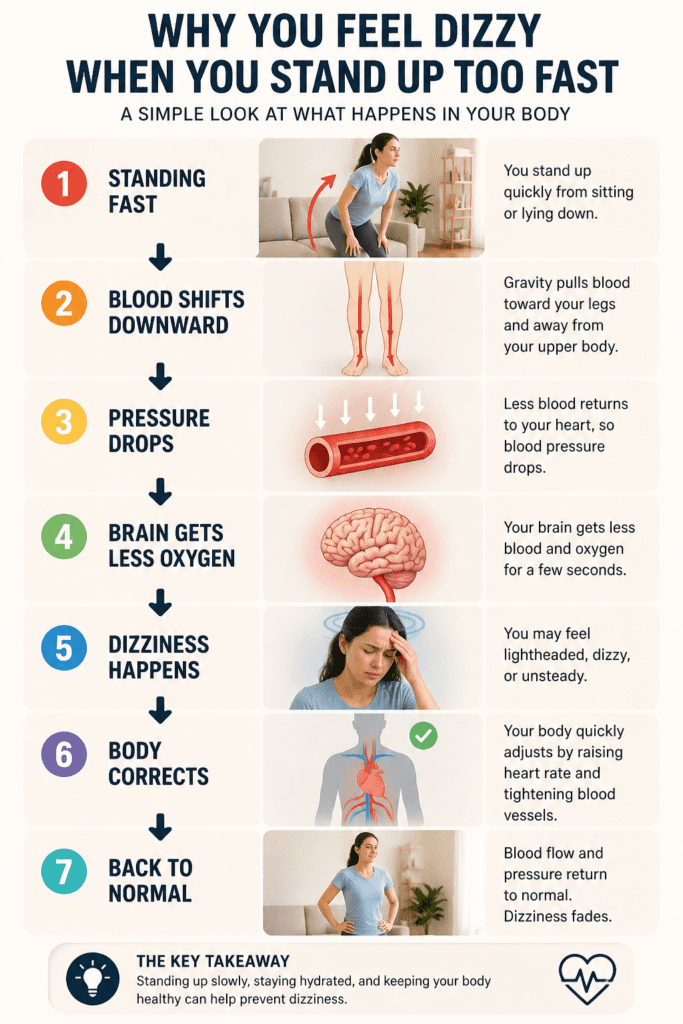
A clear cause-effect chain helps separate normal brief lightheadedness from vague fear.
Here is the basic flow:
You stand up fast.
circulation drops briefly toward your lower body.
Less blood returns to your heart for a moment.
Your blood pressure briefly drops.
Your brain receives slightly less oxygen-rich blood.
You feel dizzy, lightheaded, or unsteady.
Your nervous system responds.
Your heart and blood vessels adjust.
Blood flow stabilizes.
The dizziness fades.
This is why the symptom often feels intense but short. The uncomfortable part may happen quickly, but the correction also happens quickly.
The body is designed to protect brain blood flow. It does not casually ignore the brain. It reacts fast, but “fast” is not always faster than the sudden movement you just made.
If you were lying in bed for eight hours, then suddenly stand and walk to the bathroom, your body has to shift from a resting circulation pattern to an upright circulation pattern. That transition may be smooth, or it may create a brief dip.
If you already feel weak, drained, or unstable, standing quickly can make the feeling more noticeable. If sudden weakness is part of your pattern, this may connect with why you suddenly feel weak and tired, especially when blood sugar, hydration, or sleep are also involved.
To make this process even clearer, here’s how your body reacts step by step when you stand up too quickly and feel dizzy:
| Step | What Happens in Your Body | What You Feel |
|---|---|---|
| 1 | You stand up quickly | No symptoms yet |
| 2 | Blood shifts toward your lower body | Slight imbalance begins |
| 3 | Less blood returns to your heart | Pressure starts to dip |
| 4 | Reduced blood reaches your brain | Lightheaded or woozy feeling |
| 5 | Your nervous system reacts | Momentary instability |
| 6 | Heart rate increases and vessels tighten | Balance starts returning |
| 7 | Blood flow stabilizes | Dizziness fades |
This entire process usually happens within a few seconds, which is why the dizziness feels sudden but disappears quickly once your system stabilizes.
The Link Between Dehydration and Stronger Dizziness After Standing Episodes
Dehydration can make dizziness after standing feel stronger because it affects blood volume.

Your blood contains a lot of water. When you do not drink enough fluids, or when you lose fluid through sweating, fever, vomiting, diarrhea, or heat exposure, your total blood volume can drop. With less fluid in the system, blood pressure may be easier to disturb.
Now imagine standing up quickly when your blood volume is already lower than usual.
The same movement can create a bigger drop.
That is why dizziness may be more common first thing in the morning, after sleeping in a warm room, after sweating outside, after drinking alcohol, during hot weather, after a day with too little water, or after being sick.
This does not mean water fixes every case of dizziness. But hydration is one of the easiest factors to overlook.
A simple example: someone sits through a long morning of work with only coffee. By lunchtime, they stand up quickly from their desk and feel lightheaded. The issue may not be coffee alone. It may be low fluid intake, long sitting, skipped breakfast, and sudden movement stacking together.
That is why steady hydration habits matter. If your daily energy often feels unstable, your hydration pattern may also connect with simple daily hydration habits for energy, especially if you notice symptoms more in the morning or afternoon.
The intensity of dizziness after standing isn’t always the same. It depends on several factors happening at the same time. Here’s how different situations can affect how strong the feeling becomes:
| Situation | What’s Happening in Your Body | Dizziness Intensity |
|---|---|---|
| Well hydrated + standing slowly | Stable circulation and smooth adjustment | Very mild or none |
| Standing up quickly | Rapid blood shift before adjustment | Mild to moderate |
| After long sitting | Inactive muscles + slower circulation response | Moderate |
| Dehydrated or overheated | Lower blood volume and pressure instability | Moderate to strong |
| Morning (after sleep) | Lower pressure + fluid loss + inactivity | More noticeable |
| Skipping meals | Lower energy + reduced stability | Stronger sensation |
This is why the same movement can feel completely different depending on your hydration, activity level, and time of day. It’s not just the action—it’s the context around it.
Want to understand your daily energy patterns better?
If dizziness tends to show up with low energy, shaky feelings, or afternoon crashes, start with these simple guides on daily hydration habits for energy and why blood sugar crash symptoms happen.
Is it normal to feel dizzy after standing up?
Yes, it is normal to feel slightly dizzy after standing up quickly, especially if it only lasts a few seconds. This usually happens because your circulation hasn’t fully stabilized yet. However, frequent or severe dizziness may require attention.
How Your Nervous System and Heart Work Together to Stabilize Blood Pressure
Your nervous system and heart act like a fast correction team.
When you stand, your body uses pressure sensors to detect the drop. These sensors are often described as baroreceptors. They help monitor pressure changes and signal your body to respond.
Once the change is detected, your heart and blood vessels work together. Your heart may beat slightly faster. Your blood vessels may tighten. Your leg muscles may help push blood upward if they start moving. Your brain receives steadier blood flow again.
This process is automatic. You do not have to think, “Tighten blood vessels now.” Your body handles it in the background.
But automatic does not mean perfect every single time. Your response can be slower when you are dehydrated, tired, overheated, inactive, stressed, or recovering from illness. Certain medications may also affect blood pressure response, which is why recurring dizziness is worth paying attention to.
The American Heart Association has a helpful overview of low blood pressure and hypotension, including symptoms such as dizziness, fainting, and blurred vision.
Your body uses a fast pressure-control system, but your habits and environment can influence how smoothly that system works.
The Impact Of Sudden Movement Versus Slow Position Changes on Brain Oxygen Flow
The way you stand matters.
A slow position change gives your body time to adapt. A sudden position change asks your body to fix everything at once.
If you go from lying flat to standing fast, the shift is dramatic. Your heart, blood vessels, and nervous system all need to update quickly. If the response lags for even a few seconds, your brain feels the difference.
If you sit on the edge of the bed first, move your legs, and then stand, the shift is less dramatic. Your leg muscles start helping. Your circulation has a head start. Your brain is less likely to experience a sudden drop in blood flow.
This is why “stand up slowly” is not just generic advice. It directly matches the mechanism.
You are reducing the speed of the trigger.
The same idea applies after sitting at a desk. If you have been still for two hours, do not jump up and walk fast immediately. Shift your posture first. Move your feet. Tighten and relax your calf muscles. Then stand.
What Happens When Morning Dizziness Feels Stronger Than Usual
Morning dizziness after standing can feel more noticeable because several factors stack together. After lying down for hours, your blood pressure may be lower, your body may be slightly dehydrated, and your muscles have been inactive.

When you suddenly stand up, your circulation hasn’t fully adjusted yet, which can make the blood-flow shift feel stronger.
That is a strong setup for lightheadedness.
This is why someone may say, “I only get dizzy when I get out of bed.” That pattern often makes sense because the morning includes the biggest position change of the day.
It is also why morning dizziness can feel different from general tiredness. You may not be sleepy. You may simply feel briefly unstable because your circulation has not fully adjusted.
This can overlap with being tired after waking up, but the two are not exactly the same. Morning tiredness may involve sleep quality, circadian rhythm, or recovery. Morning dizziness after standing is more about the fast shift from lying down to standing upright.
This is why many people notice dizziness right after getting out of bed, even if they feel fine the rest of the day.
The Hidden Reason Long Sitting Makes Standing Dizziness More Noticeable
Long sitting can make standing dizziness more noticeable because your muscles have been quiet.
When your legs are inactive, they are not helping move blood back toward your heart as much. Then, when you stand quickly, your body has to restart movement and circulation adjustment at the same time.

This is common after desk work, long meetings, gaming sessions, road trips, flights, studying for hours, or sitting on the couch for a long time.
It may also happen after a big meal, since your circulation may already be slightly shifted. That does not mean every post-meal dizzy feeling has the same cause, but it shows how blood flow demands can change throughout the day.
If your energy often drops after sitting, you may want to connect this article internally with why sitting too long makes you tired, because both topics involve inactivity, circulation, and delayed body activation.
The difference is the symptom focus. Sitting fatigue may feel like heaviness, low drive, or sluggishness. Standing dizziness feels more sudden and head-based.
What Most People Miss About Dizziness, Blood Sugar, and Skipped Meals
Blood pressure is the main mechanism, but blood sugar can influence how strong the episode feels.
If you have not eaten for many hours, your body may already feel a little shaky, weak, or under-fueled. Then when you stand up quickly, the blood pressure shift can feel more intense because your brain and body are already low on available energy.
This does not mean every dizzy spell is a blood sugar problem. It means skipped meals can make your body less steady during position changes.
Think about a busy morning: coffee, no breakfast, back-to-back tasks, little water, and then a fast stand from the desk. That is not one trigger. It is a stack of triggers.
Blood pressure adjustment is the main event. But hydration, food timing, sleep, and movement all affect how resilient your body feels during that event.
This is where your existing article on why blood sugar crash symptoms happen can support the reader. It gives context for people who feel shaky, weak, or drained alongside lightheadedness.
How to Reduce Dizziness After Standing Without Overcomplicating It
The best first step is to match your habits to the mechanism.
If the problem is a fast blood flow shift, make the shift slower.

Try this simple standing routine:
- Sit upright first
- Place both feet on the floor
- Move your ankles or calves
- Pause for a few seconds
- Stand slowly
- Hold something stable if needed
- Start walking only after you feel steady
This works because it reduces the suddenness of the transition.
Hydration also matters. You do not need to force huge amounts of water at once. A steadier pattern throughout the day is usually more practical. For many busy adults, keeping a water bottle nearby or drinking a cup of water after waking can help build consistency.
Movement matters too. If you sit for long periods, small breaks can help keep circulation more responsive. Even short movement—standing slowly, walking around the room, or doing calf raises—can reduce the “inactive legs” problem.
Meal timing may also help. If dizziness is worse when you skip meals, your body may be less steady during position changes. A simple, balanced breakfast or snack may reduce the stacked effect of low fluid, low energy, and sudden standing.
The Science Behind Why Standing Slowly Works Better Than Forcing Energy
Many people try to push through dizziness. They stand, feel lightheaded, and keep walking because they think stopping means they are weak.
That is the wrong frame.
Standing slowly is not weakness. It is working with your circulation system.
Your body needs time to move blood upward, tighten vessels, and stabilize pressure. Giving it a few extra seconds can prevent the brain from feeling that short oxygen dip.
This is also why clenching or moving your leg muscles before standing can help. Your calf muscles support circulation by helping blood move upward. If they activate before you fully stand, your body gets a better start.
The counterintuitive insight is this:
The strongest move is not always moving faster.
Sometimes the strongest move is giving your body enough time to respond.
That is especially true in the morning, after long sitting, after heat exposure, or when hydration is low.
How long should dizziness after standing last?
Dizziness after standing usually lasts only a few seconds. In most cases, your body quickly restores blood flow to your brain and the feeling disappears. If dizziness lasts longer or happens often, it may indicate a slower adjustment response.
Final Thoughts on Why You Feel Dizzy After Standing Up
Feeling dizzy after standing up too fast usually comes down to one simple idea: your system is still catching up with the sudden position change.
That short delay can reduce blood flow to the brain just enough to make you feel lightheaded, woozy, or briefly unsteady. Then your nervous system, heart, blood vessels, and leg muscles work together to bring pressure and circulation back into balance.
Most people focus only on the dizziness. But the real story is the transition.
You changed position faster than your body could fully stabilize.
That is why standing slowly, moving your legs first, staying hydrated, and avoiding long periods of stillness can make a real difference. These steps do not fight your body. They help your body do what it is already trying to do: keep steady blood flow moving to your brain.
The next time it happens, remember the cause-effect chain. You stand quickly. Blood shifts downward. Brain blood flow dips briefly. Your body corrects it. The dizziness fades.
Frequently Asked Questions About Dizziness After Standing
Can standing up too fast cause you to faint?
In some cases, standing up too fast can make you feel close to fainting, especially if the drop in blood pressure is stronger than usual. This happens when your brain briefly doesn’t get enough blood flow, making your body feel unstable or weak for a few seconds.
Why does my vision go dark when I stand up?
Darkening vision when standing up happens because your brain is receiving slightly less oxygen-rich blood for a moment. Your eyes are very sensitive to changes in blood flow, so even a short dip can cause your vision to fade briefly.
Does caffeine make dizziness after standing worse?
Caffeine can sometimes make dizziness more noticeable because it may affect hydration and circulation balance. If you rely heavily on caffeine without enough water, your body may have a harder time stabilizing blood pressure when you stand.
Can anxiety make dizziness after standing feel stronger?
Yes, anxiety can make the sensation feel more intense. When your body is already in a heightened alert state, even a small change in blood flow can feel more dramatic and uncomfortable than it normally would.
Is dizziness after standing related to poor circulation?
Dizziness after standing is often linked to how efficiently your circulation adjusts to position changes. If your blood flow response is slightly delayed, the temporary imbalance can create that lightheaded feeling.
Why does dizziness feel worse after long periods of inactivity?
When you stay still for a long time, your muscles aren’t helping push blood back toward your heart. This can make your circulation slower to respond when you stand, increasing the chance of feeling dizzy.
Can dehydration make dizziness after standing worse?
Yes, dehydration can make dizziness after standing more noticeable because it lowers fluid volume in the body. With less fluid available, blood pressure may dip more easily when you stand, making the lightheaded feeling stronger.
When should dizziness after standing be taken seriously?
Dizziness after standing should be taken more seriously if it happens often, lasts longer than a few seconds, causes fainting, or comes with chest pain, trouble breathing, severe weakness, or new vision changes.
Keep learning what your body is trying to tell you.
If standing up quickly is only one part of your energy pattern, explore related guides on why you suddenly feel weak and tired, why sitting too long makes you tired, and why you feel tired after waking up.
This content is for informational purposes only and focuses on common everyday causes of dizziness related to posture and circulation. It is not intended as medical advice or a diagnosis. If symptoms are frequent, severe, or worsening, seek professional medical evaluation.
