

You wake up, swing your legs toward the edge of the bed, and expect your body to follow. But the second you sit up or stand, your head feels light, your vision softens, and your balance feels a little delayed. It is a strange feeling because nothing dramatic happened—you simply got up.
Quick Answer: If “I feel dizzy when I get up” describes what happens to you, the most common reason is a brief circulation delay as your body shifts from rest to upright movement. After lying down or sitting still, your blood pressure, hydration level, leg muscles, and brain blood flow all need a few seconds to rebalance.
This is why the feeling often shows up first thing in the morning, after a nap, or after sitting on the couch for a long time. Your body was still, then suddenly it had to move blood upward, stabilize pressure, activate your legs, and keep oxygen moving to your brain.
The key difference is timing. This article focuses on dizziness during the first move from rest into movement. If your dizziness happens mainly after standing up fast, this related guide on dizzy after standing explains that blood pressure drop pattern in more detail.
What Happens When You Get Up Before Your Circulation Fully Wakes
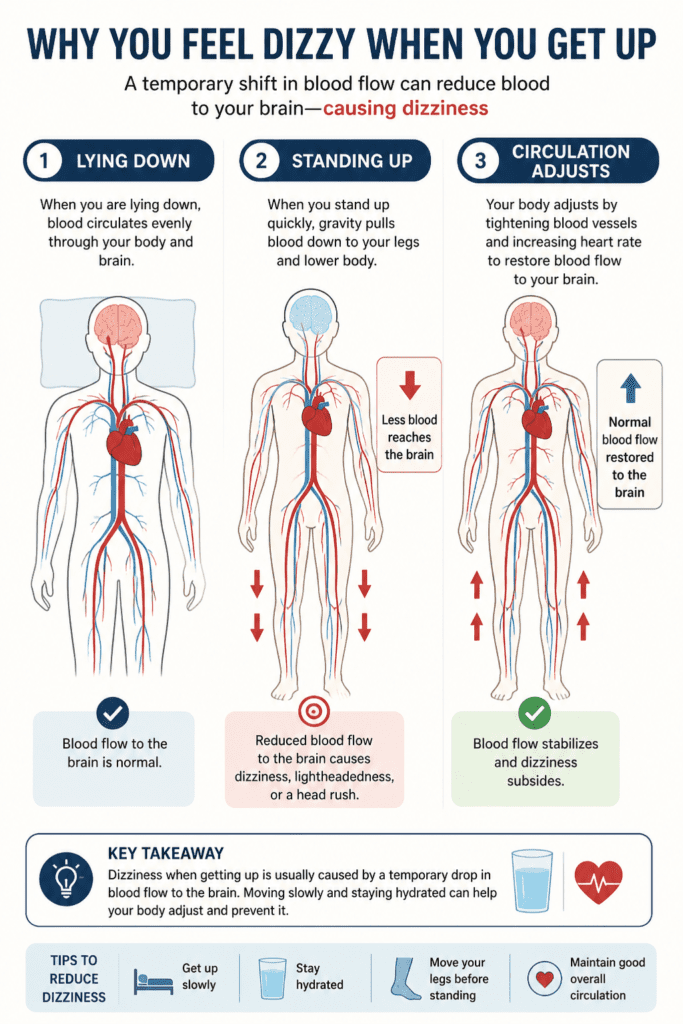
This is one reason many people feel dizzy when they get up after lying down, even if they felt completely normal a moment earlier.
Getting up is not one simple movement. Your body has to switch from a resting pattern to an upright pattern.
When you are lying down, gravity is not pulling blood strongly toward your legs. Blood flow is easier to maintain across your body. Your heart does not have to work as hard to send blood upward because your body is mostly horizontal.
Then you sit up or stand.
Suddenly, blood has to move differently. Gravity becomes a stronger factor. Your legs and lower body receive more of the downward blood shift. Your heart has to keep enough blood moving toward your brain. Your blood vessels have to tighten at the right time.
If your body adjusts smoothly, you barely notice the change.
If the adjustment is slightly delayed, you may feel dizzy, faint, woozy, or off balance.
To understand why the dizzy feeling shows up right when you get up, it helps to look at what changes during the first few seconds of movement:
| Moment | What Your Body Is Doing | Why Dizziness Can Show Up |
|---|---|---|
| Lying down or resting | Blood flow is easier to maintain because your body is horizontal | Your body is not working as hard against gravity |
| Sitting up | Blood begins shifting toward the lower body | Your circulation starts adjusting to the new position |
| First few seconds upright | Blood vessels and heart rate begin responding | The response may lag briefly |
| First steps | Leg muscles begin helping blood move upward | You may feel unsteady until circulation catches up |
| After your body stabilizes | Blood pressure and brain blood flow rebalance | The lightheaded feeling usually fades |
This is why the first few seconds matter so much. The dizziness often comes from the transition itself, not from the entire morning or the entire day.
The Hidden Reason Morning Dizziness Feels Different From Random Dizziness
Morning dizziness often feels different because it happens during the first major transition of the day.

You have been lying down for hours. Your muscles have been quiet. You may not have had fluids since the night before. Your blood pressure may be naturally lower. Your nervous system is still moving from sleep rhythm into daytime activity.
Then you get up.
That creates a bigger shift than standing after a short break during the day.
During the day, your body is already more active. You have walked around, eaten, had water, used your muscles, and changed positions many times. In the morning, your first movement may ask your body to catch up all at once.
This is why someone may feel fine once they are moving, but lightheaded right after getting out of bed.
The dizziness may not mean the whole day will feel bad. It may simply mean your first transition was too fast for your body’s early-morning state.
Harvard Health explains that dizziness after standing can happen when blood temporarily pools in the legs and the body takes a moment to compensate.
One important detail: waking up dizzy and feeling dizzy when you get up are not always the same thing.
Waking up dizzy can mean you feel off before you even move.
Feeling dizzy when you get up usually means the symptom appears during the transition from lying or sitting to upright movement.
That difference helps narrow the explanation toward circulation, posture, and timing instead of treating every morning dizzy feeling as the same problem.
Why do I feel dizzy when I get up in the morning?
You may feel dizzy when you get up in the morning because your body is moving from hours of rest into upright movement. Overnight fluid loss, lower morning blood pressure, and inactive leg muscles can make circulation slower to stabilize during the first position change of the day.
The Real Cause Behind Feeling Dizzy When I Get Up
The real cause is usually a temporary mismatch between position change and blood flow control.
When you get up, your body must quickly manage several changes at once:
Blood shifts downward.
Blood pressure may dip briefly.
Leg muscles need to start helping circulation.
Your heart and blood vessels need to respond.
Your brain needs steady oxygen-rich blood.
If those steps do not line up perfectly, dizziness can happen.
This is why the feeling often lasts only a few seconds. Your body usually corrects the imbalance quickly. But the short delay is enough for your brain to notice.
This is different from dizziness that appears while lying still, dizziness that feels like spinning, or dizziness that lasts a long time. Those patterns may involve other systems. But dizziness right when you get up often points to a brief adjustment issue.
The Link Between Overnight Fluid Loss and Lightheadedness After Getting Up
Hydration plays a major role because blood volume depends partly on fluid balance.

Even if you do not wake up feeling thirsty, your body has gone several hours without water. You may also lose fluid overnight through breathing, sweating, a warm bedroom, alcohol, caffeine, or not drinking enough the previous day.
When fluid levels are lower, blood volume may be lower too. That means there is less fluid moving through your circulation system.
Now add a sudden position change.
Your body has to move blood upward while working with a slightly lower fluid reserve. That can make the pressure dip feel stronger.
Hydration does not explain every case, and it should not be treated like a magic fix. But it is one of the simplest everyday factors that can make the get-up moment feel harder.
If hydration seems to affect your energy, you may also find these simple daily hydration habits for energy helpful.
Common reasons you may feel dizzy when you get up include:
- Getting up too quickly after lying down
- Mild overnight dehydration
- Lower morning blood pressure
- Inactive leg muscles after sleep
- Long sitting before standing
- Skipping meals or low morning energy
- Heat, sweating, or poor sleep quality
- A delayed circulation response
The same get-up movement can feel very different depending on what your body is dealing with that morning. These small factors often stack together:
| Morning Factor | How It Affects the Get-Up Moment | What the Reader May Notice |
|---|---|---|
| Low overnight fluids | Less fluid can make pressure changes feel stronger | A sharper head rush after sitting up |
| Warm bedroom or sweating | Heat can affect fluid balance and pressure stability | Wooziness before fully standing |
| Poor sleep | The body may feel slower to shift into daytime activity | Groggy, weak, or foggy first steps |
| Skipped breakfast | Low morning energy can make the transition feel harder | Shaky or drained feeling |
| Long time lying still | Leg muscles have not helped circulation for hours | Heavy legs or unstable movement |
| Standing before pausing | The body has less time to rebalance | Sudden lightheadedness |
This is why the answer is rarely one single habit. The goal is to reduce the stack: slow the first movement, support hydration, and give your body a short moment before walking.
Want to make your mornings feel steadier?
If getting up leaves you lightheaded, your morning routine may also be affected by hydration and recovery patterns. Start with these guides on simple daily hydration habits for energy and why you feel tired after waking up.
How Resting Muscles Make Your First Steps Feel Unsteady After Sleep
Your leg muscles are not just for walking. They also help circulation.

When your calves contract, they help push blood back toward your heart. This is sometimes called the muscle pump effect. It matters because blood in the legs has to move upward against gravity.
After sleep or long sitting, your muscles have been quiet. They have not been actively helping blood move upward. Then, when you get up, your circulation system has to restart while your body is already changing position.
That is why your first few steps may feel strange.
You are not only standing. You are asking your muscles, blood vessels, heart, and balance system to coordinate immediately.
If your legs are stiff, cold, inactive, or weak from sitting, the first movement may feel less stable. You might feel like you need to pause before walking.
This is also why small movements before standing can help. Moving your ankles, flexing your calves, or sitting upright for a moment gives your body a head start.
What Most People Miss About Getting Up Too Quickly
Most people focus only on speed: “I got up too fast.”
That is true, but incomplete.
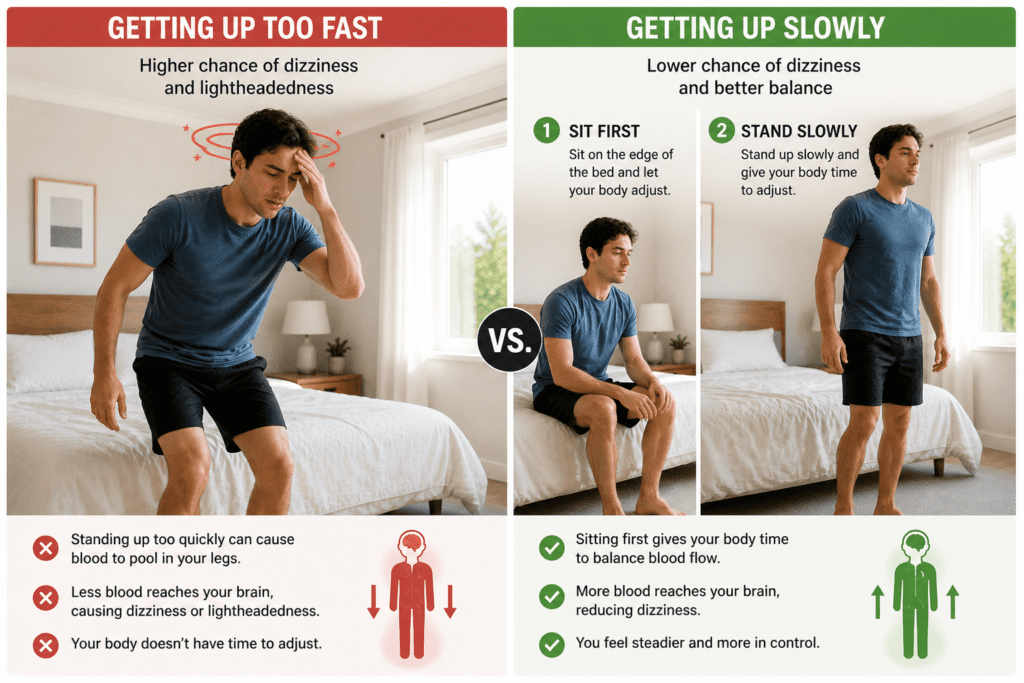
What matters is not just how fast you moved. It is how ready your body was before you moved.
The same movement can feel different depending on your internal state.
Dizziness when you get up is often a timing problem plus a readiness problem. Your body can adjust, but it may not be prepared to adjust instantly.
This is why the best solution is not always “never stand quickly.” A better goal is to make the transition less abrupt and make your body more ready before the transition happens.
The Science Behind Why Blood Pressure Dips After Resting
Blood pressure is not a fixed number. It changes throughout the day based on posture, hydration, stress, meals, temperature, movement, sleep, and nervous system activity.
When you are resting, your body does not need the same pressure response as when you are standing and moving. Once you get up, your body must increase support for upright blood flow.
Your blood vessels may tighten. Your heart rate may rise slightly. Your nervous system sends signals to keep blood moving where it needs to go.
If that response is delayed, pressure may dip for a moment.
That dip can reduce blood flow to the brain briefly. The brain is sensitive to even small changes in oxygen delivery, so the feeling may appear fast.
This is why dizziness can feel dramatic even when it fades quickly.
The body usually corrects the dip by increasing heart output, tightening blood vessels, and using muscle movement to return blood upward. But during the few seconds before that correction feels complete, you may feel lightheaded.
The Mayo Clinic describes orthostatic hypotension as a form of low blood pressure that can happen when standing after sitting or lying down.
The Impact Of Sleep, Stress, and Low Energy on Morning Dizziness
Your morning state matters.
Poor sleep can make your body feel slower to respond. Stress can keep your nervous system tense but not necessarily efficient. Low energy from skipped meals or poor hydration can make the transition feel more unstable.
This is why morning dizziness often appears with other sensations:
Heavy legs
Shaky feelings
Brain fog
Weakness
Unsteady first steps
A drained feeling before breakfast
These feelings do not always come from one cause. Often, they are stacked.
For example, imagine sleeping poorly, waking up in a warm room, drinking no water, checking your phone in bed, then jumping up because you are late. That is a strong setup for lightheadedness.
Your circulation system, nervous system, and energy system are all being pushed at the same time.
This does not mean every morning dizzy spell is serious. It means the first few minutes after waking are a sensitive transition window.
If mornings often start with low energy, this guide on why you feel tired after waking up can help explain the recovery side of the pattern.
If the feeling comes with shakiness or sudden weakness, this article on why you suddenly feel weak and tired may give useful context.
What Happens When Getting Up From Bed Feels Worse Than From A Chair
Getting up from bed can feel worse than getting up from a chair because the shift is bigger.
When you are lying flat, your whole body is horizontal. When you stand, blood distribution changes more dramatically. Your body must move from sleep posture to upright posture, sometimes within a few seconds.
A chair is different. You are already upright. Your body has already been working against gravity to some degree. Standing from a chair still creates a shift, but it may be smaller than going from lying flat to fully standing.
This is why the worst moment may be:
Lying down.
Sitting up.
Standing.
Walking.
That sequence demands a lot of coordination.
If you skip the middle step and stand too fast, dizziness is more likely. Sitting on the edge of the bed for a short moment can reduce the suddenness of the shift.
This is also why people may feel dizzy after a nap, not only after a full night of sleep. The body was still, horizontal, and relaxed. Then it had to restart quickly.
The Hidden Reason Getting Up After Sitting Still Can Also Trigger It
This problem does not only happen in bed. It can happen after long sitting too.
Long sitting creates a milder version of the same rest-to-movement issue. Your legs have been inactive. Your posture may have compressed your hips. Your breathing may have become shallow. Your circulation has been steady but not challenged.
Then you stand.
If you immediately start walking, the body has to stabilize pressure and movement at the same time.
The longer your body has been quiet, the more noticeable the first movement may feel.
Long sitting can also overlap with why sitting too long makes you tired, especially when movement and circulation have been quiet for hours.
How to Tell Whether It Is Getting-Up Dizziness or Vertigo
People often use the word “dizzy” for different sensations.
Getting-up dizziness usually feels like lightheadedness, a head rush, brief wooziness, faintness, vision fading for a moment, or feeling unsteady without spinning.
Vertigo often feels different. It may feel like the room is spinning, tilting, or moving even when you are still. It may be triggered by head position, rolling over in bed, or turning your head.
This distinction matters because the mechanism can be different.
If the feeling happens right as you get up and fades quickly, it often fits a circulation adjustment pattern. If the room spins, nausea is strong, or the feeling continues even when you sit still, it may involve the inner ear or another balance-related issue.
This article is focused on the common rest-to-movement pattern, not every possible cause of dizziness.
MedlinePlus notes that dizziness can feel like lightheadedness, wooziness, or disorientation, while vertigo often feels like spinning.
Is dizziness when getting up the same as vertigo?
Not always. Dizziness when getting up often feels like lightheadedness, faintness, or a brief head rush. Vertigo usually feels more like the room is spinning or tilting, even when you are still. The difference matters because the causes may not be the same.
The Real Cause-Effect Chain Behind Morning Lightheadedness After Getting Up
Here is the simple sequence:
What happens when you feel dizzy after getting up:
- Your body rests for hours
- Your muscles stay mostly inactive
- Fluid intake pauses overnight
- Blood pressure may be lower
- You sit up or stand quickly
- Blood shifts downward
- Brain blood flow dips briefly
- Your body corrects the imbalance
- The dizzy feeling fades
This chain is useful because it shows why the dizziness can feel sudden but short. The cause is not always one single problem. It is often a sequence of small changes happening at the same time.
That is also why small changes can help. You do not need to overhaul your entire morning. You may only need to slow the first transition, hydrate earlier, and wake up your legs before standing.
How to Get Up Without Triggering That Dizzy Feeling
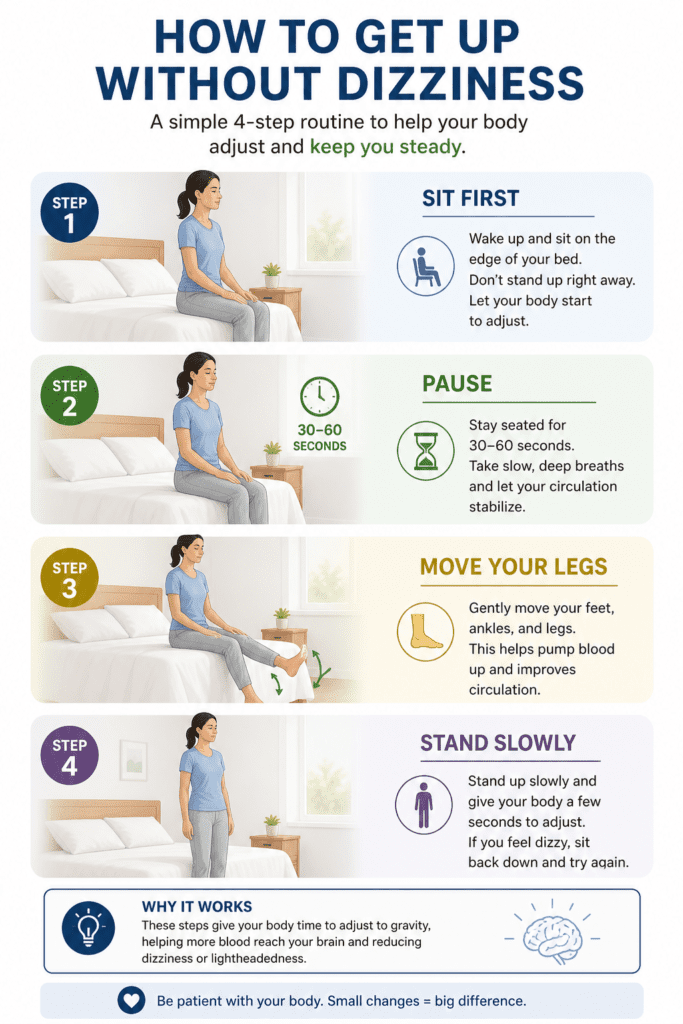
A simple get-up routine can reduce the sudden transition.
The goal is not to avoid getting up. The goal is to make the first transition less sudden.
When you slow the shift from lying down to sitting, then from sitting to standing, you give your circulation, leg muscles, and nervous system time to catch up before you start walking.
Try this:
- Open your eyes and pause for a few seconds
- Roll to your side
- Sit up slowly
- Place both feet on the floor
- Move your ankles or squeeze your calves
- Wait until your head feels steady
- Stand slowly
- Hold the bed, wall, or chair if needed
- Start walking only after the light feeling passes
This routine works because it gives your circulation system time to catch up before your body is fully upright and moving.
It also gives your leg muscles a chance to help pump blood upward.
The key is not moving like you are fragile. The key is moving in the order your body handles best.
What Most People Miss About Fixing Dizziness When You Get Up
The counterintuitive part is that the answer is not always more energy.
Many people try to push through the feeling. They stand faster, walk faster, or tell themselves to ignore it.
But dizziness during getting up is often not a motivation problem. It is a transition problem.
Pushing harder can make the transition feel worse because your body has even less time to stabilize.
A calmer start may actually be the stronger move.
Sitting up first, moving your legs, drinking water, and standing after a short pause can make your body feel more reliable. You are not giving in to the dizziness. You are removing the conditions that make it easier to trigger.
You are giving your heart, blood vessels, muscles, and brain a cleaner handoff from rest to movement.
If stress makes the sensation feel stronger, this guide on whether anxiety can make you tired explains how background tension can affect how your body feels.
What Happens When You Ignore Repeated Getting-Up Dizziness Over Time
Occasional brief lightheadedness may not disrupt much. But if it keeps happening, it can change your behavior.
You may start avoiding quick movement. You may feel nervous getting out of bed. You may rush less confidently in the morning. You may worry about falling, especially in the bathroom, on stairs, or when getting out of a car.

That is where consequence escalation matters.
The dizziness itself may be brief, but the risk can grow if it leads to poor balance, falls, panic, or repeated fear around normal movement.
It can also be a clue that something in your routine needs attention, such as hydration, medication timing, sleep quality, meal timing, heat exposure, or long inactivity.
This is also why tracking the pattern matters more than reacting to one isolated moment. Notice whether it happens mostly after sleep, after naps, after long sitting, in warm rooms, after poor hydration, or when you skip breakfast. Patterns help you understand which part of the transition may be making the feeling stronger.
If it happens often, lasts longer, causes fainting, or appears with chest pain, shortness of breath, severe weakness, or new neurological symptoms, it deserves professional evaluation.
For a deeper explanation of the shaky, drained feeling, read why blood sugar crash symptoms happen.
How long should dizziness after getting up last?
Dizziness after getting up usually lasts only a few seconds as your body stabilizes blood flow and pressure. If it lasts longer, happens often, causes fainting, or comes with chest pain, shortness of breath, severe weakness, or new vision changes, it should be checked by a healthcare professional.
What Happens When You Track the Pattern Instead of Guessing the Cause
The fastest way to understand getting-up dizziness is to notice the pattern around it. A single dizzy moment can feel random, but repeated timing often gives you a better clue.
Ask yourself when it happens most:
Does it happen only after getting out of bed?
Does it happen after naps?
Does it happen after long sitting?
Does it happen more in hot rooms?
Does it happen when you skipped water or breakfast?
Does it fade within seconds or stay longer?
This matters because the pattern tells you whether the trigger is mostly posture, hydration, inactivity, low morning energy, or something that needs more attention. Instead of guessing from one episode, you are looking at the conditions around the symptom.

Why Feeling Dizzy When You Get Up Comes Down to Transition
If “I feel dizzy when I get up” describes your morning or post-rest experience, the main idea is simple: your body may be moving from rest mode to upright movement faster than circulation can fully stabilize.
After sleep, a nap, or long sitting, your blood pressure, hydration, leg muscles, and nervous system all need a moment to shift into daytime movement. When that transition happens too quickly, your brain may briefly receive less oxygen-rich blood, creating that lightheaded feeling.
The most important thing to remember is the context.
Getting up from bed is not the same as standing after already being active. Morning movement is not the same as afternoon movement. A hydrated body is not the same as a dehydrated one.
Once you understand that, the feeling becomes less mysterious.
You are not just standing. You are asking your body to switch modes.
And when you give that switch a few extra seconds, the whole transition can feel smoother.
Frequently Asked Questions About Feeling Dizzy When Getting Up
Can dehydration make you feel dizzy when you get up?
Yes, dehydration can make dizziness more noticeable when you get up because it may lower fluid volume in the body. With less fluid available, blood pressure may dip more easily during the first position change of the day.
Why do I feel shaky when I get up?
Feeling shaky when you get up can happen when low morning energy, mild dehydration, poor sleep, or skipped meals stack together. The position change may feel stronger when your body already feels under-fueled or slow to stabilize.
Why do I feel dizzy after getting up from a nap?
Dizziness after a nap can happen because your body was resting, your muscles were inactive, and your circulation had not fully shifted into movement mode yet. Sitting up or standing too quickly can make that transition feel more noticeable.
Can getting up too fast make your vision blurry?
Yes, getting up too fast can briefly affect vision because the brain and eyes are sensitive to changes in blood flow. If circulation takes a few seconds to stabilize, your vision may blur, dim, or feel slightly delayed.
Why do I feel dizzy when I get up after sitting for a long time?
Long sitting keeps your leg muscles inactive and can make the first circulation response slower. When you get up, your body has to restart movement, stabilize pressure, and send steady blood flow upward at the same time.
Can poor sleep make getting-up dizziness worse?
Poor sleep can make your body feel slower, foggier, and less steady in the morning. If poor sleep combines with low fluids, stress, or low morning energy, the first move from bed to standing may feel harder.
Is morning dizziness always caused by low blood pressure?
Not always. Low blood pressure can be one cause, but morning dizziness may also involve dehydration, poor sleep, low energy, inactivity, inner ear issues, or medication effects. The timing and pattern can help narrow what may be contributing.
When should dizziness when getting up be checked?
Dizziness when getting up should be checked if it happens often, lasts longer than a few seconds, causes fainting or falls, or appears with chest pain, shortness of breath, severe weakness, confusion, or new vision changes.
Keep learning what your body is trying to tell you.
If feeling dizzy when you get up is only one part of your pattern, explore related guides on dizzy after standing, why sitting too long makes you tired, and why blood sugar crash symptoms happen.
This content is for informational purposes only and focuses on common everyday causes of dizziness related to getting up, posture, hydration, sleep, and circulation. It is not intended as medical advice or a diagnosis. If symptoms are frequent, severe, worsening, or linked with fainting, chest pain, shortness of breath, severe weakness, confusion, or new vision changes, seek professional medical evaluation.
