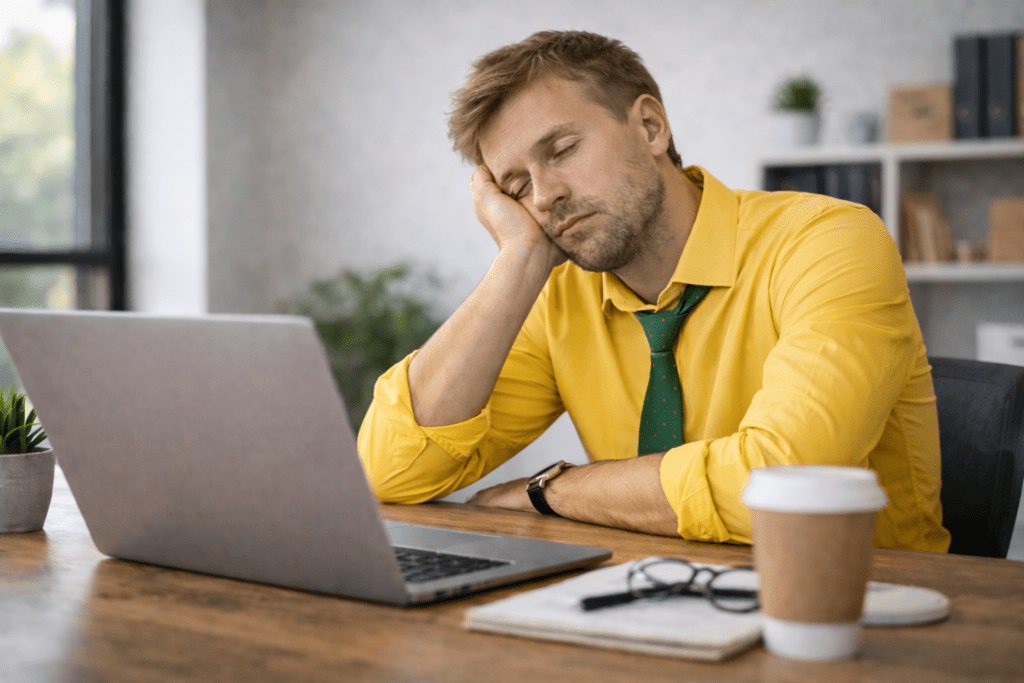
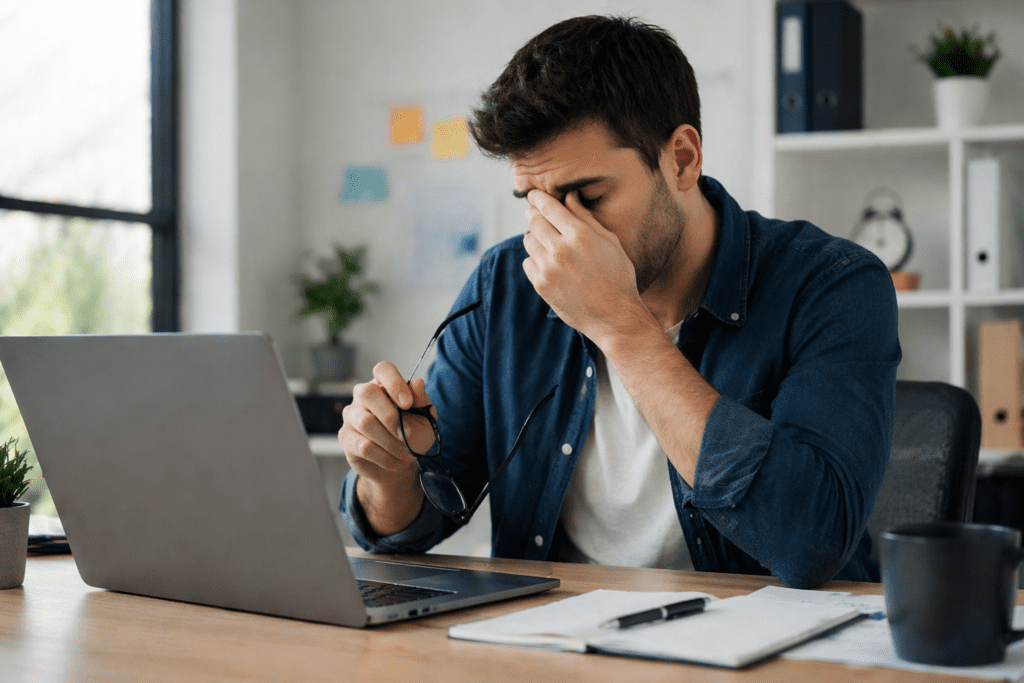
It’s mid-afternoon. You’re sitting at your desk, maybe checking emails or scrolling your phone.
But something feels off.
Your eyes feel… heavy.
Not painful. Not blurry. Just heavier than usual — like it takes more effort to keep them open. You blink, rub them, maybe stretch a little, but the feeling doesn’t fully go away.
If you’ve ever wondered why do my eyes feel heavy, the answer isn’t as simple as “you’re tired.”
Heavy eyes are not just about your eyes. They’re a signal coming from your brain, your muscles, and your energy system at the same time.
Heavy eyes refer to a sensation where your eyelids feel harder to keep open, often without true sleepiness. This feeling usually develops when visual focus, brain energy, and eyelid muscle effort build up over time, causing your eyes to feel weighted, slower, and less responsive during the day.
Heavy eyes are usually caused by a combination of visual strain, reduced blinking, brain fatigue, and natural energy dips. They often appear during long focus periods, screen use, or low-energy states, even when you’re not actually sleepy.
What Happens When Your Eyes Feel Heavy And Why It Feels Different From Tired Or Sleepy Eyes
When people say their eyes feel “heavy,” they’re describing a very specific sensation.
It’s not exactly dryness.
It’s not just fatigue.
And it’s not always sleepiness.
Instead, it’s a combination of:
- Increased effort to keep your eyelids open
- A subtle pressure or weight around the eyes
- A reduced desire to maintain visual focus
This happens because your body is shifting out of a high-focus state and moving toward a lower-energy state.
Your eyes are simply where you notice it first.
Unlike general tiredness, which affects your whole body, eye heaviness is a localized signal that your visual system and brain are starting to disengage.
If you’ve experienced eye fatigue from screens before, you’ll notice overlap, but heaviness is a broader signal than what’s explained in why your eyes feel tired after looking at screens.
The Science Behind Why Your Brain Signals Eye Heaviness Before You Actually Feel Sleepy
Your brain tracks how long you’ve been awake and how much energy you’ve used.
As the day goes on, your brain builds what’s called “sleep pressure.”
This doesn’t instantly make you sleepy. Instead, it slowly reduces your ability to maintain effort.
One of the earliest places you feel that shift is your eyes.
This is why you might notice:
- Heavy eyes during long meetings
- Heavy eyes after deep focus
- Heavy eyes even after a good night’s sleep
This effect becomes stronger during natural energy dips, especially in the afternoon, similar to what’s explained in why you feel so tired in the afternoon.
The Real Cause Of Attention Fatigue And How It Makes Your Eyes Feel Heavy
Sustained attention requires continuous effort from your brain.

When you stay focused on one task for too long, your attention system becomes less efficient over time.
This doesn’t always feel like obvious distraction — instead, it feels like a growing resistance to staying engaged.
Your brain starts to pull back from maintaining the same level of focus.
Because your eyes are directly involved in attention, they begin to reflect that shift. The result is a heavy, slowed-down sensation that signals your attention system is starting to fatigue.
Why Do My Eyes Feel Heavy But I’m Not Sleepy?
Many people feel confused by this.
You’re awake. You’re functioning. But your eyes feel heavy.
This happens because heaviness is an early fatigue signal, not a final one.
Your brain is starting to reduce effort before full sleepiness kicks in.
So even if you don’t feel like sleeping, your body is already shifting into a lower-energy state.
Your eyelids respond to that shift first.
The Hidden Reason Your Eyelid Muscles Start Feeling Heavier During Long Focus Periods
Your eyelids are controlled by small muscles that rarely get full rest.
During long periods of focus — reading, working, scrolling — these muscles stay active.
Over time:
- They lose efficiency
- Micro-fatigue builds up
- Keeping your eyes open requires more effort
This doesn’t feel like “muscle pain.”
It feels like resistance.
Like your eyes just don’t want to stay open as easily.
This is similar to subtle fatigue patterns seen in mental overload, like those explained in why you feel tired after thinking too much.
Why Keeping Your Eyes Open Is Normally Automatic — Until It Suddenly Feels Effortful
Most of the time, keeping your eyes open is automatic. You don’t think about it, and it doesn’t require noticeable effort.
But as fatigue builds, that automatic control begins to shift.
Your brain can no longer maintain the same effortless level of activity, so something that used to feel easy now feels slightly forced. This transition is subtle but important.
The moment you become aware of your eyelids, your system has already moved into a lower-effort state, and heaviness becomes the way your body signals that change.
The Hidden Reason Reduced Blinking Makes Your Eyes Feel Heavier Over Time
Blinking keeps your eyes stable and comfortable.

But when you focus:
- You blink less
- Your eyes dry slightly
- Visual stability drops
Research shows that reduced blinking during focused tasks contributes to eye fatigue and discomfort (NIH).
Even mild dryness increases effort.
And your brain translates that effort into heaviness.
The Impact Of Light Exposure And Screen Brightness On Eye Heaviness
Light exposure plays a bigger role in eye heaviness than most people realize.
When you’re exposed to bright screens or harsh lighting for long periods, your eyes are forced to constantly adjust to maintain clarity.
High contrast, glare, and blue light can increase visual processing demand, even if you don’t consciously notice it.
Over time, this continuous adjustment adds to the overall load on your visual system.
On the other hand, very dim environments can also strain your eyes by forcing them to work harder to detect detail.
In both cases, your eyes are doing extra work, and that effort often shows up as a heavy, slowed-down feeling rather than sharp discomfort.
The Hidden Role Of Visual Processing Overload In Making Your Eyes Feel Heavy
Even when your eyes seem fine on the surface, your brain may be doing more work than you realize.
This constant visual input creates a hidden workload that builds over time.
Unlike sharp eye pain, this type of overload doesn’t feel intense — it feels slow and resistant.
As this hidden workload builds, visual processing becomes less efficient, and your eyes begin to feel heavier and slower to respond.
Why Switching Focus Between Near And Far Objects Can Make Your Eyes Feel Heavier
Your eyes are constantly adjusting focus depending on what you’re looking at.
When you shift between near objects like your phone and far objects like a screen across the room, small muscles inside your eyes have to repeatedly adjust to maintain clarity.
Over time, this constant switching creates a subtle form of fatigue that doesn’t feel sharp or painful.
Instead, it builds gradually as resistance. Your visual system becomes less responsive, and your eyes begin to feel heavier as maintaining focus requires more effort than it did earlier.
How Sensory Overload Gradually Translates Into That Heavy Eye Feeling
Your brain is constantly filtering information from multiple sources.
When too many inputs stack together, your system enters a state of sensory overload.
Instead, it creates a subtle slowdown in how your brain handles incoming information.
To manage this load, your system begins reducing effort where it can.
Because your eyes are directly tied to attention and perception, they often reflect this shift first, creating a heavy, less responsive sensation.
What Happens When Your Nervous System Stays In Focus Mode Too Long Without Recovery
Your body cannot stay in “focus mode” forever.
Eventually:
- Mental energy drops
- Attention weakens
- Resistance to effort increases
Your body starts signaling:
“Slow down.”
One of the earliest signals is heavy eyes.
This often happens alongside mental fatigue, like in mentally drained but restless in the afternoon.
The Hidden Link Between Decision Fatigue And Why Your Eyes Start Feeling Heavy
Your brain doesn’t just get tired from visual input — it also gets fatigued from making decisions.
Every small choice you make throughout the day, from responding to messages to switching between tasks, adds to your cognitive load.
Over time, this decision fatigue reduces your brain’s ability to maintain sharp focus.
Instead of feeling mentally “tired” in an obvious way, your system begins to lower effort subtly.
One of the first places this shows up is in your eyes, which start to feel heavier as your focus becomes less stable and sustained effort becomes harder to maintain and avoid further strain.
Why Doing Nothing Can Still Make Your Eyes Feel Heavy And Sluggish
This usually happens when your brain lacks stimulation rather than being overworked.
When you sit idle for long periods — scrolling passively, watching content, or doing repetitive low-effort tasks — your brain’s engagement level drops.
As mental activation drops, alertness fades, your body becomes more sluggish, and your eyes begin to feel heavier without any obvious strain.
In this case, heaviness isn’t caused by strain, but by under-stimulation and reduced alertness.
The Link Between Afternoon Energy Drops And Why Your Eyes Feel Heavy During The Day
Heavy eyes often appear during predictable energy dips.
The most common:
- Early afternoon
- Late evening
During these times:
- Alertness drops
- Reaction speed slows
- Eye control weakens slightly
If combined with:
- Screen use
- Sitting too long
- Low movement
The heaviness becomes more noticeable.
Why Do My Eyes Feel Heavy In The Afternoon?
In the afternoon, your body naturally reduces alertness.

If you’ve been focusing for hours, your system is already under load.
So when the dip hits:
- Your brain slows down
- Your muscles lose responsiveness
- Your eyes feel heavier
This is a normal biological pattern, not a problem.
What Most People Miss About Why Their Eyes Feel Heavy During The Day
Most people think it’s just lack of sleep.
But it’s usually a combination of small factors:
- Continuous focus
- Mild dehydration
- Reduced blinking
- Mental fatigue
- Environmental stress
Hydration, for example, plays a bigger role than expected, which is why habits like those in simple daily hydration habits for energy can help.
The main reasons your eyes feel heavy include:
- Prolonged visual focus
- Reduced blinking
- Brain fatigue
- Natural energy dips
- Eyelid muscle fatigue
- Environmental conditions
Most people try to “fix” heavy eyes directly by rubbing them or taking short breaks, but they often miss the bigger picture.
The sensation itself is not the problem — it’s a signal. Your system is telling you that the combined load from focus, mental effort, and environment is reaching a limit.
Treating only the eyes without addressing the underlying load is why the feeling keeps coming back.
If heavy eyes tend to show up during screen use, mental overload, or afternoon energy dips, these related guides can help you understand the bigger pattern:
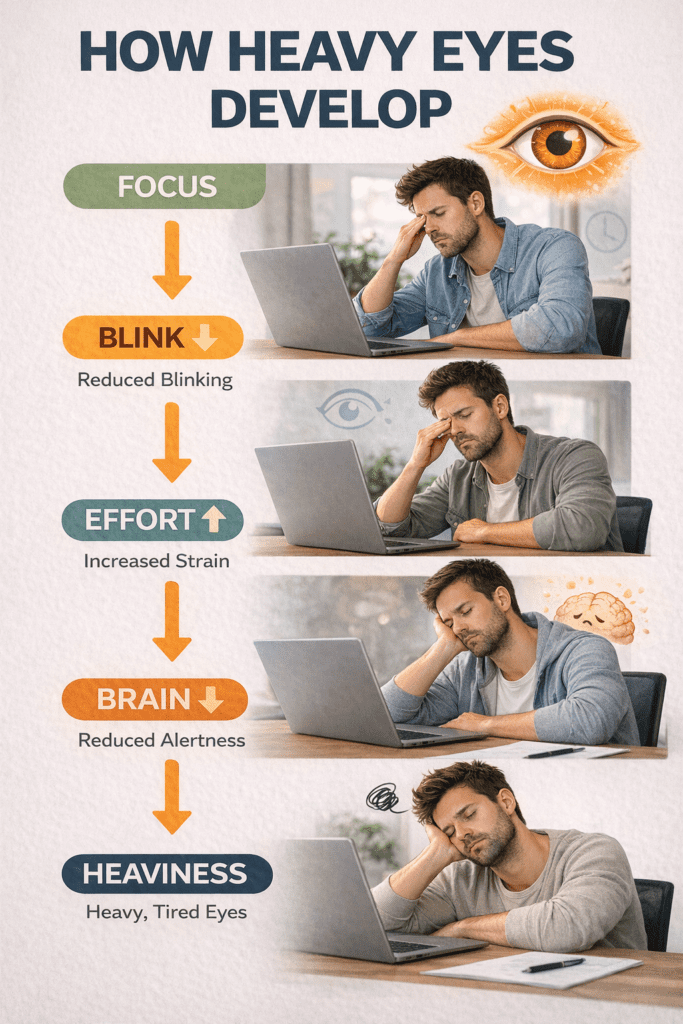
The Real Cause Effect Chain Behind That Heavy Eye Sensation

How the heavy eye sensation develops step by step:
- Continuous focus keeps eye muscles active
- Blinking decreases
- Visual effort increases
- Brain energy drops
- Nervous system shifts
- Eyelids require more effort
- Heaviness appears
This aligns with clinical explanations of eye fatigue from Mayo Clinic and Cleveland Clinic.
What Happens When Your Eyes Don’t Get Micro-Recovery Breaks During The Day
Your visual system is designed to recover in small moments throughout the day.
Every time you shift your gaze, blink fully, or briefly look away, your eyes reset slightly.
But when you stay locked into one task for long periods, those recovery moments disappear. Instead of resetting, fatigue builds continuously in the background.
This creates a stacking effect where even mild strain becomes noticeable over time. Eventually, your system reduces effort to compensate, and the first signal you feel is heaviness rather than sharp discomfort.
Why Your Eyes Can Feel Heavy Even When You Slept Well
Sleep restores your body, but it does not eliminate every form of fatigue that develops during the day.
Your eyes can still feel heavy even after good sleep if your current routine puts immediate demand on your focus system.
Long periods of concentration, screen exposure, repetitive mental work, and reduced movement can all create real-time fatigue that builds independently of how long you slept.
This is why some people wake up feeling rested but still notice heavy eyes by late morning or early afternoon.
Good sleep helps, but it does not cancel out the effects of sustained visual and cognitive effort.
Even when sleep is not the issue, the feeling of heavy eyes often comes from how multiple small factors interact rather than a single cause. Here’s how different types of load combine to create that sensation:
| Type of Load | What It Affects | Hidden Effect Over Time | Resulting Sensation |
|---|---|---|---|
| Visual Load | Eye focus and tracking | Gradual processing slowdown | Heaviness and delayed response |
| Cognitive Load | Attention and decision-making | Reduced mental efficiency | Lower engagement and eye fatigue |
| Environmental Load | Light, air, and surroundings | Increased background strain | Subtle pressure and discomfort |
| Physical Inactivity | Circulation and alertness | System-wide slowdown | Sluggishness and heavy eyelids |
| Sensory Overload | Brain input processing | Filtering fatigue | Reduced responsiveness in eyes |
This layered effect explains why heavy eyes don’t usually come from one obvious trigger. Instead, they emerge when different types of strain quietly build up together throughout the day.
Why Do Your Eyes Feel Heavy When You Wake Up Even After Sleeping?
Waking up with heavy eyes can feel confusing, especially if you slept long enough.
In many cases, this happens because your eyes haven’t fully rebalanced yet after hours of inactivity.
During sleep, tear distribution slows, and your eyes remain closed for extended periods, which can leave the surface slightly dry or uneven upon waking.
At the same time, your brain doesn’t instantly switch into full alert mode.
There’s a transition phase where your nervous system is still “booting up,” and during that window, your eyelids can feel heavier and slower to respond.
This is why your eyes may feel heavy in the morning even when your overall sleep was adequate.
Heavy Eyes vs Blurry Eyes vs Tired Eyes — The Critical Difference
This is something most articles don’t explain.
- Heavy eyes → resistance and weight
- Tired eyes → fatigue and discomfort
- Blurry eyes → focus instability
Heavy eyes often feel like resistance.
Blurry eyes feel unstable and inconsistent.
Tired eyes feel irritated or overworked.
In many cases, these sensations overlap, but the dominant feeling usually points to the primary cause. Recognizing that difference helps you understand whether the issue is coming from visual strain, brain fatigue, or surface discomfort.
To make the differences clearer, here’s a simple breakdown of how heavy eyes compare to other common eye sensations:
| Sensation Type | What It Feels Like | Main Cause | Key Signal |
|---|---|---|---|
| Heavy Eyes | Resistance, weight, slow response | Brain fatigue + reduced alertness | Harder to keep eyes open |
| Tired Eyes | Irritation, dryness, discomfort | Overuse and visual strain | Burning or soreness |
| Blurry Eyes | Unclear or unstable vision | Focus instability or eye coordination issues | Difficulty seeing clearly |
Understanding these differences helps you identify what your eyes are actually signaling, which is key to recognizing whether the issue comes from focus overload, physical strain, or visual instability.
Environmental Triggers That Quietly Make Your Eyes Feel Heavier
Sometimes the problem isn’t your eyes or brain directly. It’s the environment around you.

Dry air, harsh overhead lighting, screen glare, and constant airflow from fans or air conditioning can all increase visual effort in subtle ways.
Your eyes have to work harder to stay comfortable and maintain stable focus when the surrounding conditions are off.
This extra effort may not feel dramatic in the moment, but it builds gradually over time.
That is why heavy eyes often show up more quickly in offices, cars, or dry indoor spaces where your visual system is under quiet but constant stress.
The Link Between Body Posture, Neck Tension, And Heavy Eye Sensation
Your eyes don’t work in isolation. They’re closely connected to your neck, shoulders, and upper body.

When you spend long periods sitting with poor posture — especially looking slightly downward at a screen — tension builds in these areas.
This tension can subtly affect circulation and increase overall fatigue signals in your system.
As your body becomes more strained, your brain starts reducing effort in other areas to balance that load.
One of the first places this shift becomes noticeable is in your eyes, which begin to feel heavier and less responsive.
Why Sitting Still For Too Long Can Make Your Eyes Feel Heavier Without You Noticing
Movement plays a quiet but important role in keeping your system alert.

When you stay physically still for long periods, your circulation slows slightly, and your overall activation level drops.
This doesn’t just affect your muscles — it affects your brain as well.
Lower physical movement reduces stimulation, making your system drift toward a lower-energy state.
As that happens, your eyes begin to feel heavier, not because they’re strained, but because your entire system is becoming less engaged and less responsive.
The Overlooked Role Of Breathing Patterns And Oxygen Levels In Eye Heaviness
Breathing patterns can influence how alert or fatigued your system feels.
When you’re deeply focused or sitting for long periods, your breathing often becomes shallow without you noticing.
This reduces oxygen flow slightly and can lower overall alertness.
As alertness drops, your body reduces effort, and your eyes begin to feel heavier. This connection is subtle, but it becomes more noticeable during long periods of stillness or concentration.
Why Your Eyes Feel Heavy After Crying And Emotional Release
After crying, many people notice their eyes feel unusually heavy and tired.
This isn’t just emotional exhaustion — it’s also physical. Crying activates facial muscles, increases blood flow around the eyes, and can temporarily disrupt tear balance.
The swelling and fluid buildup around the eyelids can create a real sense of weight, making your eyes feel harder to keep open.
At the same time, emotional release often lowers your body’s alertness, shifting you out of a high-energy state.
The combination of muscle fatigue, fluid changes, and nervous system slowdown creates that distinct heavy-eye feeling after crying.
Real-Life Scenarios Where Heavy Eyes Appear The Most
You’re most likely to feel this when:
- Working long hours at a computer
- Driving for extended periods
- Scrolling late at night
- Sitting without movement
- Doing repetitive mental tasks
These situations combine multiple fatigue triggers.
During long drives, your eyes remain open, but the effort behind that action increases slowly, making them feel heavier even without discomfort.
Over time, these patterns become predictable. Your brain starts linking certain activities with fatigue, which is why your eyes may begin to feel heavy faster in the same situations day after day.
Why Your Eyes Feel Heavy Even Without Screens, Stress, Or Lack Of Sleep
Sometimes, heavy eyes appear even when none of the obvious triggers are present.
You’re not using screens excessively, you’re not stressed, and you slept well — yet the feeling still shows up.
This usually points to subtle system-level fatigue rather than a single clear cause.
Small factors like reduced movement, low hydration, repetitive mental patterns, or even monotony can gradually lower your overall alertness. Your body doesn’t need a major trigger to start conserving energy.
When enough minor factors stack together, your system shifts slightly toward rest mode, and your eyes become one of the first places that shift becomes noticeable.
Why Heavy Eyes Are Often The First Warning Sign Before Full Fatigue Sets In
Heavy eyes rarely appear at the peak of fatigue — they usually show up at the beginning.
Your body doesn’t wait until you’re completely exhausted to send signals.
Instead, it starts with subtle cues that are easy to ignore.
Eye heaviness is one of the earliest indicators that your system is approaching its limit.
If you continue pushing without adjusting, that mild heaviness can develop into deeper fatigue, reduced concentration, and slower performance.
Recognizing this early signal allows you to respond before the effect spreads to the rest of your system.
Why Heavy Eyes Often Build Gradually Instead Of Hitting All At Once
Heavy eyes usually do not arrive suddenly. They tend to build in layers.
A little reduced blinking, a little visual overload, a little mental fatigue, and a little physical stillness may not feel significant on their own.
But when they continue without interruption, the effect compounds.
That is why the sensation often seems to “sneak up” on you.
By the time you notice it clearly, several smaller forms of fatigue have already been building in the background for a while.
What Does It Mean When Your Eyes Feel Heavy All The Time?
If your eyes feel heavy most of the time, it usually means the underlying load is happening repeatedly rather than occasionally.
That load may come from prolonged focus, poor recovery between tasks, low movement, screen-heavy routines, or environmental stress that never fully resets during the day.
In many cases, constant heaviness does not point to one dramatic cause, but rather a pattern of repeated strain that builds over time.
How To Reset Heavy Eyes Without Fighting The Symptom Directly
Heavy eyes don’t need to be “fixed” directly. In most cases, they respond faster when you shift the conditions that created them instead of focusing on the sensation itself.

Start by changing how your attention is being used. If you’ve been locked into one visual task, introduce variation rather than stopping completely. Looking at something dynamic, switching contexts, or briefly engaging in a different type of activity can restore responsiveness more effectively than passive rest.
Next, change your physical state. Even small adjustments like standing up, walking a short distance, or repositioning your body can increase alertness and reduce that heavy, slowed-down feeling. This works because your system reacts to movement as a signal to stay engaged.
Your environment also matters more than it seems. Subtle shifts like reducing contrast extremes, softening light intensity, or eliminating direct airflow can remove background strain that quietly builds throughout the day.
Finally, pay attention to rhythm rather than isolated breaks. Instead of waiting until heaviness becomes noticeable, short and regular shifts in focus, posture, or environment prevent the buildup from reaching that point in the first place.
The key is not to fight heaviness once it appears, but to interrupt the pattern that allows it to develop.
Why Your Eyes Feel Heavy — And What It’s Really Telling You
Heavy eyes are not random, and they’re not just a sign of being tired.
They’re a signal.
Your brain, your visual system, and your daily habits are constantly interacting, and when the load builds up — even in small ways — your eyes are often the first place that change becomes noticeable.
What makes this feeling confusing is that it doesn’t come from one single cause. It builds gradually from focus, attention, environment, and energy patterns throughout your day.
Once you start recognizing those patterns, heavy eyes stop feeling unpredictable.
Instead of wondering what’s wrong, you begin to understand what your system is telling you — and that awareness alone makes the sensation easier to manage.
If this article helped you understand why your eyes feel heavy, explore these next guides to keep connecting the pattern between focus, fatigue, and daily energy:
Frequently Asked Questions
Why do my eyes feel heavy even when I’m not using screens?
Heavy eyes can still appear without screen use because the sensation isn’t only linked to digital strain. It can come from mental fatigue, low movement, repetitive tasks, or reduced alertness. Even without screens, your brain may still be under load, which can make your eyes feel heavier over time.
Can dehydration make your eyes feel heavy during the day?
Yes, mild dehydration can affect how your body maintains energy and focus. When hydration levels drop, your system may become less efficient, which can lead to subtle fatigue signals. This can make your eyes feel heavier, especially during long periods of concentration or low activity.
Why do my eyes feel heavy after long conversations or social interaction?
Extended conversations and social interaction require mental processing, emotional regulation, and sustained attention. Over time, this can lead to cognitive fatigue, even if you don’t feel physically tired. Since your eyes are closely linked to focus and attention, they may start to feel heavy as your mental energy decreases.
Do heavy eyes mean your vision is getting worse?
Not necessarily. Heavy eyes are usually related to fatigue, focus, or environmental factors rather than a direct change in vision. However, if the sensation is constant and combined with blurred vision or discomfort, it may be worth checking your visual habits or routine.
Why do my eyes feel heavy more on some days than others?
Eye heaviness often depends on how your day is structured. Differences in sleep quality, screen time, stress levels, movement, and workload can all affect how much fatigue builds up. On days where multiple factors combine, your eyes may feel heavier earlier or more intensely.
Can low stimulation or boredom make your eyes feel heavy?
Yes, when your brain is under-stimulated, your alertness naturally drops. This can happen during repetitive or passive activities, such as scrolling or watching content for long periods. As your engagement decreases, your system shifts toward a lower-energy state, and your eyes may begin to feel heavier.
Is it normal for heavy eyes to come and go throughout the day?
Yes, this is very common. Eye heaviness often follows natural energy patterns and daily habits. It may appear during periods of prolonged focus, low movement, or energy dips, and then improve when your system resets through movement or changes in activity.
This article is based on current understanding of visual fatigue, attention systems, and everyday behavioral patterns that influence how the brain and body respond to prolonged focus and energy shifts.
The explanations focus on real-world mechanisms rather than isolated symptoms, helping connect how daily habits, environment, and mental load contribute to the sensation of heavy eyes.