
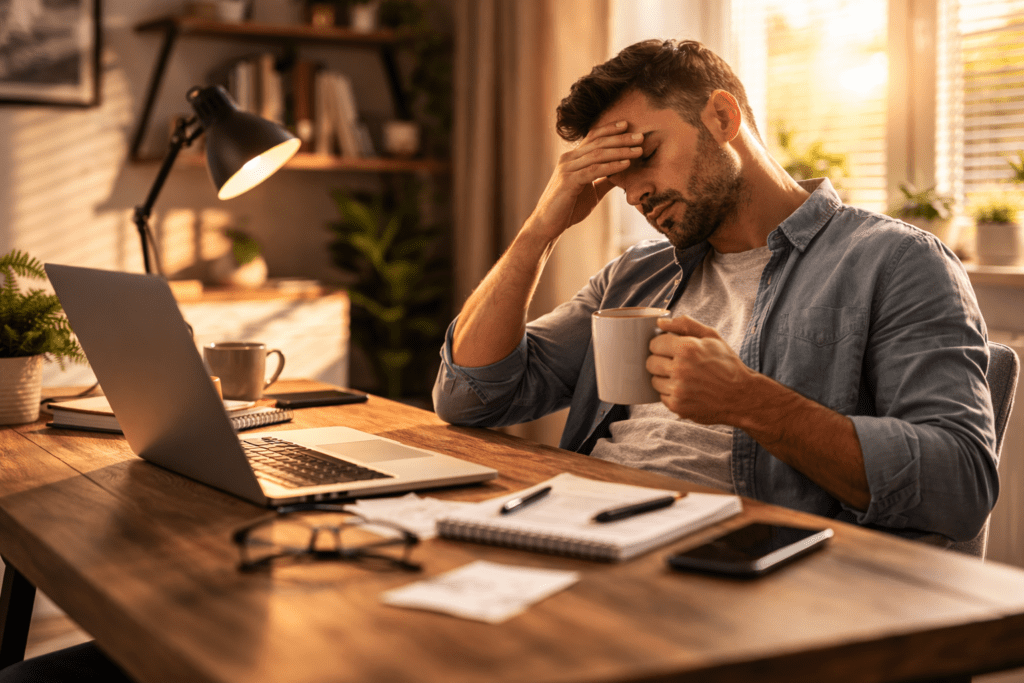
It’s 2:45 PM. You’re staring at your screen, rereading the same sentence for the third time. Your energy feels flat, your focus drifts, so you grab another cup of coffee.
For about 20 minutes, it works. You feel sharper, more alert.
But for some people, the effect can feel completely different—even immediate. In some cases, coffee can make you feel sleepy right after drinking it, which follows a slightly different mechanism explained here: Why Coffee Makes You Sleepy Immediately
Then an hour or two later, you crash. And that’s when it stops making sense.
Why does caffeine make you tired instead of awake? Because caffeine doesn’t create energy—it temporarily blocks fatigue signals in your brain. When it wears off, those signals return all at once, which can make tiredness feel stronger than before.
If you’ve experienced this, you’re not imagining it. The effect is real, and it’s driven by how caffeine interacts with your brain, your body clock, and your natural energy rhythms.
Table of Contents
If coffee has ever made you feel more tired instead of energized, you’re not alone. Keep reading—this is where most people finally understand what’s actually happening.
Why Does Caffeine Make You Tired? (Simple Answer)
Caffeine makes you feel tired because it blocks fatigue signals instead of removing them. As caffeine wears off, those signals return all at once, often creating a stronger feeling of tiredness.
This effect is amplified if your body is already in a low-energy state, such as during the afternoon circadian dip or after poor sleep.
In most cases, the issue is not caffeine itself, but when and how your body is using it.
Why You Feel Tired After Drinking Coffee Instead of Energized
Most people expect caffeine to create energy, but it only changes how your brain experiences fatigue.
The main reason caffeine makes you feel tired is how your brain reacts when stimulation fades.
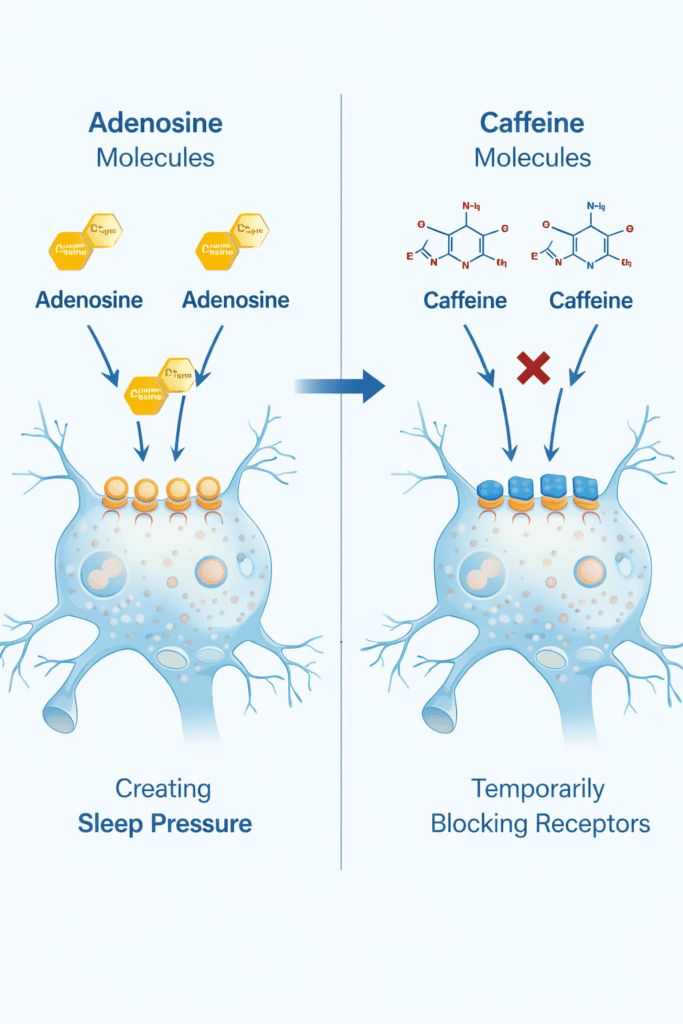
Feeling tired after drinking coffee happens because caffeine temporarily blocks adenosine, a chemical that builds sleep pressure in the brain. When caffeine wears off, accumulated adenosine reattaches quickly, creating rebound fatigue — especially if cortisol timing and circadian rhythm are already declining.
Why Does Caffeine Make Me Tired Instead of Awake in the Afternoon?
Many people notice that caffeine makes them more tired in the afternoon instead of energized. This happens because your body naturally enters a circadian dip between 1 PM and 4 PM.
This is closely related to why many people experience a strong energy drop during the day, especially if you’re already dealing with being tired in the afternoon.
During this time, cortisol levels decline and sleep pressure is already high. When you drink caffeine in this window, it temporarily blocks fatigue signals. But once it wears off, you don’t return to normal—you crash directly into your body’s natural low-energy phase.
This is why caffeine timing, not just caffeine itself, plays a major role in why you feel tired after drinking it.
The Science Behind Why You Feel Tired After Drinking Coffee Later
Caffeine blocks a chemical in your brain called adenosine. Adenosine builds up throughout the day and creates sleep pressure. The longer you’re awake, the more adenosine accumulates. By late afternoon, your levels are significantly higher than they were at 9 AM. The National Institutes of Health explains how caffeine interacts with adenosine receptors in the brain .
When you drink coffee, caffeine attaches to adenosine receptors in your brain. It doesn’t remove adenosine. It just temporarily blocks your brain from sensing it.
- Adenosine builds up during the day.
- You drink coffee.
- Caffeine blocks adenosine receptors.
- You temporarily feel alert.
- Caffeine wears off.
- All the accumulated adenosine floods back in.
- You feel more tired than before.
That “flood back” effect is called adenosine receptor rebound. It’s one of the main reasons you experience a caffeine crash a few hours later.
What Happens When Adenosine Receptors Rebound After Caffeine Wears Off
Your brain is adaptive. If you drink coffee daily, your body tries to maintain balance.

Over time, your brain creates more adenosine receptors to compensate for caffeine blocking them. This means:
- You need more coffee for the same effect.
- When caffeine wears off, more receptors are available.
- The crash feels heavier.
Here’s where it becomes counterintuitive:
The more regularly you use caffeine to fight fatigue, the more sensitive your brain becomes to fatigue signals once caffeine leaves your system.
That’s why some people feel sleepy 90 minutes after coffee.
In other cases, that sleepy feeling can happen much sooner—even within minutes—depending on your baseline state and nervous system response. You can explore that immediate effect here: Why Coffee Makes You Sleepy Immediately
If this crash happens at the same time each day, it often connects to patterns like waking up tired even after 8 hours.
If you’re also someone who feels exhausted at 3PM even after 8 hours of sleep, you may already have elevated afternoon adenosine pressure layering on top of caffeine rebound.
Why does caffeine make me sleepy instead of alert?
Caffeine can make you feel sleepy when your sleep pressure is already high. It blocks fatigue signals temporarily, but once it wears off, accumulated adenosine can overwhelm your system and make tiredness feel stronger.
The 5-Step Process That Explains Why Caffeine Makes You Tired
- Adenosine builds up throughout the day
- Caffeine blocks adenosine receptors temporarily
- Sleep pressure continues increasing in the background
- Caffeine metabolizes over several hours
- Adenosine floods receptors, causing rebound fatigue
This sequence explains why the answer to “why does caffeine make me tired” often comes down to timing rather than the caffeine itself.
The Hidden Reason Cortisol Timing Changes How Coffee Affects You
Cortisol is your natural alertness hormone. It follows a daily rhythm. The Mayo Clinic outlines how cortisol levels naturally rise and fall across the day
In most healthy adults:
- Cortisol peaks within 30 to 45 minutes of waking.
- It gradually declines throughout the day.
- It dips significantly in the early afternoon.
- It lowers further in the evening.
If you drink coffee when cortisol is already high, like immediately after waking, caffeine competes with your body’s natural alertness cycle.
If you drink coffee when cortisol is crashing, like between 2 PM and 4 PM, you may feel a short lift followed by a deeper drop.
Why?
Because caffeine stimulates your sympathetic nervous system. It artificially elevates alertness. When it wears off, cortisol continues its natural downward slope.
So instead of returning to baseline, you drop below it.
That’s why being tired after drinking coffee is especially common in the afternoon, particularly if you already struggle with why you’re so tired in the afternoon.
Can caffeine cause an energy crash later?
Yes, caffeine can cause an energy crash. When it wears off, adenosine rebounds while cortisol continues declining, which can create a sharper drop in alertness than before the coffee.
The Real Cause of Feeling Jittery and Exhausted at the Same Time
Some people don’t just feel sleepy after caffeine. They feel wired and tired.
This happens when caffeine activates your sympathetic nervous system, your fight-or-flight mode.
Heart rate increases. Blood pressure rises slightly. Dopamine temporarily increases. You feel alert.
But if your sleep pressure is already high, your brain is still carrying heavy adenosine buildup underneath that stimulation.
So you end up with:
Physical stimulation, mental fatigue, restlessness, and brain fog.
Your nervous system is in conflict.
This pattern is very similar to the experience of feeling mentally drained but restless, where your brain feels overloaded but your body can’t fully settle.
Your body is saying it needs recovery. Caffeine is saying stay alert.
That mismatch feels like anxious exhaustion and is closely related to being wired but tired at night.
Why do I feel wired but tired after coffee?
This happens when caffeine stimulates your nervous system while your body still carries high fatigue levels. Your brain receives alertness signals, but underlying sleep pressure remains high, creating a mismatch between stimulation and exhaustion.
Can caffeine have the opposite effect and make you tired?
Yes. When caffeine is used on top of existing fatigue, it may increase alertness briefly while underlying tiredness continues building, making the crash feel stronger later.
What Most People Miss About Why Caffeine Makes You Tired
Most people assume caffeine failing means their body is weak or sensitive.
In reality, caffeine is not failing. It is exposing an unstable baseline.
If your sleep pressure is already high, your circadian rhythm is misaligned, or your nervous system is overstimulated, caffeine will only mask the problem temporarily — not solve it.
When it wears off, the imbalance becomes more noticeable.
The Link Between Blood Sugar Swings and Post-Coffee Fatigue
If you drink coffee on an empty stomach, especially in the morning, caffeine can temporarily increase blood sugar by stimulating stress hormones like epinephrine.
Later, insulin responds.
That fluctuation can create mild energy instability, especially if you add flavored syrups, sweeteners, or pastries.
While blood sugar isn’t the main cause of feeling tired after drinking coffee, it can amplify the crash. You can read more about why blood sugar crash symptoms happen
This is especially true in mid-morning or late afternoon when your body is already navigating hormonal shifts.
Why do I feel tired after coffee with sugar?
If coffee is combined with sugar, blood glucose may spike and then drop. This drop can overlap with caffeine rebound, making fatigue feel stronger and more sudden.
How Circadian Rhythm Makes Caffeine Crashes Feel Stronger
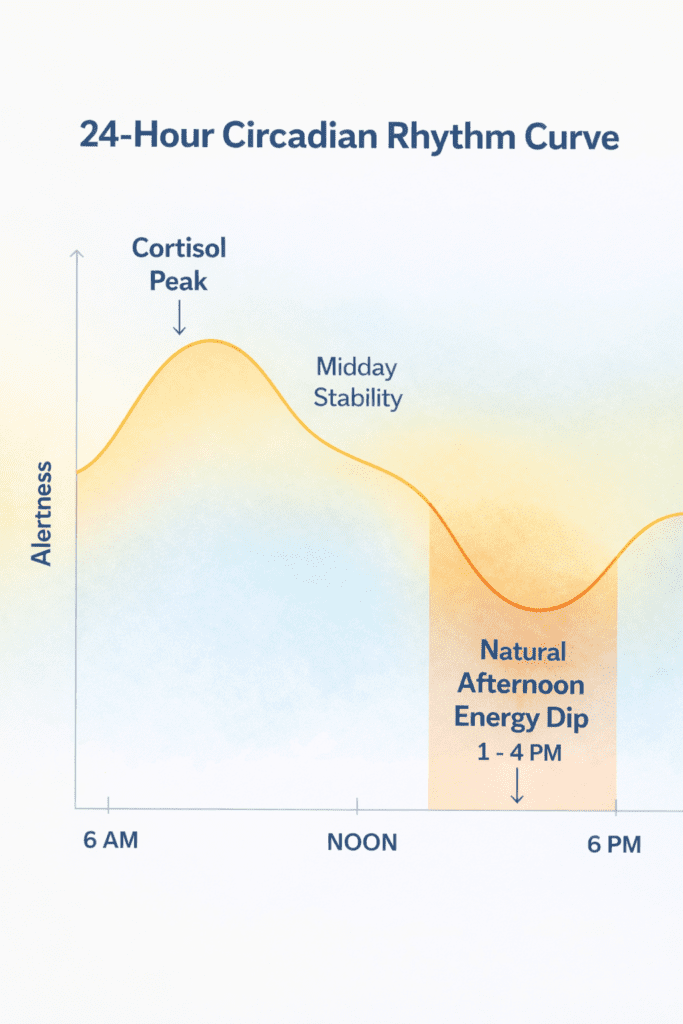
As mentioned earlier, this period represents your natural circadian low point. The National Institute of General Medical Sciences explains how circadian rhythms regulate alertness and sleep timing
Your core body temperature lowers slightly. Alertness decreases. Adenosine accumulation peaks relative to wake time.
If you add caffeine during this window, you are fighting both sleep pressure and circadian rhythm decline.
When caffeine fades, both forces remain. If you already started the day with poor sleep or high sleep pressure, that rebound can feel even heavier.
That’s why afternoon crashes feel heavier than morning crashes.
Still tired after coffee? Don’t guess—follow the pattern.
If coffee leaves you drained, the problem is often your afternoon biology—not willpower. These two quick reads will help you pinpoint what’s driving your crash and what your body is actually asking for.
- Mentally drained but restless? That “wired-exhausted” feeling has a specific nervous-system pattern.
- Consistently crashing in the afternoon? Timing, sleep pressure, and daily habits may be stacking the drop.
What Happens When Repeated Caffeine Use Escalates Energy Instability
Here’s the escalation chain most people never see:
Stage 1: Occasional use
Stage 2: Mild crash
Stage 3: Increased use
Stage 4: Stronger rebound fatigue
Stage 5: Energy instability
Over months, this can shift your baseline energy lower.
Not because coffee is bad, but because the timing and dependency pattern destabilize your rhythm.
If this pattern continues, you may also notice you wake up tired even after 8 hours because sleep quality quietly declined.
The Science Behind Why Coffee Feels Different at 9 AM vs 3 PM
The same 8 ounce cup can feel different depending on when you drink it. This table shows why timing changes the outcome.
| Coffee Timing | What’s Happening in Your Body | How It Feels Initially | What Happens 2–4 Hours Later | Impact on Sleep |
|---|---|---|---|---|
| Early Morning (after waking) | High cortisol + low adenosine | Smooth energy boost | Mild rebound | Minimal disruption |
| Late Morning | Moderate adenosine buildup | Noticeable focus increase | Moderate dip | Slight delay in sleep onset |
| Early Afternoon (1–3 PM) | Circadian dip + rising sleep pressure | Temporary alertness spike | Strong crash | Reduced deep sleep quality |
| Late Afternoon (after 3 PM) | Declining cortisol + high adenosine | Artificial stimulation | Heavy fatigue rebound | Delayed melatonin release |
| Evening | High sleep pressure + melatonin rising | Wired but alert feeling | Severe next-day fatigue | Significant sleep disruption |
What Most People Miss About Light Exposure and Caffeine
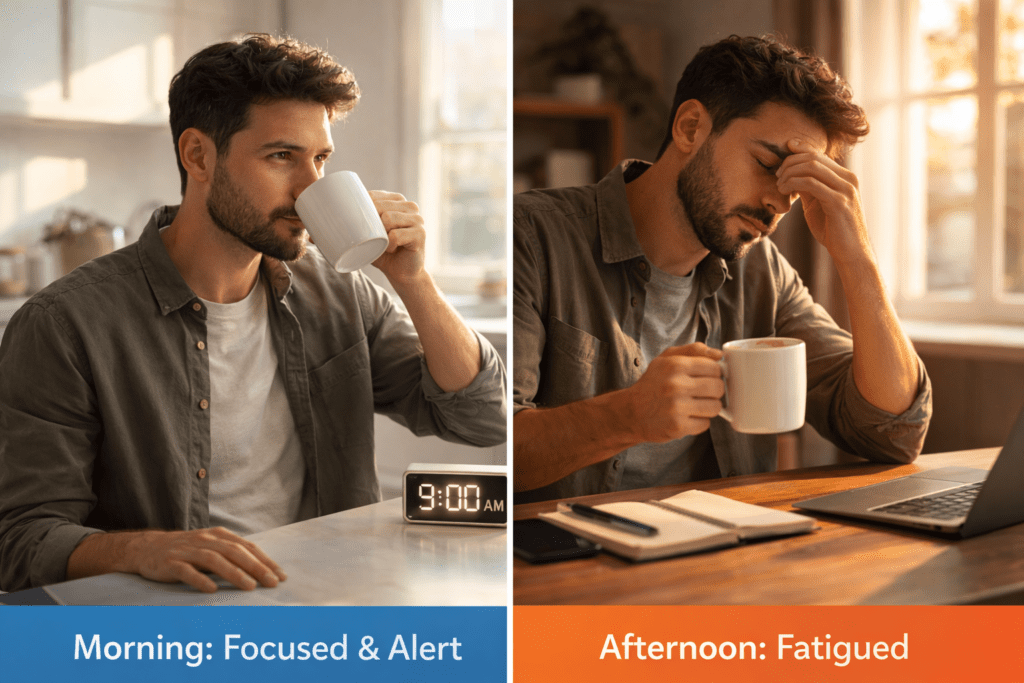
Morning sunlight strengthens circadian timing, while long indoor afternoons can weaken your brain’s time-of-day cues. When those cues are weak, caffeine becomes a stronger artificial alertness signal, and the crash can feel sharper when it fades.
The Hidden Reason Cutting Coffee Completely Isn’t Always Necessary
The goal is not elimination.
The goal is rhythm alignment.
Coffee can coexist with stable energy if it is timed after your cortisol peak, not used to override severe sleep deprivation, limited in the late afternoon, paired with stable meals, and supported by healthy routines.
Most fatigue problems come from misuse, not existence.
What Happens When Afternoon Coffee Becomes a Daily Habit
Imagine this pattern.
6:30 AM wake up and immediate coffee
9:30 AM second cup
2:30 PM energy dip and third cup
9:30 PM wired but tired
12:00 AM struggle to sleep
6:30 AM wake exhausted
The next day starts with higher adenosine accumulation because sleep quality was reduced.
Now coffee has to work harder.
That’s how dependency cycles begin.
The Most Common Biological Reasons You Feel Tired After Drinking Coffee
- Adenosine receptor rebound
- Cortisol rhythm mistiming
- Afternoon circadian dip
- Sympathetic nervous system overstimulation
- Dopamine contrast drop
- Late-day caffeine delaying sleep pressure
Why Simple Explanations Don’t Fully Explain Caffeine Fatigue
Most explanations focus on isolated causes like adenosine, dehydration, or tolerance.
While each of these factors is real, they rarely act alone.
In real life, caffeine fatigue usually comes from overlap—not a single trigger. Sleep pressure, hormone timing, nervous system load, and daily habits all combine in the background.
When these systems are already out of sync, caffeine doesn’t create the problem—it amplifies the imbalance.
Looking at one cause at a time can make the experience seem confusing. But when you view it as an interaction between multiple systems, the pattern becomes much clearer.
The Hidden Reason Chronic Stress Changes How Coffee Affects You
Caffeine does not operate in isolation. It interacts with whatever state your nervous system is already in.
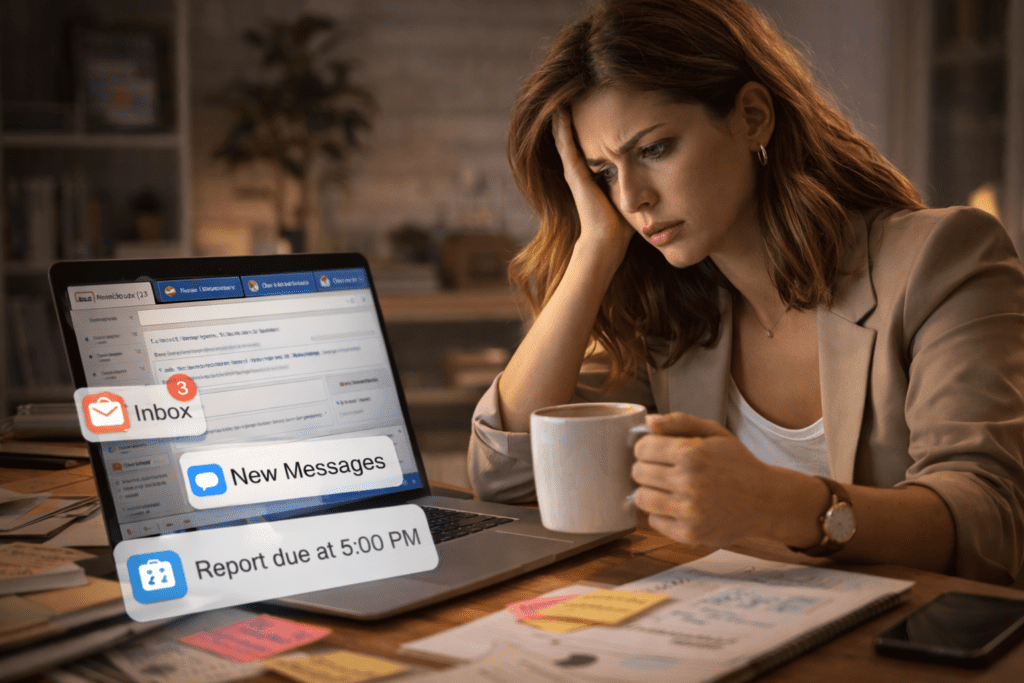
If you live in a constant low-level stress state — tight deadlines, phone notifications, poor sleep, long commutes — your baseline cortisol and adrenaline patterns may already be irregular.
When morning cortisol is blunted, you wake up feeling groggy and may notice you wake up tired even after 8 hours. Coffee feels necessary immediately. But because your natural alertness signal is weak, caffeine has to compensate more aggressively.
That increases reliance.
In the afternoon, if cortisol drops steeply, caffeine stimulation can overshoot your nervous system. When it fades, you crash harder than someone with stable rhythm patterns.
So if you feel tired after drinking coffee consistently, it may reflect stress-adapted hormone timing rather than caffeine intolerance.
Coffee magnifies what is already unstable.
How long does a caffeine crash last?
A caffeine crash typically lasts between one to three hours, depending on your sleep quality, caffeine intake, and overall energy balance during the day.
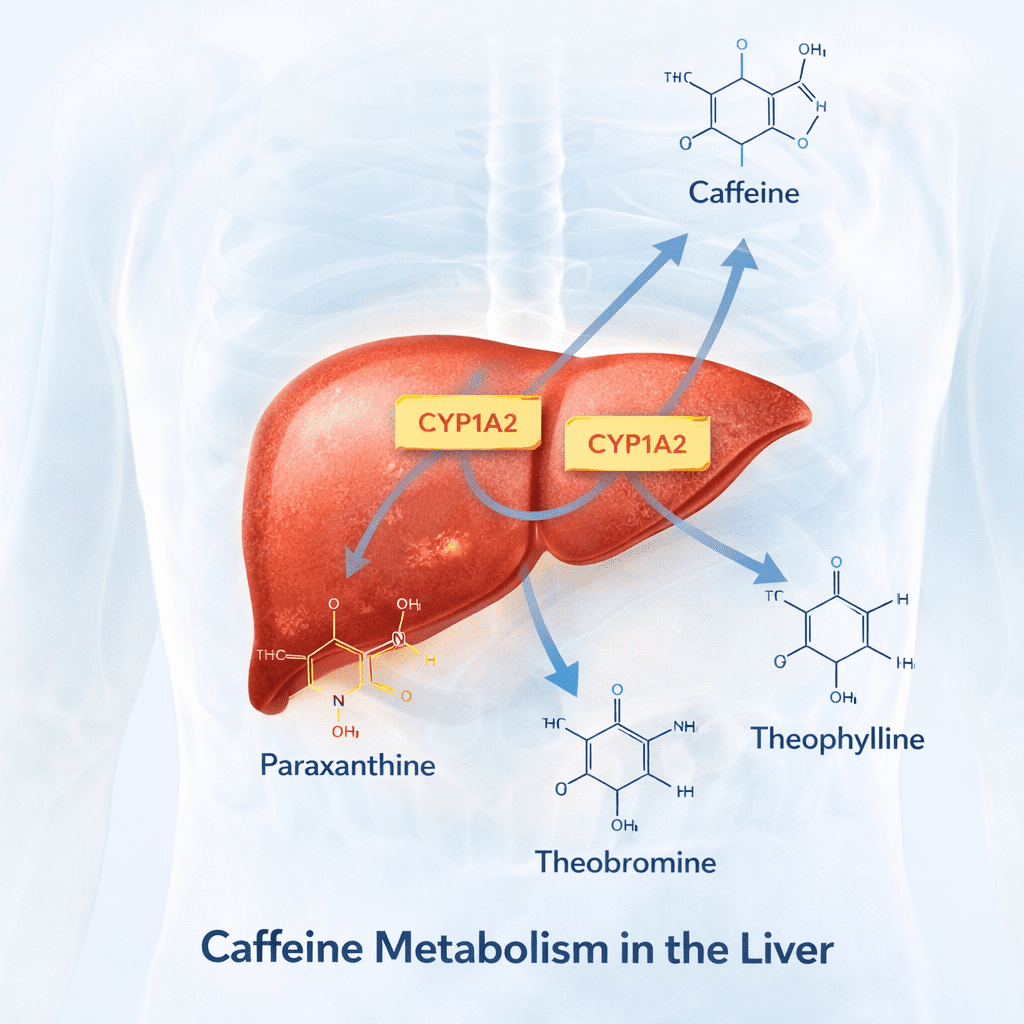
The Hidden Reason Liver Metabolism Speed Changes Your Coffee Crash
Caffeine is processed in the liver, and people break it down at different speeds. This affects how long the alertness lasts and when the crash shows up.
If your body processes caffeine quickly, the boost may fade sooner, which can lead to an earlier drop in energy.
If it processes it more slowly, stimulation can last longer and sometimes carry into the evening, increasing the chance of feeling wired but tired later.
This doesn’t change why caffeine makes you feel tired—but it can change when and how strongly the crash appears.
Same drink. Different timing.
What Happens in the Brain During a Caffeine Crash
When caffeine levels decline, three shifts occur:
- Adenosine signaling returns strongly
- Dopamine signaling normalizes downward
- Sympathetic activation decreases
This creates a triple effect:
- Increased fatigue perception
- Reduced motivation
- Decreased stimulation
If this happens during a natural circadian dip, such as when you feel exhausted at 3PM even after 8 hours sleep, the crash feels heavier.
Context magnifies physiology.
Why Afternoon Light Exposure Changes the Outcome
Natural daylight strengthens circadian signals and improves alertness regulation.
If your entire afternoon is spent indoors under dim light, your brain receives weaker time-of-day cues.
Weaker signals mean:
- Stronger perceived dip
- Greater caffeine reliance
- More dramatic rebound
Short outdoor light exposure can soften the contrast between caffeine stimulation and circadian decline.
Light stabilizes rhythm. Coffee temporarily overrides it.
The Real Cause of Mental vs Physical Fatigue After Coffee
Some people report brain fog without body heaviness.

Others feel physically drained but mentally restless.
Mental fatigue is more connected to dopamine shifts and cognitive overload.
Physical heaviness is more connected to adenosine pressure and circadian rhythm.
If your crash feels physical, sleep pressure likely dominates.
If it feels restless and overstimulated, nervous system imbalance is involved.
Understanding this difference prevents you from blaming coffee alone.
What Happens When Coffee Interacts With Different Energy States
Coffee does not produce the same result in every biological state.
It interacts with whatever condition your body is already in.
The table below summarizes how different internal states can change the way caffeine feels.
How Coffee Affects Your Energy in Different Biological States
| Biological State | Body Condition | Effect of Coffee | Crash Risk |
|---|---|---|---|
| Rested and Regulated | Good sleep, stable cortisol, low stress | Coffee acts as a mild alertness enhancer | Low |
| Sleep-Deprived but Calm | High sleep pressure but stable nervous system | Caffeine temporarily masks fatigue signals | Moderate |
| Overstimulated and Exhausted | High stress, sympathetic nervous system activation | Caffeine adds stimulation on top of exhaustion | High |
| Afternoon Circadian Dip | Natural drop in alertness between 1 PM and 4 PM | Caffeine briefly increases alertness before rebound fatigue | High |
| High Daily Caffeine Intake | Brain adapted to regular caffeine stimulation | Reduced caffeine effectiveness with stronger crashes | Moderate to High |
What Happens When Feeling Tired After Drinking Coffee Becomes a Cycle
Occasional crashes are normal.
But if you:
- Depend on coffee every morning
- Add more in the afternoon
- Struggle with evening alertness
- Repeat the pattern daily
You are likely in a feedback loop.
The loop looks like this:
Poor sleep → higher adenosine → more caffeine → receptor adaptation → stronger crash → worse sleep → repeat.
Over time, baseline energy lowers.
Over time, this pattern can turn into a situation where you feel tired for no clear reason, even when nothing obvious seems wrong.
The solution is rhythm correction, not just caffeine removal.
How a Biological Reset Strategy Realigns Your Energy Rhythm

If you want to reduce how often you feel tired after drinking coffee, focus on timing alignment:
- Delay first coffee 60 to 90 minutes after waking
- Get natural light early in the morning
- Avoid caffeine after early afternoon
- Pair coffee with balanced meals to stabilize glucose
- Use movement instead of caffeine during natural dips
These adjustments support hormone timing and reduce rebound intensity.
They work because they align with biology.
Why Some People Don’t Feel Tired After Drinking Coffee
Not everyone experiences caffeine crashes.
People who rarely feel tired after drinking coffee usually have several stabilizing factors working in their favor:
- Consistent sleep timing
- Morning light exposure
- Moderate caffeine intake
- Balanced meals
- Lower chronic stress load
In these individuals, caffeine doesn’t have to override extreme sleep pressure or unstable hormone patterns.
It enhances an already stable system.
This contrast explains why caffeine feels stable for some people and unpredictable for others.
If coffee feels volatile in your body, it’s not necessarily because you are sensitive. It may be because your baseline rhythm needs stabilization.
The Cause-and-Effect Chain Behind Why Caffeine Makes You Tired
You wake up and adenosine starts building.
You drink coffee and block fatigue signals.
Sleep pressure continues increasing in the background.
Caffeine wears off after a few hours.
Adenosine floods brain receptors.
Cortisol is already declining.
Fatigue rebounds stronger than before.
How to Fix the “Coffee Makes Me Tired” Problem Without Quitting Caffeine
If coffee keeps leaving you more tired instead of energized, the problem isn’t the caffeine itself—it’s how and when your body is using it.
The first shift is to stop using caffeine as a “rescue tool.” When you drink coffee only when you already feel drained, you’re stacking stimulation on top of high fatigue. That almost guarantees a rebound crash later.
Instead, use caffeine proactively. Drink it when your energy is stable—not when it’s already collapsing. This reduces the contrast between stimulation and fatigue.
Next, change your afternoon strategy. Most people automatically reach for coffee during the 1–4 PM dip. This is exactly when your body is biologically least responsive to it. Replace that habit with a short reset—light exposure, movement, or even a 5-minute break away from screens. These stabilize your energy instead of forcing it.
Another overlooked fix is consistency. Irregular caffeine timing confuses your brain’s expectation of stimulation. When caffeine hits at different times each day, your energy rhythm becomes less predictable, which makes crashes feel stronger. Keeping your caffeine timing consistent reduces that volatility.
Also, pay attention to your “last cup cutoff.” Even if you fall asleep easily, late caffeine can reduce sleep depth. That creates a hidden fatigue layer the next day, making coffee feel weaker and crashes feel stronger.
Finally, think in patterns, not moments. One bad crash isn’t the problem. A repeated daily cycle is. When you adjust timing, consistency, and baseline recovery together, caffeine becomes more stable—and far less likely to leave you feeling drained.
The goal is not to fight fatigue with caffeine, but to align caffeine with the state your body is already in.
Signs Caffeine Is Making You More Tired Instead of Energized
- You crash 1–3 hours after coffee
- You feel wired but tired at night
- You need more caffeine each week
- You wake up tired even after enough sleep
- You crave sugar after coffee
If you keep asking yourself why caffeine makes you tired, the real issue may not be the coffee itself, but how it interacts with your daily energy rhythm.
The Counterintuitive Truth About Why Coffee Feels Like It Fails You
Coffee temporarily changes how your brain experiences fatigue rather than eliminating it.
If your sleep pressure is high, your cortisol rhythm is misaligned, or your nervous system is overstimulated, caffeine will not fix the imbalance. It will briefly override it — and then reveal it more clearly when it fades.
When you repeatedly feel tired after drinking coffee, your body is not failing.
It is signaling that stimulation is being used to compensate for rhythm instability.
When timing improves, energy becomes steadier — often with less reliance on stimulation.
Once you understand this pattern, coffee stops feeling like the problem—and starts revealing what your body actually needs.
What to Read Next If Coffee Keeps Draining Your Energy?
If you often feel mentally exhausted yet strangely restless after coffee, your nervous system may be stuck between stimulation and fatigue. Understanding that pattern is the first step toward fixing it.
Start here:
When you understand the biology behind your energy dips, coffee becomes a tool — not a crutch.
Frequently Asked Questions
Why does caffeine make me tired instead of energized?
Caffeine can make you feel tired because it blocks adenosine temporarily rather than removing it. When caffeine wears off, accumulated adenosine binds quickly to brain receptors, creating a rebound effect that can make fatigue feel stronger than before.
How long does a caffeine crash usually last?
A caffeine crash typically appears 3 to 5 hours after consumption and can last anywhere from 30 minutes to several hours. The intensity depends on your sleep quality, cortisol timing, caffeine tolerance, and whether you consumed it during a circadian low point.
Can coffee make you feel both wired and exhausted at the same time?
Yes. Caffeine stimulates your sympathetic nervous system, increasing alertness and heart rate. But if your sleep pressure is already high, your brain may still carry underlying fatigue. This mismatch can create the feeling of being “wired but tired.”
Does drinking coffee on an empty stomach make crashes worse?
For some people, yes. Caffeine can temporarily raise blood sugar through stress hormone activation. When insulin responds later, that fluctuation may contribute to energy instability, especially if combined with refined carbohydrates.
Why does coffee feel different in the morning compared to the afternoon?
In the morning, cortisol is naturally higher and adenosine load is lower, so coffee tends to feel smoother. In the afternoon, cortisol declines and circadian alertness dips, which increases the likelihood of a sharper boost followed by a stronger crash.
Does caffeine tolerance cause stronger crashes?
High tolerance means your brain has adapted by increasing adenosine receptor availability. When caffeine leaves your system, more receptors are available for adenosine to bind to, which can make rebound fatigue feel more intense.
Is it better to delay coffee after waking up?
Waiting 60 to 90 minutes after waking allows your natural cortisol awakening response to peak before adding caffeine. This timing may reduce afternoon dependence and improve overall rhythm stability.
Why don’t some people feel tired after drinking coffee?
People with consistent sleep schedules, strong circadian alignment, moderate caffeine intake, and lower chronic stress often experience smoother stimulation with less dramatic rebound. Baseline stability reduces volatility.
Experience, Expertise, Authoritativeness, and Trust
This article is based on well-established concepts in neurobiology, circadian rhythm science, and energy regulation. It explains how caffeine interacts with systems like adenosine signaling, cortisol timing, and nervous system activation using simplified, evidence-based insights.
The goal is to help you understand real patterns behind caffeine-related fatigue—not just list isolated causes. Many of the effects described here reflect common daily experiences, such as afternoon crashes, “wired but tired” states, and inconsistent energy after coffee.
This content is for educational purposes only and is not a substitute for professional medical advice. If fatigue is persistent or significantly affects your daily life, consider consulting a qualified healthcare professional.
