

Most people expect afternoon fatigue to feel slow, calm, and heavy.
Instead, what many busy adults experience is something far more frustrating.
Your focus drops. You reread the same email twice. Simple decisions take longer than they should. But at the exact same time, your body feels tense. Your leg bounces under the desk. You feel an urge to grab coffee, check your phone, or start something new—even though you’re exhausted.
If you feel mentally drained but restless in the afternoon, this is not just a normal 3PM dip.
It’s a biological mismatch.
Your brain is running low on cognitive fuel, but your stress system hasn’t powered down. Understanding that difference is what separates temporary relief from long-term stability.
What Does It Mean to Feel Mentally Drained but Restless in the Afternoon?
Feeling mentally drained but restless in the afternoon means your cognitive system is fatigued while your nervous system remains activated. Declining cortisol, rising adenosine, dopamine depletion, and lingering sympathetic stress signals combine to create exhaustion layered with agitation instead of calm tiredness.
This is why the experience feels confusing. You’re tired—but not relaxed. Sluggish—but unable to settle.
The Science Behind Feeling Mentally Drained but Restless in the Afternoon
Three major systems intersect during the mid-day window:
- Circadian rhythm
- Cortisol regulation
- Dopamine and adenosine balance
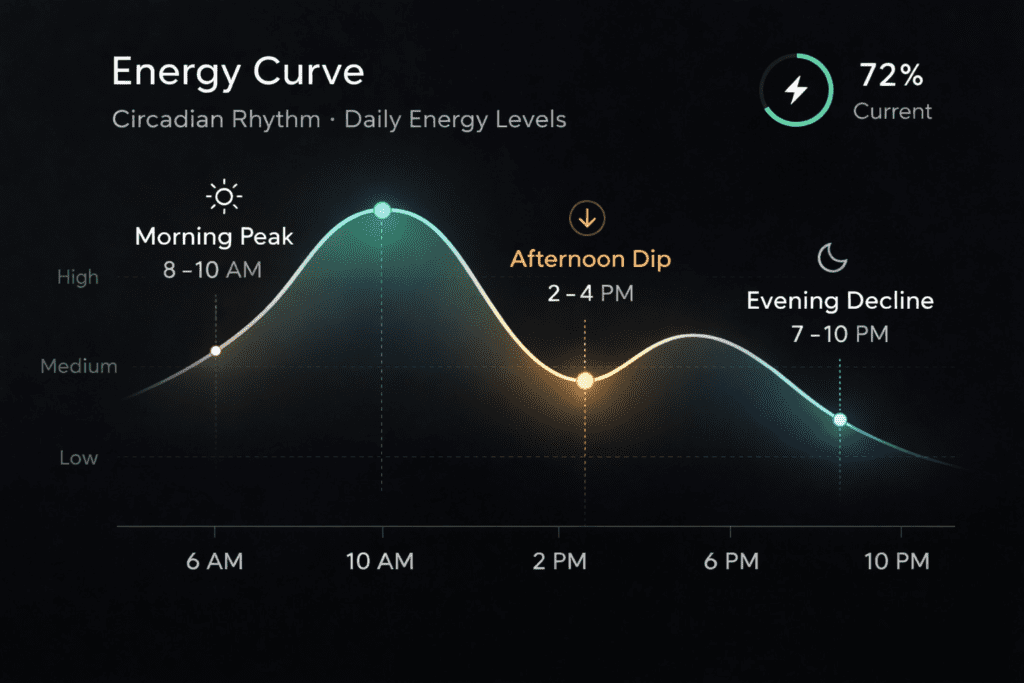
Your circadian rhythm naturally dips between 1 PM and 4 PM. The National Institute of General Medical Sciences explains how circadian rhythms regulate alertness, hormone timing, and body temperature across the day:
https://www.nigms.nih.gov/education/fact-sheets/Pages/circadian-rhythms.aspx
During this dip:
- Core body temperature falls slightly
- Alertness declines
- Reaction time slows
That creates mental heaviness.
But heaviness alone does not create restlessness.
Cortisol is your primary daytime alertness hormone. According to the NIH overview of cortisol physiology:
https://www.ncbi.nlm.nih.gov/books/NBK538239/
Cortisol rises in the morning and gradually declines throughout the day.
If your day has involved constant notifications, meetings, performance pressure, multitasking, or decision overload, your sympathetic nervous system may remain active even as cortisol drops.
That creates the mismatch.
Your alertness falls.
Your stress signaling lingers.
That tension feels like mental exhaustion mixed with agitation.
What Happens When Adenosine Builds Up in Your Brain Mid-Day
Adenosine accumulates the longer you stay awake. It creates sleep pressure and contributes to cognitive fatigue. The biological role of adenosine in sleep regulation is detailed here:
https://www.ncbi.nlm.nih.gov/books/NBK279297/
By mid-afternoon:
- Adenosine levels are high
- Cognitive drive weakens
- Focus becomes effortful
Caffeine temporarily blocks adenosine receptors.
But as caffeine wears off, adenosine pressure returns strongly. If stress hormones are still circulating, you experience fatigue without relaxation.
This is one of the core reasons you feel mentally drained but restless in the afternoon instead of simply sleepy.
The Hormone Stack That Peaks and Collapses by Mid-Afternoon
The body operates like a finely-tuned machine, with various hormones that peak and decline throughout the day. By mid-afternoon, several hormones have reached critical points of fluctuation that directly impact your energy levels and emotional state.
- Cortisol:
Cortisol, the body’s primary stress hormone, peaks in the early morning to help you wake up. However, as the day progresses, cortisol levels decline. This natural drop in cortisol during mid-afternoon often aligns with the body’s circadian rhythm dip, making you feel mentally drained.
- Insulin:
After eating, insulin rises to help transport glucose into cells for energy. But insulin is not just related to sugar metabolism—it also interacts with cortisol. A rapid insulin spike, especially from high-carb meals, can lead to a quicker drop in cortisol, contributing to that mid-afternoon energy crash.
- Dopamine:
Dopamine is a neurotransmitter that helps regulate motivation, focus, and mental alertness. After hours of focused work, dopamine depletion occurs, making it harder to stay productive. This drop in dopamine leads to the feeling of mental fatigue and lack of motivation during the afternoon slump.
- Adenosine:
Adenosine builds up the longer you’re awake, creating a sensation of sleep pressure. As adenosine levels rise, the brain naturally begins to feel more tired. However, when paired with high sympathetic tone, adenosine buildup can feel like an overwhelming exhaustion that won’t allow you to rest, keeping you physically restless.
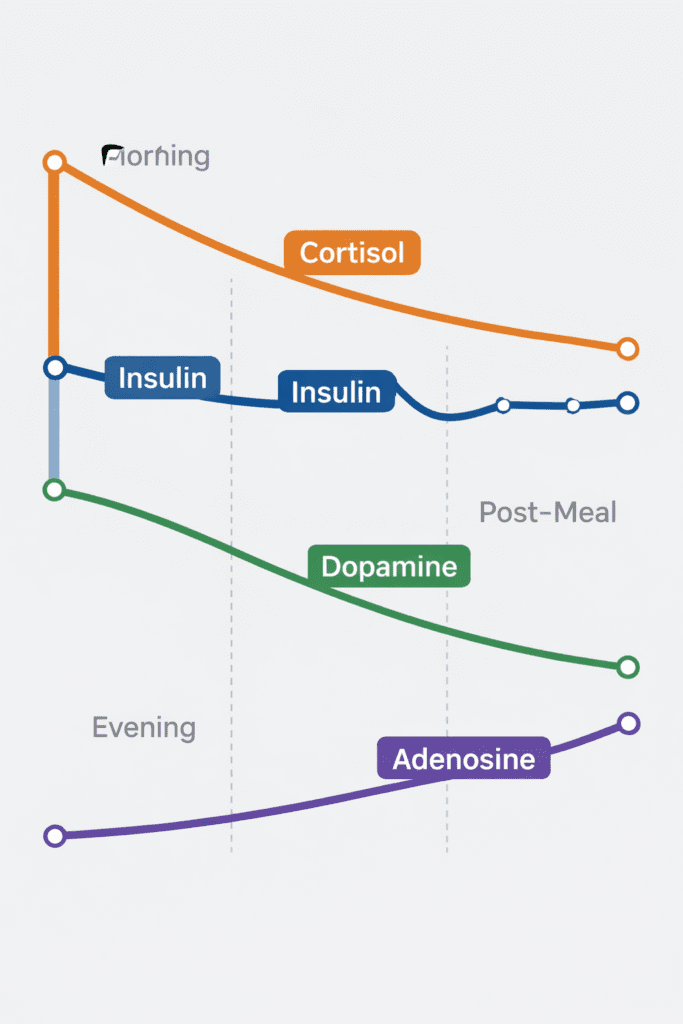
This hormonal interplay in the afternoon is a perfect storm, leading to both mental fatigue and physical restlessness at the same time.
The 4 Biological Drivers of Afternoon Mental Drain With Restlessness
- Natural circadian dip
- Declining cortisol slope
- Dopamine depletion from cognitive switching
- Residual sympathetic nervous activation
When these overlap, you feel tired but unable to settle.
| Biological Factor | Effect on Energy | Action for Stabilization |
|---|---|---|
| Circadian Rhythm | Natural dip in energy between 1 PM – 4 PM | Try taking a short walk or a deep breathing session to reset. |
| Cortisol Decline | Alertness drops gradually during the afternoon. | Regulate stress through mindfulness or moderate physical activity. |
| Dopamine Depletion | Focus and motivation weaken after sustained cognitive effort. | Switch tasks or take a break to reset mental focus. |
| Adenosine Buildup | Builds up throughout the day and creates sleep pressure. | Limit caffeine intake after lunch, and hydrate properly. |
By understanding these biological factors, you can better regulate your energy throughout the day, preventing the mid-afternoon crash.
Feeling drained but restless?
Struggling with that tired-but-wired sensation? You’re not alone. Discover how you can balance your energy and stop the 3PM crash with our proven strategies.
Learn More About Restoring Your Energy
The Real Cause of the Tired but Wired Afternoon Feeling
The real cause is dysregulated energy.
Not low energy.
Not laziness.
Not lack of discipline.
Dysregulated alignment between systems.
If you often search for why am I so tired in the afternoon, you may recognize the fatigue side of the pattern.
If you relate more to exhausted at 3PM even after 8 hours of sleep, that explains the circadian dip.
But this article focuses on the paradox—fatigue plus agitation.
Your brain wants to power down.
Your nervous system refuses.
The Hidden Reason Desk Work Increases Afternoon Restlessness
Prolonged sitting reduces muscle contractions that help regulate circulation and nervous system tone.
When sitting for hours:
- Diaphragmatic breathing decreases
- Oxygen efficiency drops
- Carbon dioxide tolerance lowers
- Shoulders round forward
- Neck muscles tighten
Shallow breathing increases sympathetic activation.
If you’ve noticed feeling tired after sitting too long, the mechanism overlaps.
Your brain is fatigued.
Your breathing pattern keeps your body alert.
That contradiction intensifies the restless feeling.
What Most People Miss About Feeling Mentally Drained but Restless
Most assume:
“I need more caffeine.”
“I didn’t sleep enough.”
“I just have to push through.”
But restlessness often reflects incomplete stress recovery, not insufficient sleep.
If you also struggle with feeling wired but tired at night, that is the same dysregulation pattern extending into the evening.
The problem is not that you lack energy.
The problem is that your nervous system never downshifted.
The Link Between Screen Overstimulation and Afternoon Brain Fatigue
Every notification, scroll, and task switch drains dopamine signaling efficiency.
The brain does not truly multitask—it switches rapidly. Each switch consumes cognitive resources.
By mid-afternoon:
- Dopamine tone drops
- Motivation weakens
- Tasks feel heavier
Low dopamine increases the urge to seek stimulation. That urge feels like restlessness.
Eye strain adds another layer. If you work on screens all day, strategies from computer eye fatigue relief can reduce cognitive strain and visual overload.

The Link Between Screen Overstimulation
A common response to afternoon fatigue is simply to push through. You think to yourself, “If I just keep working, I’ll get through this.” But this approach often makes the situation worse.
When you attempt to power through mental fatigue, you’re overriding your body’s signals for rest, pushing your sympathetic nervous system into overdrive. This strategy:
- Increases Cortisol: By pushing yourself beyond your energy limits, you inadvertently increase cortisol levels, which is the body’s stress hormone. Elevated cortisol heightens alertness and focus, but also contributes to anxiety and physical tension.
- Depletes Dopamine Faster: When you keep pushing forward without giving your brain time to recharge, dopamine levels dip even further. This reduces your ability to concentrate and makes it harder to complete even simple tasks.
- Amplifies Physical Restlessness: With rising cortisol and dopamine depletion, the mismatch between mental fatigue and physical restlessness grows. This leads to an overwhelming feeling of being “tired but wired.”
Instead of pushing through the exhaustion, allowing your body to reset through a break, movement, or relaxation techniques can help alleviate this mismatch.
Counterintuitive Insight: Movement Reduces Restlessness Faster Than Rest
When you feel mentally drained but restless in the afternoon, lying down or scrolling often makes it worse.
Why?
Because mental fatigue is high, but stress chemistry has not cleared.
Movement metabolizes residual stress hormones.
A brisk 5–10 minute walk can:
- Increase oxygen delivery
- Lower residual adrenaline
- Improve dopamine signaling
- Reset breathing rhythm
That’s why many strategies in afternoon energy crash prevention prioritize movement over caffeine.
Rest alone does not clear stress chemistry.
Movement does.

What Happens When This Pattern Becomes Chronic Over Time
Stage 1: Afternoon agitation and brain fog.
Stage 2: Increased caffeine use and late-day sugar cravings.
Stage 3: Evening wired feeling.
Stage 4: Poor sleep quality.
Stage 5: Flatter cortisol rhythm and stronger crashes.
This becomes a loop.
The afternoon instability predicts the nighttime instability.
What Chronic Afternoon Dysregulation Does to Your Sleep Architecture
Chronic afternoon fatigue and restlessness, if left unaddressed, can have significant effects on your sleep. When your body’s natural rhythms are consistently disrupted during the afternoon, it sends signals that interfere with your ability to relax and fall asleep at night.
- Elevated Evening Cortisol:
In a typical day, cortisol naturally decreases in the evening to prepare the body for sleep. However, chronic afternoon stress can lead to elevated evening cortisol levels. This makes it harder for your body to wind down, resulting in poor sleep quality or difficulty falling asleep.
- Reduced Slow-Wave Sleep:
Slow-wave sleep is the deepest phase of sleep, where the body performs most of its recovery processes. Disrupted cortisol levels can limit the amount of slow-wave sleep you get, leaving you feeling unrefreshed in the morning.
- Sleep Fragmentation:
With elevated cortisol and adrenaline levels, your sleep can become fragmented. You may wake up several times during the night, unable to enter the deeper stages of restorative sleep.
- Next-Day Cortisol Flattening:
Inconsistent sleep patterns lead to flattened cortisol rhythms the next day. This means your body struggles to wake up fully in the morning, setting you up for a repeat of the cycle of mental drain and physical restlessness in the afternoon.
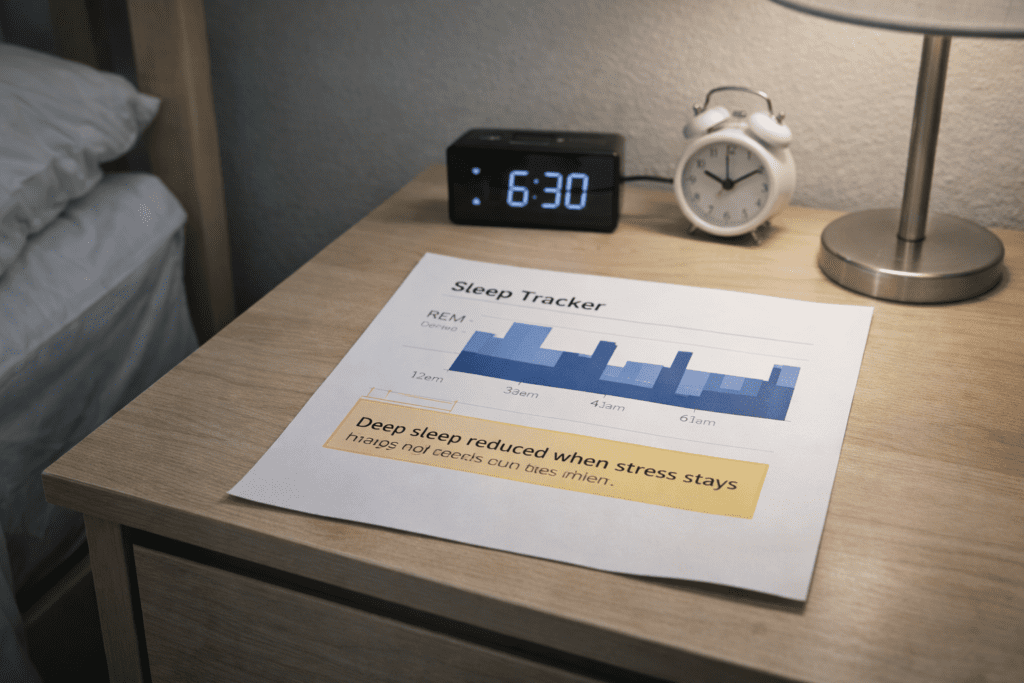
To break this cycle, it is crucial to reset your energy patterns in the afternoon, allowing cortisol to decline naturally and setting the stage for a more restful night.
The Impact of Cortisol Rhythm Disruption on Afternoon Energy
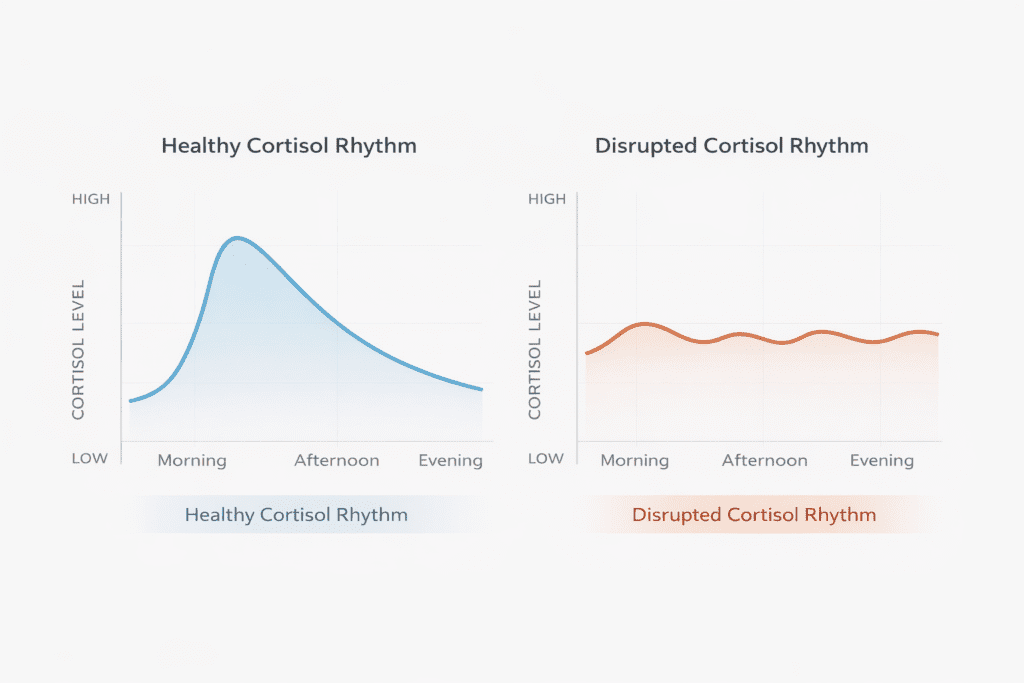
A healthy cortisol rhythm follows a slope:
High in the morning.
Gradual decline through the day.
Low at night.
Irregular sleep timing, chronic stress, and excessive evening stimulation flatten this slope.
When flattened:
- Morning alertness weakens
- Afternoon dysregulation intensifies
- Evening alertness increases
Consistent evening structure matters. See evening habits for next-day energy for ways to protect next-day stability.
The Hidden Interaction Between Blood Sugar Stability and Nervous Agitation
Even subtle insulin shifts after lunch can accelerate cortisol decline.
This is not always a dramatic crash like those explained in why blood sugar crash symptoms happen — and in some cases, it may even show up as feeling dizzy and tired in the afternoon instead of just sleepy.
Instead, it is a timing misalignment.
Alertness drops.
Stress chemistry lingers.
Restlessness increases.
It’s not always about dramatic hypoglycemia. Sometimes it’s about rhythm mismatch.
Quick Signs Your Nervous System Is Dysregulated at 3PM
- Brain fog but racing thoughts
- Leg bouncing or fidgeting
- Sudden urge for caffeine
- Irritability or impatience
- Difficulty finishing simple tasks
These signs indicate that your sympathetic system has not powered down.
A Structured Nervous System Reset Protocol for 3PM
Step 1: Stand and move for 3–5 minutes.
Step 2: Inhale 4 seconds, exhale 6 seconds for 2 minutes.
Step 3: Look 20 feet away for 60 seconds.
Step 4: Complete one small task fully.
Step 5: Delay caffeine by 20 minutes.
These five steps realign brain fatigue with nervous system state.
Why Chronic Micro-Stress Quietly Amplifies Afternoon Restlessness
Most people believe stress has to feel dramatic to matter.
It doesn’t.
Micro-stress accumulates silently throughout the day:
Unread emails.
Slack notifications.
Calendar alerts.
Performance pressure.
Financial concerns.
Traffic during your commute.
Each one triggers a small sympathetic response.
Individually, they seem harmless. But stacked together for five or six hours, they prevent your nervous system from completing a full recovery cycle.
By the time your natural circadian dip arrives mid-afternoon, your body hasn’t downshifted once.
This is why you feel mentally drained but restless in the afternoon instead of calmly tired.
Your brain wants to slow down.
Your body never got the signal that it’s safe to.
Why Breathing Patterns Control Your Mid-Day Energy More Than You Realize
Most desk workers shift into shallow chest breathing without noticing.
Shallow breathing:
Increases heart rate slightly
Maintains alert signaling
Reduces vagal tone
Keeps carbon dioxide levels lower than optimal
Lower carbon dioxide tolerance increases anxiety sensitivity and physical agitation.
Diaphragmatic breathing does the opposite:
Improves vagal activation
Signals safety to the brain
Reduces sympathetic dominance
If your breathing has been shallow since 9AM, your body stays in alert mode.
So when your brain gets tired, it cannot transition into relaxed fatigue.
It transitions into restless fatigue.
The Environmental Factors That Intensify the 3PM Crash
Your office environment plays a role.
Warm rooms amplify circadian dips.
Dim lighting increases perceived fatigue.
Low hydration thickens blood slightly and increases perceived effort.
If you sit in stagnant air with artificial lighting all afternoon, your brain receives more “low energy” signals.
When those signals combine with sympathetic activation, you get agitation layered on top of fatigue.
This is why small environmental adjustments — cooler temperature, natural light exposure, standing breaks — can noticeably reduce restlessness.
The Hidden Role of Mild Dehydration in Afternoon Brain Fog
Even mild dehydration reduces plasma volume.
Lower plasma volume affects circulation efficiency and oxygen delivery to the brain.
Research consistently shows that even 1–2% dehydration can reduce cognitive performance and increase perceived task difficulty.
Dehydration alone doesn’t cause the restless feeling.
But it magnifies it.
When you’re already mentally drained, even small physiological inefficiencies increase frustration and agitation.
Hydration is not a cure. But it is a stabilizer.
Why Lunch Timing and Composition Matter
After lunch, insulin rises.
Insulin helps shuttle glucose into cells.
But insulin also interacts with cortisol rhythm.
A rapid insulin spike — especially from refined carbohydrates — may accelerate the normal afternoon cortisol decline.
When cortisol drops quickly:
Alertness drops sharply.
Adenosine impact increases.
But if sympathetic tone is still elevated from stress, restlessness persists.
This creates that strange sensation of being tired and wired at the same time.
For more detailed explanations of dramatic glucose fluctuations, see why blood sugar crash symptoms happen.
But remember — you don’t need a full crash to feel unstable. Subtle rhythm shifts are enough.
The Escalation Chain That Most People Never Notice
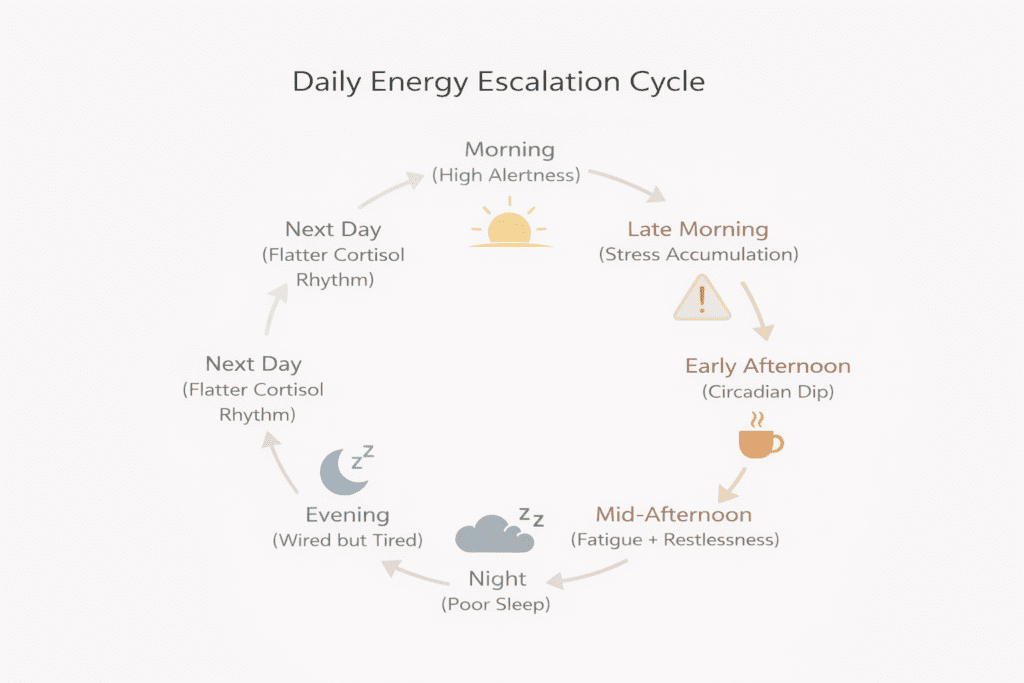
Morning
High cortisol. Good alertness.
Late Morning
Cognitive demand increases. Stress accumulates.
Early Afternoon
Circadian dip begins. Adenosine rises.
Mid-Afternoon
Dopamine weakens. Cortisol falls. Sympathetic tone lingers.
Late Afternoon
Caffeine temptation increases.
Evening
You feel wired but tired — similar to wired but tired at night.
Night
Sleep quality decreases.
Next Day
The cycle repeats with stronger intensity.
Afternoon restlessness is rarely isolated. It’s part of a larger rhythm disturbance.
What Happens When You Rely on Caffeine to Fix It
Caffeine blocks adenosine receptors.
Short term, that increases alertness.
But caffeine does not reduce sympathetic activation. It often increases it.
If you drink coffee at 3PM:
Adenosine is blocked temporarily.
Cortisol may spike slightly.
Sympathetic tone increases further.
You feel temporarily better.
Then the caffeine wears off.
Now you have:
High adenosine
Low cortisol
Elevated sympathetic tone
The crash feels worse.

If this sounds familiar, read tired after drinking coffee to understand rebound fatigue patterns.
Why Feeling Mentally Drained but Restless in the Afternoon Is a Regulation Problem — Not a Motivation Problem
If you feel mentally drained but restless in the afternoon, the issue is rarely effort.
It’s timing.
By 3PM, adenosine is high. Cortisol is declining. Dopamine has been taxed by hours of cognitive switching. But your sympathetic nervous system may still be partially activated from accumulated stress.
That biological misalignment creates the tired-but-wired sensation.
When you understand this sequence — circadian dip, hormone shift, neurotransmitter fatigue, stress carryover — the pattern stops feeling mysterious.
It becomes predictable.
And once something is predictable, it becomes manageable.
The solution is not pushing harder.
It’s restoring alignment.
Regulate your nervous system before you stimulate it.
Support your cortisol rhythm instead of overriding it.
Reduce cumulative stress before it compounds.
Because feeling mentally drained but restless in the afternoon is not a flaw in your discipline.
It’s a signal that your internal systems are out of sync — and they can be brought back into rhythm.
Still Struggling With the 3PM Crash?
If you feel mentally drained but restless in the afternoon, the solution isn’t more caffeine — it’s better regulation. Explore these related guides to stabilize your energy, support your cortisol rhythm, and reduce the tired-but-wired cycle.
- Why Am I So Tired in the Afternoon?
- Exhausted at 3PM Even After 8 Hours of Sleep?
- Afternoon Energy Crash Prevention Guide
- Wired but Tired at Night: What It Really Means
- Dizzy and Tired in the Afternoon? Find Out Why
Start with the guide that best matches your symptoms — and begin restoring steady, predictable energy throughout the day.
Frequently Asked Questions
Why do I feel mentally drained but restless in the afternoon even after sleeping well?
Feeling mentally drained but restless in the afternoon often happens when sleep duration is adequate but stress recovery is incomplete. Adenosine builds up naturally through the day, cortisol declines, and dopamine becomes taxed from cognitive effort. If sympathetic nervous system activity remains elevated, the brain feels fatigued while the body stays tense.
Is it normal to feel a 3PM energy crash every day?
A mild drop in alertness between 1 PM and 4 PM is normal due to circadian rhythm patterns. However, daily crashes combined with agitation, irritability, or caffeine dependence may signal cortisol rhythm disruption, stress carryover, blood sugar instability, or excessive task switching.
Can anxiety cause afternoon restlessness with brain fog?
Yes. Anxiety increases sympathetic activation and can keep adrenaline and cortisol slightly elevated. When cognitive fatigue develops later in the day, the brain slows down but the stress system does not fully deactivate, creating a tired-but-wired sensation.
Does caffeine make afternoon fatigue worse?
Caffeine blocks adenosine receptors temporarily, increasing alertness. However, it does not reduce stress hormone activation. When caffeine wears off, adenosine rebounds while cortisol is already lower, which can intensify both fatigue and restlessness.
Why does my body feel tense when my brain feels exhausted?
This happens when neurotransmitter fatigue lowers mental drive while stress signaling remains active. Dopamine depletion reduces focus and motivation, while residual sympathetic tone maintains muscle tension, fidgeting, and agitation.
Can poor sleep architecture affect afternoon energy?
Yes. Reduced slow-wave sleep, fragmented sleep, or late-night cortisol elevation can flatten your natural cortisol slope the next day. This makes the mid-afternoon dip feel stronger and less stable.
What is the fastest way to reset nervous system imbalance at 3PM?
The fastest reset combines movement and breathing. A brisk 5–10 minute walk followed by slow exhalation breathing can lower sympathetic tone, improve oxygen delivery, and help realign mental fatigue with physical relaxation.
E-E-A-T Trust & Editorial Standards
This article is grounded in established principles of circadian biology, cortisol rhythm regulation, autonomic nervous system function, neurotransmitter dynamics, and sleep architecture. Physiological explanations align with educational materials from institutions such as the National Institutes of Health and peer-reviewed biomedical research sources.
All content is written for informational and educational purposes, focusing on lifestyle regulation and nervous system stability. The recommendations provided emphasize behavioral physiology and daily rhythm alignment rather than medical diagnosis or treatment.
The goal is to translate complex biological mechanisms into clear, practical understanding for everyday adults experiencing afternoon cognitive fatigue and restlessness.
