

You sit down to solve a problem. Maybe it’s work-related. Maybe it’s something personal you can’t stop replaying. Hours go by. You haven’t moved much, you didn’t exercise, and you weren’t physically active.
Yet somehow, you feel completely drained.
Your mind feels heavy. Your body starts to slow down. Even simple decisions feel overwhelming. If you’ve ever felt tired after thinking too much, you’re not imagining it. Your brain is actively using energy, triggering stress responses, and pushing your entire system toward fatigue.

Thinking is not passive. It’s one of the most energy-demanding processes in your body.
Most people assume tiredness comes from physical effort—but your brain alone can drain your energy even when your body is completely still.
If you tend to analyze situations deeply, replay conversations in your head, or constantly try to figure things out before taking action, your brain is likely working much harder than you realize—even during moments that seem like rest.
Why do you feel tired after thinking too much?
Thinking too much can make you tired because your brain requires continuous energy input to process information, regulate decisions, and manage stress responses. Prolonged mental activity increases neurotransmitter demand, activates stress hormones like cortisol, and eventually forces the brain to slow down, leading to both mental and physical fatigue.
Table of Contents
Why Thinking Too Much Drains Your Energy Faster Than You Expect Over Time
Your brain weighs only about 3 pounds, yet it uses around 20% of your body’s total energy. When you think intensely, that demand increases.
But here’s what most people don’t realize:
Not all thinking is the same.
Focused thinking follows a clear path. It starts, processes, and ends. Overthinking does the opposite. It becomes a constant overthinking loop without clear resolution. Your brain keeps checking, analyzing, and predicting outcomes without closure.
That constant loop keeps your brain active far longer than necessary, which is why you feel tired after thinking too much.
Can thinking too much make you physically tired?
Yes. Even without movement, excessive thinking increases brain energy use and activates stress responses, which can drain your body’s energy and lead to physical fatigue.
Why does thinking make you tired even without doing anything?
Thinking can make you tired even without physical activity because your brain uses a large amount of energy to process information, make decisions, and manage stress signals. Even when your body is still, your brain increases glucose use, activates stress pathways, and overloads cognitive systems, which results in a noticeable drop in mental clarity and physical energy.
The Science Behind How Your Brain Uses Energy When You Think Intensely
The prefrontal cortex is responsible for your most demanding mental tasks. It controls decision-making, planning, problem-solving, and emotional regulation.

Every time you engage in deep thinking, this part of your brain consumes more glucose, which is its main energy source. According to research from the National Institutes of Health, the brain relies heavily on a continuous energy supply to maintain cognitive performance. to maintain cognitive performance.
At the same time, your brain uses neurotransmitters like glutamate and dopamine to keep signals moving between neurons. When thinking becomes prolonged and intense, these systems begin to strain.
That strain is the starting point of mental fatigue.
The Impact Of Your Environment On How Mentally Draining Thinking Becomes
Your environment plays a major role in how exhausting thinking feels. Bright screens, background noise, poor lighting, and constant digital interruptions force your brain to process additional stimuli while thinking.

This increases cognitive load and reduces your ability to focus efficiently. As a result, your brain uses more energy to complete the same mental task.
If you often feel mentally drained after screen time, you may also relate to how visual strain contributes to fatigue, as explained in why eyes feel tired after looking at screens.
What Happens When You Overload Your Prefrontal Cortex With Too Much Thinking
When you think continuously without breaks, your brain enters a state of overload.
Neural activity increases. Glutamate builds up in areas responsible for control and decision-making. Processing becomes less efficient. Your ability to focus declines, and your reaction time slows.
Your brain recognizes this overload and responds by reducing activity to protect itself. That reduction is what you experience as fatigue.
The Hidden Reason Overthinking Activates Your Stress System All Day Long
One of the most important reasons you feel tired after thinking too much is that your body treats thoughts as real events.
When you replay situations, imagine future problems, or try to control outcomes, your brain activates the stress response system, as explained by Mayo Clinic. This includes releasing cortisol and increasing alertness.
Even if you are sitting still, your body behaves as if it is under pressure.
This is why overthinking is more exhausting than simple thinking. It activates both cognitive and stress systems at the same time.
If you’ve ever felt mentally drained but restless, you may relate to patterns explained in mentally drained but restless in the afternoon.
Why do I feel exhausted after overthinking all day?
Because your brain stays in a continuous loop of analysis and stress activation, which prevents mental recovery and gradually drains your energy throughout the day.
The Link Between Overthinking and Anxiety That Accelerates Mental Exhaustion
Overthinking is closely tied to anxiety, and the two often reinforce each other. When you repeatedly analyze situations or anticipate worst-case outcomes, your brain treats these thoughts as ongoing threats.
This keeps your nervous system activated for longer periods, increasing cortisol levels and preventing true relaxation. Over time, this continuous activation accelerates mental exhaustion and reduces your ability to recover.
This is why overthinking doesn’t just make you tired—it can also make you feel restless, tense, and mentally overloaded at the same time.
Why Mental Fatigue Turns Into Physical Exhaustion Even Without Movement
Many people ask: why does my body feel tired if I’ve only been thinking?
Instead of focusing only on energy use, the real shift happens in how your nervous system redistributes resources. Your body starts prioritizing brain function over physical energy output, which is why your muscles feel heavy even without movement.
This can feel like low energy, heavy limbs, and reduced motivation. Even without movement, your internal systems have been working intensely.
This is similar to what people experience when they feel tired after doing nothing all day, where the fatigue is driven internally rather than physically.
The Real Cause of Decision Fatigue After Thinking Too Much and Continuous Mental Load
After prolonged thinking, even small decisions can feel exhausting.

Your prefrontal cortex has a limited capacity. Every decision uses part of that capacity. When you overthink, you repeatedly evaluate options, simulate outcomes, and revisit the same ideas.
This leads to decision fatigue.
You may start avoiding tasks, choosing easier options, or feeling mentally checked out. This is your brain trying to conserve energy.
The Real Difference Between Short-Term Thinking and Prolonged Cognitive Strain Over Time
Short bursts of thinking are generally manageable because your brain can recover quickly afterward. When you focus on a task for a limited period and reach a conclusion, your brain disengages and resets.
Prolonged thinking, on the other hand, keeps your brain active for extended periods without sufficient recovery. This continuous activation increases energy demand, reduces efficiency, and leads to cumulative fatigue.
This is why thinking for hours without resolution feels significantly more draining than solving a problem quickly and moving on.
What Happens When Your Brain Builds Up Too Many Neural Activity Chemicals Over Time
Glutamate is a key neurotransmitter that helps neurons communicate. It is essential for thinking and learning.

However, when you think too much for too long, glutamate can accumulate in the prefrontal cortex. Research highlighted by Harvard Health shows that central brain fatigue can reduce concentration, motivation, and overall mental energy.
To protect itself, your brain slows down activity. This slowdown creates brain fog, reduced clarity, and mental exhaustion.
What Most People Miss About Why Overthinking Feels More Draining Than Focused Work
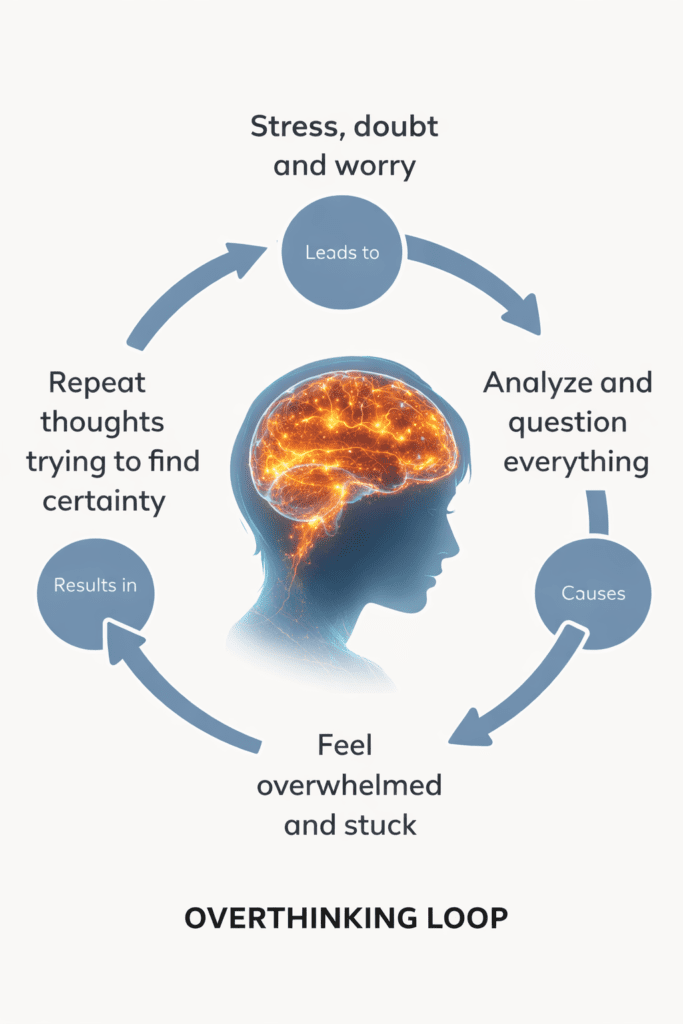
Most people assume all thinking is equally tiring. It’s not.
Overthinking is more exhausting than productive thinking because it is repetitive, unresolved, emotionally charged, and open-ended.
This is where most people get it wrong—overthinking feels productive, but it actually drains your brain faster than focused work.
Your brain never reaches closure. It keeps running in the background, using energy without producing results.
Signs your fatigue is caused by thinking too much:
- You feel tired without physical activity
- Your brain feels slow or foggy after focusing
- Simple decisions feel overwhelming
- You replay thoughts repeatedly without resolution
- You feel drained after problem-solving or worrying
To better understand how your brain responds to different types of thinking and why some patterns drain your energy faster, the comparison below breaks it down clearly:
| Thinking Type | Brain Pattern 🔄 | Energy Demand ⚡ | Mental State 🧠 | Fatigue Result 😴 |
|---|---|---|---|---|
| Focused Thinking | Linear and goal-oriented | Moderate | Clear and controlled | Manageable tiredness |
| Overthinking | Repetitive and unresolved | High | Anxious and overloaded | Rapid mental exhaustion |
| Multitasking | Constant switching | Very High | Scattered and distracted | Severe cognitive fatigue |
This is why overthinking feels more exhausting than productive thinking. Your brain is not just working harder—it’s working inefficiently.
Is mental fatigue the same as brain fog?
Not exactly. Mental fatigue is the underlying cause, while brain fog is one of the symptoms that results from reduced cognitive efficiency.
The Counterintuitive Reason Why Doing Nothing Can Feel More Exhausting Than Being Busy
One of the most surprising things about mental fatigue is that doing nothing can feel more exhausting than being busy.

When you’re actively engaged in a task, your brain follows a structured path with a clear start and end. But when you’re idle and thinking too much, your brain stays in an open loop.
This lack of closure forces your brain to keep scanning, predicting, and analyzing without resolution. Instead of resting, your mind keeps working in the background.
That’s why a day filled with overthinking can leave you more drained than a physically active day with clear tasks and outcomes.
The Mental Energy Crash Cycle That Explains Why Thinking Too Much Makes You Tired
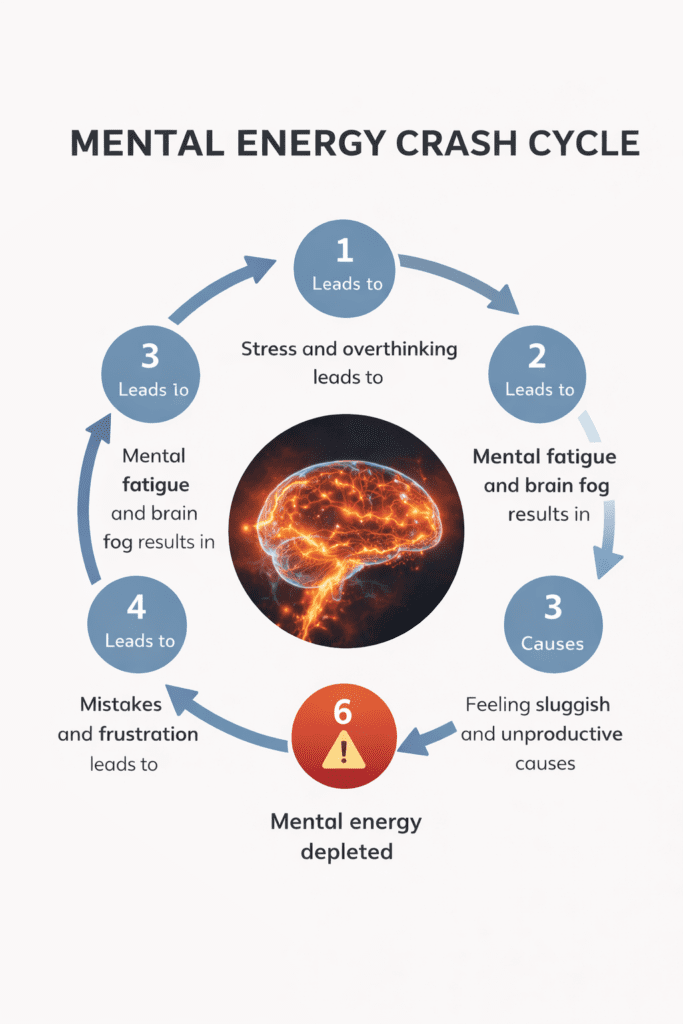
To fully understand this fatigue, you need to see the complete chain.
The Mental Energy Crash Cycle works like this:
- Thought overload begins as you analyze or worry continuously
- The prefrontal cortex increases activity to manage the load
- Neurotransmitter demand rises, especially glutamate and dopamine
- Stress hormones like cortisol remain elevated
- Brain efficiency drops and processing slows
- A protective slowdown reduces activity
- You experience full mental and physical exhaustion
5 reasons you feel tired after thinking too much:
- Your brain consumes more glucose during intense thinking
- The prefrontal cortex becomes overloaded from continuous decisions
- Stress hormones like cortisol stay elevated during overthinking
- Neurotransmitters like glutamate accumulate and reduce efficiency
- Your brain triggers a protective slowdown to prevent overload
This is not just mental tiredness — it’s a full-system response where brain overload directly triggers physical fatigue.
To better understand what’s happening inside your brain during overthinking, here’s a simplified breakdown of the key processes involved:
| Brain System 🧠 | What Happens During Overthinking 🔄 | Impact on Energy ⚡ | Result You Feel 😵 |
|---|---|---|---|
| Prefrontal Cortex | Continuous decision-making overload | High energy consumption | Mental fatigue and confusion |
| Glutamate Activity | Chemical buildup from prolonged thinking | Reduced neural efficiency | Brain fog and slow thinking |
| Cortisol (Stress Hormone) | Constant activation of stress response | Drains physical energy | Tension and exhaustion |
| Dopamine Regulation | Decreased motivation signaling | Lower mental drive | Lack of focus and motivation |
This combination of biological changes is what makes thinking too much feel physically and mentally draining at the same time.
Still trying to figure out why your energy keeps crashing?
If this pattern feels familiar, these related guides can help you connect the dots between overthinking, unexplained fatigue, and daily energy crashes.
The Link Between Overthinking, Brain Fog, and Low Energy Levels
Brain fog often follows periods of intense thinking.
Your brain becomes less efficient, dopamine levels may drop, and motivation decreases. Tasks feel harder, and your thinking slows down.
If you’ve experienced this alongside unexplained fatigue, you might also relate to patterns discussed in why feel tired for no reason.
Can your brain get tired from thinking too much?
Yes. Your brain can become fatigued from prolonged thinking because it continuously uses energy, processes information, and maintains stress responses. Over time, this leads to reduced efficiency, slower thinking, and a noticeable drop in mental clarity.
The Impact Of Constant Cognitive Load On Your Daily Energy Levels
Modern life creates continuous mental demand. Notifications, decisions, multitasking, and information overload keep your brain active throughout the day.
This constant load prevents full recovery. Over time, it leads to chronic fatigue patterns similar to those seen in why am I so tired in the afternoon.
Why Multitasking Increases Cognitive Load and Makes Thinking More Exhausting
Multitasking may feel productive, but it actually increases the amount of effort your brain has to use. Each time you switch between tasks, your brain must reset its focus, re-engage different neural pathways, and reprocess information.
This constant switching creates additional cognitive load, which makes thinking more demanding and less efficient. Instead of saving time, multitasking drains your mental energy faster.
Over time, this pattern contributes to fatigue, reduced concentration, and increased mental strain, especially in environments with constant notifications and interruptions.
How Your Brain Signals You to Stop Thinking Before Real Damage Happens Internally
Fatigue is not just a problem. It’s a signal.
Your brain uses fatigue to reduce activity, prevent overload, and protect neural function. When you feel tired after thinking too much, your brain is telling you it needs recovery.
Ignoring this signal can lead to reduced performance, more mistakes, and longer recovery time.
Why You Feel Tired After Thinking Too Much Even If You Slept Well
Sleep restores your brain, but it does not prevent overload during the day.
You can sleep well and still feel exhausted if your day involves constant decision-making, emotional thinking, or problem-solving without breaks.
This is why people often feel drained despite getting enough rest, similar to experiences described in always tired even after sleeping.
Why do I feel tired even after resting but still thinking?
Because your brain continues to consume energy and activate stress pathways even during rest if your thoughts remain active and unresolved.
The Hidden Pattern Of When Mental Fatigue From Overthinking Builds Up During the Day
Mental fatigue from overthinking doesn’t show up instantly—it builds gradually as your brain stays active for long periods without real recovery.
Most people notice this type of exhaustion:
- In the afternoon after extended focus or problem-solving
- Late at night when thoughts start looping repeatedly
- After making multiple decisions without breaks
This pattern reflects how cognitive load accumulates over time. By the moment you feel tired, your brain has already been under sustained pressure for hours.
The Hidden Reason Overthinking Disrupts Sleep Quality Even When You Sleep Enough Hours
Even if you technically get 7 to 8 hours of sleep, overthinking can still reduce how restorative that sleep actually is.

This is why you can sleep for hours and still wake up mentally exhausted—your brain never fully switched off.
When your mind stays active late into the night, your brain struggles to fully transition into deep sleep stages.
This affects how your nervous system resets and how efficiently your brain clears metabolic waste from the day. As a result, you wake up feeling mentally heavy and physically drained.
This is why many people feel exhausted even after a full night’s sleep, especially when their thoughts remain active before bed. If this sounds familiar, you may also relate to patterns explained in wake up tired even after 8 hours.
What Happens When Mental Fatigue Builds Up Day After Day Without Recovery
Mental fatigue doesn’t always reset overnight. When you repeatedly overload your brain with continuous thinking, stress, and decision-making, fatigue can accumulate over multiple days.
This creates a baseline level of exhaustion where even small mental tasks feel overwhelming. Your brain becomes more sensitive to cognitive effort, and your energy levels drop faster than usual.
This is often why people experience persistent fatigue without a clear cause, especially when their daily routines involve constant mental engagement.
Now that you understand why this happens, the next step is learning how to reduce its impact effectively.
How to Reduce Mental Fatigue Caused by Thinking Too Much Using Targeted Recovery Strategies
If you want to stop feeling tired after thinking too much, the goal is not to stop thinking completely. It’s to reduce cognitive overload and give your brain the conditions it needs to recover efficiently.

Here are the most effective ways to do that based on how your brain actually works:
1. Create “mental closure” instead of endless thinking
Unresolved thoughts keep your brain active. Writing things down or making a simple decision—even if it’s temporary—helps your brain exit the loop and reduce energy demand.
2. Use low-stimulation breaks, not high-stimulation distractions
Scrolling your phone or switching tasks doesn’t give your brain real rest. Instead, step away from input completely for a few minutes to allow neural activity to settle.
3. Reduce decision load during the day
Too many small decisions drain your prefrontal cortex. Simplifying routines or batching decisions helps preserve mental energy.
4. Shift from abstract thinking to physical action
When possible, take action instead of continuing to think. Even small actions reduce cognitive load and interrupt overthinking cycles.
5. Protect your brain’s recovery window at night
Avoid intense thinking before bed. This helps your brain transition into recovery mode and improves sleep quality, which directly impacts mental energy the next day.
6. Limit continuous cognitive input from screens and notifications
Constant input prevents your brain from resetting. Reducing digital noise can significantly lower cognitive load and improve focus.
Once you understand this pattern, your fatigue stops feeling random and starts making sense.
How do you stop feeling tired from overthinking?
You stop feeling tired from overthinking by reducing continuous mental loops and giving your brain clear stopping points. The goal is not to stop thinking completely, but to interrupt repetitive thought cycles and lower cognitive load.
The most effective ways include:
- Turning unresolved thoughts into decisions or written notes to create mental closure
- Taking low-stimulation breaks instead of switching to another mentally demanding task
- Reducing the number of daily decisions to protect your mental energy
- Shifting from thinking to small physical actions to break the cycle
- Limiting constant input from screens, notifications, and distractions
When your brain is no longer stuck in open-ended thinking loops, it uses less energy and recovers more efficiently, which reduces both mental and physical fatigue.
What Most People Miss About How Your Brain Recovers From Mental Fatigue Caused by Overthinking
Recovery from mental fatigue isn’t just about stopping work—it’s about reducing the amount of input your brain is processing.
Activities like sitting quietly, taking a slow walk without distractions, or simply pausing without stimulation allow your brain to lower its activity and reset its internal balance.
Switching from one task to another may feel like a break, but it often keeps your brain engaged at the same level, which is why it doesn’t fully relieve mental exhaustion.
The Real Cause Behind That “I Did Nothing But I’m Exhausted” Feeling All Day
At this point, the pattern becomes easier to recognize.
You didn’t move much, but you feel drained. In reality, your brain was working continuously. Your nervous system stayed active, and your energy systems were engaged.
Thinking is not passive. It is an active biological process that consumes energy and triggers physical responses.
When it becomes excessive, it leads to real fatigue.

This is what mental clarity feels like when your brain is no longer overloaded.
When you understand why you feel tired after thinking too much, your fatigue stops feeling random and starts becoming predictable—and manageable.
This is why mental fatigue is not random—it’s a predictable response to how your brain processes prolonged thinking and stress.
Explore more hidden reasons your body feels tired
Mental fatigue is only one piece of the bigger picture. If you’re trying to understand why your energy feels off in everyday life, these next articles are the best place to go.
Frequently Asked Questions
Why does overthinking make it hard to focus on simple tasks?
Overthinking overloads your prefrontal cortex with too many active thoughts at once. This reduces your brain’s ability to prioritize information, making even simple tasks feel harder and slower to complete.
Can overthinking affect your motivation levels?
Yes. Prolonged thinking reduces dopamine efficiency, which plays a key role in motivation. As a result, you may feel less driven to start or complete tasks even when you know what needs to be done.
Why do I feel mentally tired but physically restless at the same time?
This happens when your brain is fatigued but your stress system is still active. Your mind feels drained, but your body remains in a semi-alert state, creating a mix of exhaustion and restlessness.
Does thinking too much slow down your brain over time?
In the short term, yes. Continuous cognitive overload reduces processing efficiency, making your thinking feel slower. However, this effect is usually temporary and improves with proper mental recovery.
Can overthinking affect your mood and emotions?
Yes. Repetitive thinking often amplifies negative emotions like worry, frustration, or self-doubt. This emotional strain adds another layer of fatigue on top of cognitive exhaustion.
Why do I make more mistakes after thinking too much?
Mental fatigue reduces attention, reaction time, and decision accuracy. When your brain is overloaded, it becomes harder to process information clearly, leading to more frequent errors.
Is it normal to feel tired after solving complex problems for a long time?
Yes. Complex thinking requires sustained brain activity, which increases energy use and cognitive load. Feeling tired afterward is a natural response to prolonged mental effort.
Can reducing screen time help with mental fatigue from overthinking?
Yes. Screens add constant cognitive input and stimulation, which prevents your brain from fully resting. Reducing screen exposure can help lower cognitive load and improve recovery.
About This Content
This article is based on established neuroscience concepts related to cognitive load, brain energy usage, and stress physiology. It integrates research on how the prefrontal cortex manages decision-making, how neurotransmitters like glutamate influence mental fatigue, and how stress hormones such as cortisol impact both brain and body energy levels.
The explanations are designed to reflect real-world experiences of overthinking, mental overload, and daily fatigue patterns. By combining scientific understanding with practical behavioral insights, this content aims to help readers better understand why thinking too much can lead to both mental and physical exhaustion.
