

It’s 10:07 a.m.
You woke up early. You skipped the drive-thru. You made oatmeal with berries and honey. Or maybe a banana-spinach smoothie with almond milk. You felt responsible. Clean. On track.
And now your eyes feel heavy. Your focus is fading. You’re reaching for coffee again.
If you feel tired after a healthy breakfast, you are not imagining it. And it does not mean your metabolism is broken. It means your hormones, blood sugar, and nervous system are interacting in a very specific way.
Feeling tired after a healthy breakfast is usually a timing problem between cortisol, insulin, and glucose regulation.
Definition: Why You Feel Tired After a Healthy Breakfast
Feeling tired after a healthy breakfast usually happens when a rapid rise in blood sugar triggers a strong insulin response, causing glucose to drop too quickly. When this occurs during the natural morning cortisol peak, the combined hormone shift can lead to a noticeable 10 a.m. energy crash.
Let’s walk through the biology step by step.
The Science Behind Morning Cortisol and Circadian Energy Timing
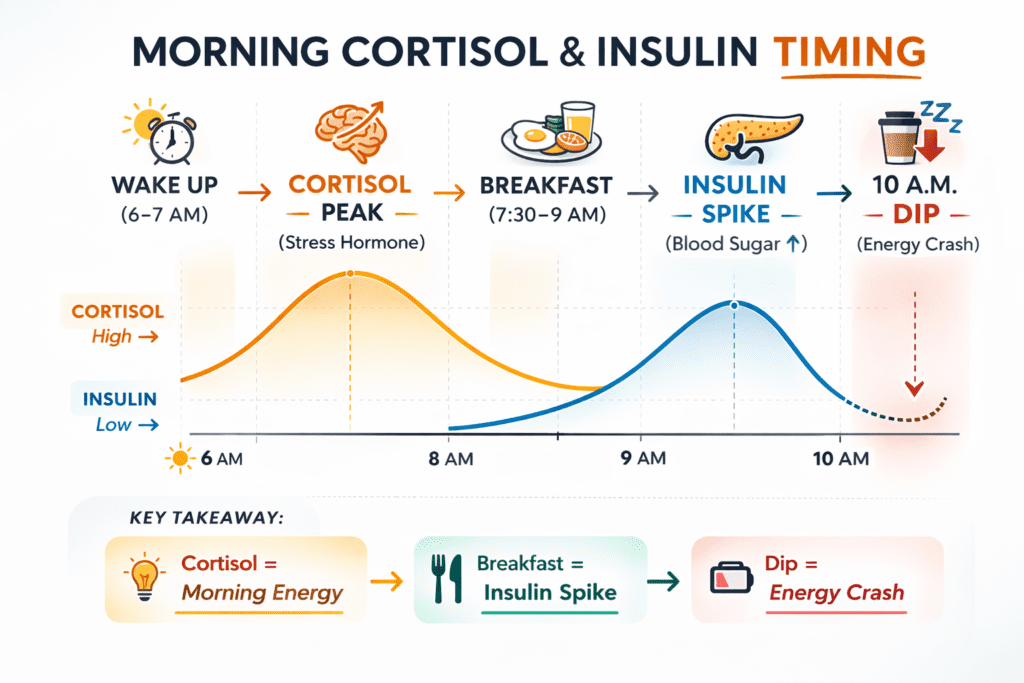
When you wake up your body activates the HPA axis which stands for hypothalamic-pituitary-adrenal axis. This system releases cortisol as part of your circadian rhythm.
Cortisol naturally rises within 30 to 60 minutes after waking. According to the National Institutes of Health overview of cortisol physiology https://www.ncbi.nlm.nih.gov/books/NBK538239/ this morning surge is designed to increase alertness and raise blood glucose.
Cortisol does three important things in the morning:
- Signals the liver to release stored glycogen
- Increases blood sugar
- Activates the sympathetic nervous system
This is your internal alarm clock.
Before you eat anything your body is already increasing blood glucose to fuel your brain.
This timing matters more than most people realize.
What Happens When Insulin Spikes During Peak Cortisol Window
When you eat carbohydrates your pancreas releases insulin. Insulin’s job is to move glucose out of the bloodstream and into muscle and liver cells.
Now imagine this sequence.
Cortisol is already raising blood sugar.
You eat a carbohydrate-heavy breakfast.
Blood sugar rises further.
Insulin releases strongly.
If insulin overshoots, blood glucose can drop below baseline within 90 to 120 minutes.
That drop is the reason many people feel tired after a healthy breakfast.
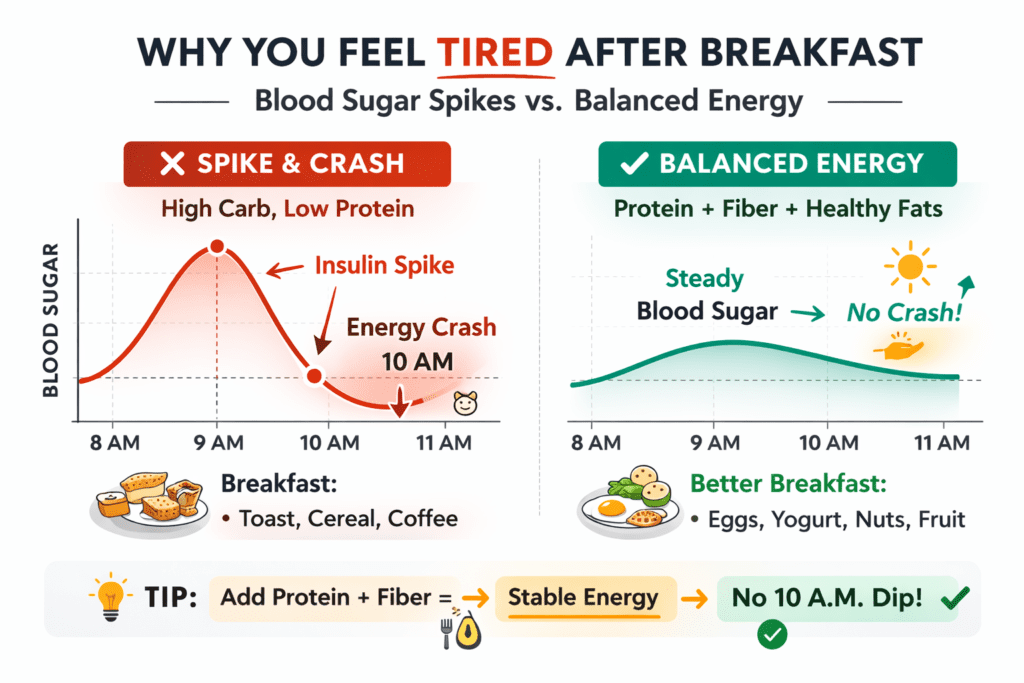
The 4-Step Hormone Chain Behind the 10AM Crash
- Cortisol increases blood sugar after waking.
- A high-carb breakfast raises glucose further.
- Insulin releases aggressively to lower glucose.
- Insulin overshoots causing a temporary dip and fatigue.
This pattern is a mild form of reactive hypoglycemia. NIH educational resources explain how post-meal insulin surges can temporarily lower blood sugar in some individuals https://medlineplus.gov/hypoglycemia.html
When this dip happens you may feel sleepy shaky irritable or suddenly hungry.
Why Healthy Carbs Can Still Trigger Blood Sugar Instability
The word healthy does not equal slow digestion.
Many popular American healthy breakfasts are:
- Oatmeal with fruit
- Smoothies with banana and mango
- Whole grain toast with jam
- Low-fat yogurt with granola
These foods contain vitamins and fiber. But they can still digest quickly and raise blood glucose fast.
The Centers for Disease Control and Prevention explains how insulin regulates post-meal glucose levels https://www.cdc.gov/diabetes/managing/index.html
The issue is glucose speed.
Fast glucose rise leads to strong insulin release. Strong insulin release increases the chance of overshoot.
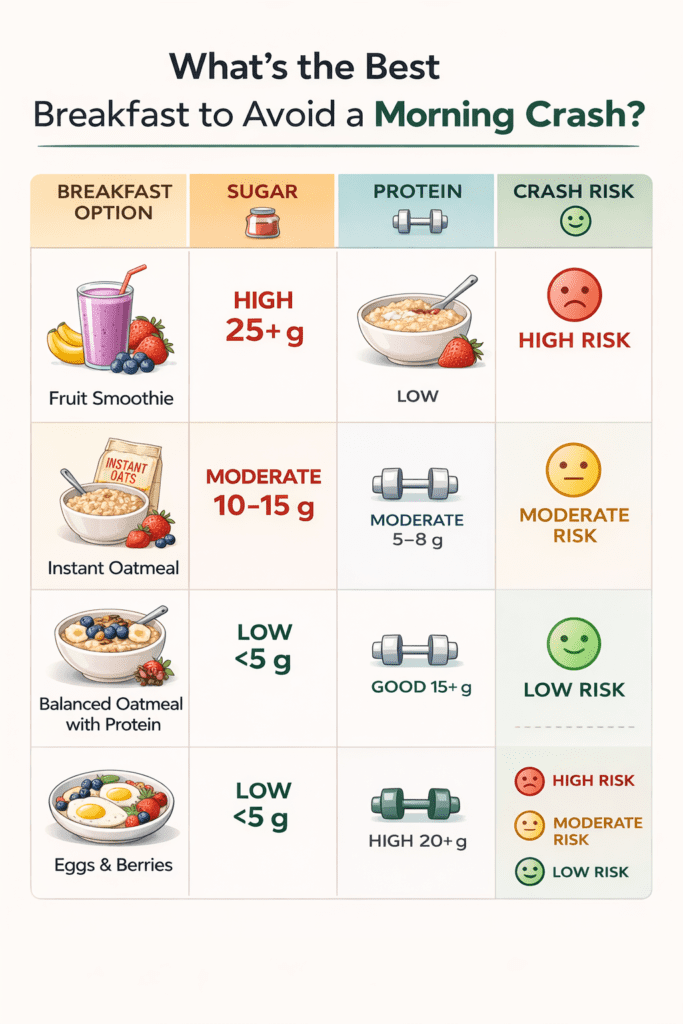
| Breakfast Type | Glucose Speed | Insulin Response | Crash Risk |
|---|---|---|---|
| Fruit-only smoothie | Very fast | High | High |
| Instant oatmeal with honey | Fast | High | Moderate–High |
| Oatmeal + protein + fat | Moderate | Balanced | Low |
| Eggs + berries + nuts | Slow | Stable | Very Low |
That overshoot is why some people consistently feel tired after a healthy breakfast even when they are eating clean.
The Hidden Reason You Feel Tired After a Healthy Breakfast
The deeper reason involves glycogen depletion.
Overnight your liver uses stored glycogen to maintain blood sugar. By morning those stores are partially reduced.
Cortisol helps release what remains.
If breakfast triggers a strong insulin spike insulin suppresses further glucose release from the liver.
Now your body shifts from releasing energy to storing energy.
If insulin lowers blood sugar too quickly your brain senses decline.
Your brain depends on steady glucose delivery. Even small rapid drops can trigger fatigue brain fog and cravings.
If you have experienced tiredness after meals in general this breakdown of tired after eating https://everydayhealthplan.com/tired-after-eating/ explores similar mechanisms across different times of day.
What Most People Miss About Caffeine and Morning Crashes
When you feel tired after a healthy breakfast your first instinct might be coffee.
Here is the counterintuitive truth.
Caffeine blocks adenosine which builds sleep pressure. But caffeine also stimulates cortisol and adrenaline.
If you are already in a blood sugar dip caffeine may temporarily mask symptoms. When it wears off the crash can feel worse.
Now you have:
- Declining glucose
- Rising adenosine
- Falling cortisol
- Nervous system fluctuation
That layered shift feels like mental exhaustion.
For a deeper breakdown of how caffeine timing alone can trigger its own fatigue cycle, especially when it collides with natural cortisol decline, read why you feel tired after drinking coffee:
https://everydayhealthplan.com/tired-after-drinking-coffee/
Common Triggers That Make You Tired After a Healthy Breakfast
- Breakfast low in protein
- High carbohydrate load
- Eating during cortisol peak
- No morning movement
- Elevated stress state
- Caffeine timing that mismatches your circadian rhythm (see why you feel tired after drinking coffee in the afternoon)
These factors amplify one another.
The Link Between Breakfast Protein and Insulin Sensitivity
Protein changes the hormonal response to breakfast.
When you include 20 to 30 grams of protein three things happen:
- Gastric emptying slows
- Glucagon releases alongside insulin
- Blood sugar rises more gradually
Glucagon acts as insulin’s counterbalance. It helps prevent glucose from dropping too fast.
Low protein breakfast patterns increase overshoot risk.
Even simple changes like adding eggs Greek yogurt cottage cheese or nut butter can reduce the chance you feel tired after a healthy breakfast.
The Real Cause of 10AM Fatigue After Oatmeal
Oatmeal is not the enemy. The structure of the meal is.
Instant oats digest faster than steel-cut oats. Adding honey increases total glucose load. Eating oats alone without protein accelerates insulin response.
Pairing oatmeal with protein and healthy fats changes the glucose curve.
The issue is not whether the food is wholesome. It is whether it stabilizes glucose velocity.
How Reactive Hypoglycemia Develops Across the Workday
Repeated morning dips create a pattern.
High-carb breakfast
Insulin spike
Blood sugar drop
Mid-morning snack
Second insulin spike
Afternoon instability
This cycle can extend into the afternoon. Many people then search why am I so tired in the afternoon https://everydayhealthplan.com/why-am-i-so-tired-in-the-afternoon/ without connecting it to breakfast structure.
Morning instability compounds throughout the day.
The Impact Of Sedentary Mornings on Glucose Regulation

Muscle contraction increases glucose uptake independent of insulin.
When you wake up eat and sit for hours insulin has to do more work.
Light movement improves insulin sensitivity.
A short routine like this 5 minute morning stretch for desk workers https://everydayhealthplan.com/5-minute-morning-stretch-desk-workers/ can improve glucose handling.
Hydration also supports circulation and metabolic signaling. Reviewing simple daily hydration habits for energy https://everydayhealthplan.com/simple-daily-hydration-habits-energy/ may support overall stability.
The body expects movement after food.
Why Hormone Timing Creates the Classic 10AM Crash Window
Timing is everything.
6 30 wake cortisol rising
7 00 eat high-carb breakfast
7 30 insulin peaks
9 30 cortisol declining insulin still active
That overlap creates vulnerability.
The sharper the initial rise the sharper the contrast.
Contrast drives the fatigue sensation.
The Role of Sleep Adenosine and Circadian Misalignment
If sleep was fragmented adenosine may not fully clear overnight.
High adenosine plus falling glucose equals stronger fatigue.
Circadian rhythm misalignment also alters cortisol timing. Patterns such as wired but tired at night https://everydayhealthplan.com/wired-but-tired-at-night/ often reflect disrupted rhythm that carries into morning metabolism.
Energy systems are interconnected.
How to Prevent Feeling Tired After a Healthy Breakfast
Instead of eliminating carbohydrates adjust the composition and timing.
- Wait 30 minutes after waking before eating
- Include 20 to 30 grams protein
- Add healthy fats
- Choose slower-digesting carbs
- Move lightly after eating
- Reduce morning stress exposure
These changes stabilize glucose without extreme dieting.
If you are experimenting with skipping meals understand that skipping breakfast makes you tired https://everydayhealthplan.com/skipping-breakfast-makes-you-tired/ for different hormonal reasons.
The goal is balance not restriction.
What Happens When Stress Elevates Morning Glucose Output
Stress activates the sympathetic nervous system and increases cortisol and adrenaline.
If you eat a high-carb breakfast during stress your liver releases additional glucose on top of food-derived glucose.
Insulin then reacts to a larger load.
The crash becomes stronger.
Context shapes metabolism.

Why Eliminating Carbs Completely Is Not the Long-Term Solution
Removing carbohydrates may blunt glucose spikes temporarily. But extremely low carbohydrate intake can increase cortisol and alter thyroid signaling over time.
The goal is metabolic flexibility and insulin sensitivity not avoidance.
Balanced macronutrients aligned with circadian rhythm produce more stable energy.
What Happens When You Stabilize Morning Hormone Interactions
When cortisol insulin glucagon and muscle activity are aligned your morning energy feels steady.
You are less likely to need extra caffeine. Less likely to crave mid-morning snacks. Less likely to crash in the afternoon.
If you repeatedly feel tired after a healthy breakfast the issue is not willpower.
It is hormone choreography.
Once you adjust protein intake timing movement and stress exposure the 10 a.m. crash often fades.
Energy is not about eating perfectly.
It is about aligning your biology with your breakfast.
The Real Cause of Morning Glucose Volatility in Busy Adults
To understand why you feel tired after a healthy breakfast, you have to understand glucose volatility.
Glucose volatility means how quickly your blood sugar rises and falls.
Two people can eat the same breakfast and have very different glucose curves depending on:
- Insulin sensitivity
- Sleep quality
- Stress levels
- Muscle mass
- Previous day carb intake
- Hydration status
If you are under chronic stress your baseline cortisol may already be elevated. That changes how aggressively your body releases glucose in the morning.
If you slept poorly insulin sensitivity decreases the next day. That means your body needs more insulin to manage the same carbohydrate load.
More insulin increases overshoot risk.
That overshoot is the crash.
What Happens Inside the Brain During a Blood Sugar Dip
Your brain does not store energy. It depends on a constant supply of glucose from the bloodstream.
When glucose declines rapidly the hypothalamus detects it first. This activates:
- Sympathetic nervous system
- Adrenaline release
- Hunger signaling
- Reduced executive function
The prefrontal cortex becomes less efficient.
That is why when you feel tired after a healthy breakfast it often feels like:
- Poor focus
- Slower thinking
- Lower motivation
- Increased irritability
This is not laziness. It is neurochemistry.
Rapid glucose changes create cognitive fatigue before they create physical weakness.
The Link Between Insulin Sensitivity and Morning Energy Stability
Insulin sensitivity determines how effectively your cells respond to insulin.
High insulin sensitivity means your muscles absorb glucose efficiently with less insulin.
Low insulin sensitivity means your pancreas must release more insulin to manage the same meal.
Higher insulin release increases the chance of overshoot.
Factors that reduce insulin sensitivity include:
- Chronic stress
- Poor sleep
- Sedentary lifestyle
- High ultra-processed food intake
- Central body fat accumulation
Even mild reductions in insulin sensitivity can increase the chance you feel tired after a healthy breakfast.
This is why someone who eats oatmeal at age 22 may feel great but at 38 starts crashing.
The biology shifts.
The Hidden Role of Muscle Mass in Breakfast Energy Response
Muscle tissue is your largest glucose disposal system.
The more metabolically active muscle you have the more stable your post-meal glucose tends to be.
If you are sedentary most of the day your muscles are less responsive to glucose uptake signals.
Even light resistance training improves insulin sensitivity.
You do not need intense workouts. Consistent muscle activation matters more than intensity.
When muscle is metabolically active glucose stability improves and the likelihood you feel tired after a healthy breakfast decreases.
Why Fruit-Only Breakfasts Increase Crash Risk
Fruit contains fiber and micronutrients. But fruit alone is primarily carbohydrate.
When eaten alone fruit digests quickly. Fructose is processed in the liver and contributes to glycogen restoration.
But if combined with existing cortisol-driven glucose release the total glucose exposure increases.
Without protein or fat to slow digestion insulin may spike rapidly.
That spike increases the chance of a mid-morning dip.
Adding protein to fruit changes the response dramatically.
This is not anti-fruit. It is about balance.
What Happens When You Eat Too Fast
Speed of eating changes hormonal response.
When you eat quickly glucose enters circulation faster. The pancreas responds quickly.
When you eat slowly incretin hormones such as GLP-1 increase. These hormones moderate insulin response and slow gastric emptying.
Rapid eating increases volatility.
Slower eating improves stability.
If you regularly feel tired after a healthy breakfast examine how fast you consume it.
Five extra minutes can change the glucose curve.
The Real Cause of Feeling Shaky and Tired Mid-Morning
Shakiness often reflects adrenaline release triggered by glucose decline.
When blood sugar drops the body attempts to correct it by releasing adrenaline to mobilize stored energy.
That adrenaline can produce:
- Jitteriness
- Rapid heartbeat
- Anxiety
- Sweating
This is not always severe hypoglycemia. It is relative hypoglycemia where glucose drops rapidly compared to earlier levels.
If this happens frequently review why do I feel shaky and tired https://everydayhealthplan.com/why-do-i-feel-shaky-and-tired/ for additional metabolic explanations.
The pattern often begins at breakfast.
The Impact Of High-Glycemic Breakfasts on Afternoon Energy
Morning instability often predicts afternoon fatigue.
If you start the day with volatile glucose your nervous system shifts repeatedly between sympathetic and parasympathetic states.
By mid-afternoon your system is fatigued.
This is why people who feel tired after a healthy breakfast often also experience exhausted at 3pm even after 8 hours sleep https://everydayhealthplan.com/exhausted-at-3pm-even-after-8-hours-sleep/
It is rarely random.
It is cumulative metabolic stress.
Why Low-Fat Diet Patterns Can Backfire in the Morning
For years low-fat breakfast advice was popular.
But dietary fat slows digestion and reduces glucose velocity.
A completely fat-free breakfast allows carbohydrates to enter the bloodstream faster.
Even 10 to 15 grams of healthy fat can meaningfully change glucose absorption rate.
Fat is not the enemy in the morning. Excessive imbalance is.
Balanced macronutrients stabilize insulin dynamics.
The Connection Between Cortisol Decline and Mid-Morning Fatigue
Cortisol naturally declines after its morning peak.
If insulin is still elevated when cortisol drops the combined effect can create a low-energy window.
You feel tired not because cortisol is low but because glucose is unstable during the decline.
The contrast between earlier high energy and current lower levels amplifies fatigue perception.
The body reads relative change more strongly than absolute value.
How Hydration Influences Morning Energy Perception
Even mild dehydration increases perceived fatigue.
Overnight you lose water through breathing and sweating.
If you wake slightly dehydrated blood volume is lower. Glucose delivery efficiency may feel reduced.
Drinking 12 to 16 ounces of water upon waking supports circulation and may blunt perceived crash intensity.
Hydration does not fix insulin overshoot but it improves overall stability.

What Happens When Sleep Debt Alters Insulin Response
Short sleep duration reduces insulin sensitivity the next day.
One night of restricted sleep can increase insulin resistance temporarily.
If you eat a carbohydrate-heavy breakfast after poor sleep insulin response is exaggerated.
More insulin equals greater dip risk.
This is why someone can eat the same breakfast one week feel fine and the next week feel tired after a healthy breakfast.
Sleep changed the equation.
The Role of the Parasympathetic Nervous System in Digestion
Digestion requires parasympathetic activation also known as rest-and-digest mode.
If you eat in a stressed sympathetic state glucose regulation becomes less predictable.
Taking a few deep breaths before eating can activate vagal tone.
Better vagal tone improves digestive efficiency and moderates glucose spikes.
Simple breathing exercises such as those described in 5 simple breathing exercises to reduce daily stress https://everydayhealthplan.com/5-simple-breathing-exercises-to-reduce-daily-stress/ can indirectly support morning stability.
Why Some People Never Experience Morning Crashes
Not everyone feels tired after a healthy breakfast.
Those who do not often share these characteristics:
- Higher muscle mass
- Better sleep consistency
- Lower chronic stress
- Balanced macronutrient intake
- Morning movement habit
Genetics also influence insulin response variability.
But lifestyle factors dominate.
Most morning crashes are modifiable.
The Escalation Chain That Leads to Metabolic Burnout
If morning crashes continue unchecked the body adapts.
Frequent insulin spikes can reduce receptor sensitivity.
Reduced sensitivity requires more insulin release.
More insulin increases storage signaling and appetite.
Over time this can contribute to central fat gain and chronic fatigue patterns.
The earlier you stabilize morning metabolism the easier it is to prevent escalation.
Small adjustments create long-term protection.
Why Feeling Tired After a Healthy Breakfast Is a Feedback Signal
Fatigue is not random punishment.
It is feedback.
Your body is signaling that glucose regulation timing needs adjustment.
When you align:
- Cortisol peak
- Protein intake
- Carbohydrate load
- Movement
- Stress management
- Sleep quality
The signal changes.
Energy becomes stable rather than volatile.
If you consistently feel tired after a healthy breakfast your body is asking for better synchronization not stricter dieting.
The Practical Morning Stability Framework
Use this structured model:
Step 1 Hydrate immediately upon waking
Step 2 Get natural light within 30 minutes
Step 3 Delay breakfast slightly if cortisol is still rising
Step 4 Include at least 20 grams protein
Step 5 Pair carbs with fat and fiber
Step 6 Move lightly for 5 to 10 minutes
Step 7 Limit early caffeine until after food
This framework reduces insulin overshoot risk and stabilizes morning glucose delivery.
What Happens When You Apply These Changes Consistently
Within days many people report:
- Reduced 10 a.m. sleepiness
- Fewer cravings
- Less need for caffeine
- More stable mood
- Improved afternoon focus
Within weeks improved insulin sensitivity may further smooth glucose curves.
Consistency matters more than perfection.
The Final Explanation for Why You Feel Tired After a Healthy Breakfast

When you feel tired after a healthy breakfast it is rarely because the food is unhealthy.
It is because of:
- Cortisol timing
- Insulin dynamics
- Glycogen status
- Sleep quality
- Stress activation
- Movement level
- Insulin sensitivity
Energy is not about eating less or eating more.
It is about hormonal choreography.
When cortisol insulin glucagon and the nervous system move in harmony morning energy stabilizes.
When they overlap aggressively glucose dips and fatigue appears.
You are not failing at breakfast.
Your biology simply needs better alignment.
Stabilize the timing. Balance the macronutrients. Support sleep. Reduce stress.
Do that and the pattern of feeling tired after a healthy breakfast can shift from daily frustration to rare exception.
Stop the 10 a.m. crash with one simple breakfast reset
If you keep feeling tired after a healthy breakfast, don’t change your willpower—change your breakfast structure. Use the quick reset below today, then follow the related guides to stabilize energy all day.
2-Minute Morning Reset (Do This Tomorrow)
- Drink 12–16 oz of water within 10 minutes of waking.
- Add 20–30g protein to breakfast (eggs, Greek yogurt, cottage cheese, or a protein add-in).
- Take a 5–10 minute walk (or do a short stretch) after eating.
Want to pinpoint your exact trigger—blood sugar dip, stress response, or post-meal fatigue? Start here:
Keep Your Energy Stable All Day (Recommended Next Reads)
- If your crash shows up later: Why You’re So Tired in the Afternoon
- If it hits hard at the same time daily: Exhausted at 3pm Even After 8 Hours Sleep
- If stress keeps you wired at night: Wired But Tired at Night
- If you’re debating skipping breakfast: Why Skipping Breakfast Makes You Tired
- If movement is the missing piece: 5-Minute Morning Stretch for Desk Workers
- If hydration is quietly dragging energy down: Simple Daily Hydration Habits for Energy
Pro tip: If your symptoms include shakiness, sudden hunger, or irritability, read the blood sugar crash guide first—then come back and adjust breakfast composition.
Frequently Asked Questions
Why do I feel tired after eating a healthy breakfast?
You may feel tired after a healthy breakfast because your blood sugar rises quickly and triggers a strong insulin response. If insulin lowers glucose too aggressively during the natural morning cortisol peak, energy can dip within one to two hours, leading to fatigue, brain fog, and increased hunger.
Can oatmeal make you sleepy in the morning?
Yes. Oatmeal can make you sleepy if it is eaten alone or combined with added sugars. Fast-digesting carbohydrates may spike blood sugar and insulin, followed by a mid-morning drop. Pairing oatmeal with protein and healthy fats helps slow digestion and stabilize glucose levels.
Is feeling tired after breakfast a sign of low blood sugar?
Sometimes. A rapid drop in blood glucose after a meal is often referred to as reactive hypoglycemia. In many cases it is mild but can cause shakiness, irritability, and sleepiness. The issue is usually timing and macronutrient balance rather than a serious medical condition.
Why does a fruit smoothie cause a mid-morning crash?
Fruit-heavy smoothies digest quickly, especially when they lack protein or fat. This can cause a fast rise in blood sugar followed by a strong insulin response. The resulting dip may make you feel tired, unfocused, or suddenly hungry about 90 to 120 minutes later.
Should I skip breakfast if it makes me tired?
Skipping breakfast is not automatically the solution. For some people, skipping meals can disrupt cortisol rhythm and lead to afternoon fatigue. Instead of eliminating breakfast, adjusting protein intake, carbohydrate load, and meal timing often improves energy stability.
How much protein should breakfast include to prevent crashes?
Many adults benefit from including 20 to 30 grams of protein at breakfast. Protein slows gastric emptying, supports glucagon release, and reduces the risk of insulin overshoot that can trigger a mid-morning energy dip.
Why does the crash usually happen around 10 a.m.?
Cortisol naturally declines after its early morning peak. If insulin remains elevated from a high-carbohydrate breakfast, the overlap between falling cortisol and active insulin can create a vulnerable window where blood sugar dips and fatigue appears.
Can caffeine make a morning energy crash worse?
Yes. Caffeine can temporarily block fatigue signals by affecting adenosine, but it does not correct unstable blood sugar. When caffeine wears off, the combination of declining glucose and shifting stress hormones may make the crash feel stronger.
Editorial Standards
This article is based on current understanding of metabolic physiology, insulin-glucose regulation, circadian hormone timing, and nervous system interactions. The goal is to explain biological mechanisms in clear language without making medical claims or guarantees. Content is written for educational purposes and reflects publicly available research from recognized health institutions.
