

It’s 2:45 PM. You’re staring at your screen, rereading the same sentence for the third time. Your energy feels flat. Your focus drifts. So you do what millions of Americans do every afternoon — you grab another cup of coffee.
For about 20 minutes, it works. You feel sharper. More alert. Almost productive again.
Then around 4:30 PM, you crash.
If you’ve ever wondered why you feel tired after drinking coffee, especially later in the day, you’re not imagining it. Coffee doesn’t actually create energy inside your cells. It temporarily blocks fatigue signals in your brain. When that block fades, the underlying sleep pressure can rebound harder than before.
Understanding why you feel tired after drinking coffee requires looking at adenosine buildup, cortisol timing, blood sugar regulation, circadian rhythm patterns, dopamine signaling, and nervous system activation. When these systems collide in the afternoon, caffeine can backfire.
What Does It Really Mean to Feel Tired After Drinking Coffee
Feeling tired after drinking coffee usually happens because caffeine blocks adenosine temporarily, then triggers a rebound effect once it wears off. During this rebound, accumulated sleep pressure floods the brain and often combines with a natural afternoon circadian dip and declining cortisol levels, making fatigue feel stronger than before.
The Science Behind Why You Feel Tired After Drinking Coffee
Caffeine’s primary biological target is a molecule called adenosine. Adenosine builds up in your brain the longer you stay awake. It binds to receptors and signals that your body needs rest. This buildup is called sleep pressure.
Caffeine does not remove adenosine. It does not eliminate sleep debt. It does not increase ATP production in your mitochondria. Instead, caffeine competes for the same receptors and temporarily blocks adenosine from attaching.
While caffeine is active:
- Adenosine cannot bind
- Alertness temporarily improves
- Dopamine signaling increases slightly
- Reaction time sharpens
- Cortisol may rise briefly
But adenosine continues accumulating in the background.
When caffeine levels decline, all the stored adenosine suddenly binds to open receptors. That surge produces what many people describe as a caffeine crash. This rebound effect is a major reason people feel tired after drinking coffee instead of sustained energy.
For deeper scientific detail on caffeine’s mechanism of action, the National Center for Biotechnology Information explains caffeine pharmacology here:
https://www.ncbi.nlm.nih.gov/books/NBK223808/
What Happens When Adenosine Rebound Collides With the Afternoon Circadian Dip
Most adults experience a natural dip in alertness between 1 PM and 3 PM. This drop is not laziness. It is circadian biology.
Your circadian rhythm is controlled by the suprachiasmatic nucleus in the hypothalamus. It regulates body temperature, hormone release, melatonin timing, and alertness patterns across the day.
During the early afternoon:
- Core body temperature slightly decreases
- Cortisol levels decline
- Alertness dips
- Reaction time slows
If you drink coffee during this dip, caffeine artificially overrides the slowdown.
When caffeine metabolizes, you don’t return to baseline. You crash directly into the circadian dip plus accumulated adenosine.
This is why many people researching why am I so tired in the afternoon discover caffeine timing plays a hidden role.

The circadian system is one of the strongest biological regulators in the body. The National Institute of General Medical Sciences provides a clear overview of circadian rhythm regulation here: https://www.nigms.nih.gov/education/fact-sheets/Pages/circadian-rhythms.aspx
The Hidden Reason Coffee Feels Powerful Before It Suddenly Backfires
Here’s the counterintuitive truth:
Coffee does not create energy. It masks fatigue.
Because adenosine signaling is blocked, your brain stops receiving the tiredness message. That relief feels dramatic.
But underneath:
- Sleep debt remains
- Glycogen stores are unchanged
- Inflammatory markers are not reduced
- Mitochondrial ATP production is unchanged
- Nervous system strain may increase
You are borrowing alertness from your stress response system.
And the later in the day you borrow it, the more disruptive the repayment becomes.
The Real Cause of the Afternoon Coffee Crash Cycle
Occasional caffeine rebound is normal. The problem develops when it becomes daily.
The cycle looks like this:
- Afternoon dip hits
- You drink coffee
- Adenosine builds silently
- Caffeine metabolizes
- Fatigue rebounds harder
- Evening alertness feels wired but tired
- Sleep quality decreases
- Next day fatigue increases
That wired but tired pattern is often connected to delayed melatonin and sympathetic nervous system overstimulation. You can explore that mechanism further in wired but tired at night.
Over time, your brain adapts. It increases adenosine receptor density. This means you need more caffeine for the same effect. Tolerance builds. Crashes intensify.
The Impact Of Cortisol Timing and Nervous System Overdrive
Caffeine stimulates the sympathetic nervous system. This is your fight or flight system. It increases heart rate, blood pressure, and alertness.
Cortisol naturally peaks 30 to 45 minutes after waking. It gradually declines through the day.
If caffeine is consumed when cortisol is already declining, it creates a temporary spike. When caffeine fades, cortisol does not rebound upward. It continues its downward trajectory.
That leaves you with:
- High adenosine
- Lower cortisol
- Reduced dopamine signaling
- Increased sleep pressure
This is why the crash feels heavier than the initial fatigue.
According to Mayo Clinic’s guidance on caffeine timing and half life, caffeine can remain active for five to seven hours in many adults:
https://www.mayoclinic.org/healthy-lifestyle/nutrition-and-healthy-eating/in-depth/caffeine/art-20045678
If you drink 150 mg at 3 PM:
- About 75 mg may still be active at 8 PM
- Around 35 mg may still circulate at midnight
Residual stimulation interferes with deep sleep and slow wave recovery.
The Impact Of Cortisol Timing and Nervous System Overdrive
The issue is not simply how much coffee you drink. It is when you drink it relative to your circadian rhythm and bedtime.
For many adults, caffeine should stop at least six to eight hours before sleep.
Signs Your Afternoon Coffee Is Backfiring
- You crash two to four hours later
- You crave sugar after caffeine
- You feel wired but tired at night
- You need more coffee each week
- You wake up groggy despite eight hours in bed
If these signs are familiar, caffeine timing may be colliding with your biological clock.
The Link Between Blood Sugar Fluctuations and Caffeine Energy Crashes
Many afternoon coffees are not black. They include flavored syrups, sweet creamers, or pastries.
Glucose spikes trigger insulin release. If insulin clears glucose quickly, blood sugar may dip below baseline. Low blood sugar signals the brain to conserve energy.
If that dip occurs at the same time adenosine rebounds, fatigue intensifies.

You can see how glucose instability contributes to energy crashes in why blood sugar crash symptoms happen.
For some people, combining caffeine with a sugar spike creates a double crash.
The 5 Step Caffeine Rebound Process
- Adenosine builds throughout the day
- Caffeine blocks adenosine receptors
- Sleep pressure accumulates silently
- Caffeine metabolizes over several hours
- Adenosine floods receptors causing fatigue rebound
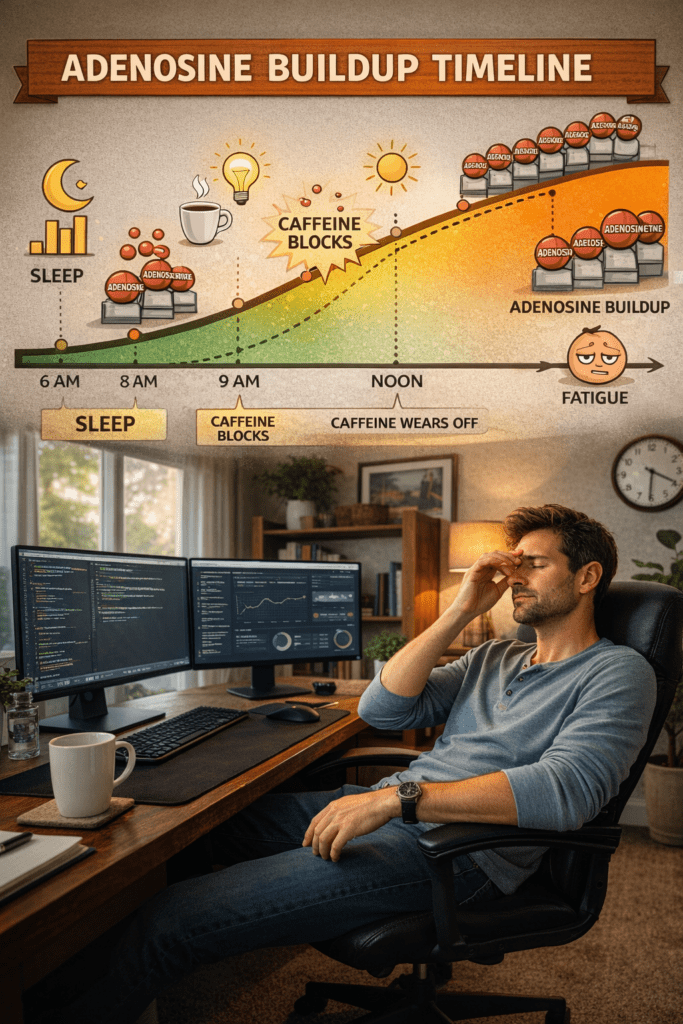
This structured chain explains why you feel tired after drinking coffee instead of consistently energized.
| Coffee Timing | Biological Interaction | Short-Term Effect | 2–4 Hours Later | Sleep Impact |
|---|---|---|---|---|
| Early Morning (after cortisol peak) | Blocks adenosine with high baseline cortisol | Smooth alertness boost | Mild rebound | Minimal disruption |
| Late Morning | Adenosine rising moderately | Noticeable focus increase | Moderate dip | Slight delay in sleep onset |
| Early Afternoon (1–3 PM) | Collides with circadian dip | Temporary alertness spike | Strong rebound crash | Reduced deep sleep quality |
| Late Afternoon (after 3 PM) | Declining cortisol + rising sleep pressure | Artificial stimulation | Heavy fatigue rebound | Delayed melatonin release |
| Evening | High sleep pressure + melatonin rise | Wired but alert feeling | Severe crash next day | Significant sleep fragmentation |
What Happens When Sleep Debt Amplifies the Caffeine Rebound Effect
Sleep debt changes the equation.
When you are sleep deprived:
- Adenosine baseline starts higher
- Cortisol rhythms flatten
- Dopamine signaling weakens
- Insulin sensitivity may decline
- Inflammation increases
Caffeine masks fatigue but does not fix sleep debt. When it fades, the rebound feels amplified.
This overlap explains why crashes often feel worse after a poor night of sleep or during stressful workweeks.
The Impact Of Light Exposure and Sedentary Behavior on Afternoon Energy
Afternoon indoor lighting is often dim compared to natural sunlight. Light signals from the retina regulate circadian rhythm and alertness.
Spending long hours under artificial lighting while sitting reduces:
- Dopamine stimulation
- Circulation
- Oxygen delivery
- Nervous system variability
If you combine low light, sedentary posture, and caffeine rebound, the crash deepens.

Short outdoor exposure can stimulate retinal ganglion cells and reinforce circadian signals. For those exploring non caffeine approaches, see midday energy boost without coffee.
What Happens When the Coffee Crash Pattern Escalates Over Months
If uncorrected, the pattern may escalate into:
- Daily 3 PM crashes
- Increased caffeine tolerance
- Evening insomnia
- Weekend oversleeping
- Emotional irritability
- Greater reliance on sugar
Many people assume this is aging or low energy genetics. Often, it is caffeine timing layered on circadian drift and nervous system overactivation.
Harvard Medical School discusses circadian rhythm control and brain timing mechanisms here:
https://hms.harvard.edu/news-events/publications-archive/brain/circadian-rhythms-brain
The Cause-Effect Chain Behind Why You Feel Tired After Drinking Coffee
Morning wake triggers cortisol peak. Adenosine begins building. Afternoon circadian dip lowers alertness. Coffee blocks adenosine receptors. Sleep pressure continues rising in the background. Caffeine metabolizes. Adenosine floods receptors. Cortisol declines further. Fatigue rebounds stronger than before.
That biological chain explains why you feel tired after drinking coffee in the afternoon.
Coffee does not generate cellular energy. It delays fatigue signals. When those signals return during a natural circadian dip, the rebound feels amplified.
Understanding this mechanism changes how you approach caffeine. Instead of reacting automatically to afternoon fatigue, you can evaluate sleep quality, light exposure, hydration, meal timing, stress levels, and movement patterns.
If you consistently feel tired after drinking coffee, especially later in the day, the solution is rarely another cup. It is timing, sleep depth, circadian alignment, and nervous system balance.
Still crashing in the afternoon?
If you feel tired after drinking coffee, the real issue may be blood sugar timing, circadian rhythm dips, or sleep disruption. These quick reads will help you pinpoint the cause.
Frequently Asked Questions
Why do I feel tired after drinking coffee?
You feel tired after drinking coffee because caffeine blocks adenosine temporarily rather than removing it. When caffeine wears off, accumulated adenosine binds to brain receptors at once, triggering a rebound effect that can make fatigue feel stronger than before.
Can caffeine cause an afternoon energy crash?
Yes, caffeine can cause an afternoon energy crash. If consumed during the natural circadian dip between 1 PM and 3 PM, the rebound effect may combine with declining cortisol levels and create a sharper drop in alertness.
How long does a caffeine crash usually last?
A caffeine crash typically lasts one to three hours. The duration depends on sleep quality, total caffeine intake, hydration, stress levels, and whether blood sugar drops occur alongside the adenosine rebound.
Why does coffee make me sleepy instead of awake?
Coffee can make you sleepy when sleep pressure is already high. Caffeine temporarily masks fatigue signals, but once it metabolizes, the accumulated adenosine can overwhelm the system and make tiredness feel amplified.
Does caffeine affect cortisol and stress hormones?
Caffeine can temporarily raise cortisol and activate the sympathetic nervous system. When caffeine fades, cortisol does not rebound upward, which may leave you feeling more drained than before the coffee.
Can blood sugar drops make caffeine crashes worse?
Yes, blood sugar fluctuations can intensify caffeine crashes. If coffee is paired with sugary drinks or pastries, insulin spikes may lead to a glucose dip that overlaps with caffeine rebound, increasing fatigue.
How many hours before bed should I stop drinking coffee?
Most adults should stop drinking coffee six to eight hours before bedtime. Caffeine’s half-life averages five to seven hours, meaning stimulation can remain active well into the evening and interfere with melatonin release.
About This Article
This article is grounded in established research from leading medical and scientific institutions. The explanation of caffeine metabolism and adenosine receptor activity is supported by data published by the National Center for Biotechnology Information (NCBI).
The circadian rhythm mechanisms discussed in this article are based on educational materials provided by the National Institute of General Medical Sciences (NIGMS), part of the National Institutes of Health.
Information regarding caffeine half-life and its physiological impact aligns with guidance from Mayo Clinic.
Additional context on brain timing systems and circadian regulation is informed by publications from Harvard Medical School.
This content is written in clear, evidence-based language to help readers understand how caffeine timing, sleep pressure, cortisol rhythms, and blood sugar fluctuations interact to influence afternoon fatigue in healthy adults.
