

Long shifts leaving you drained? The reason isn’t just physical—it’s how your body handles circulation, gravity, and muscle load over time.
You finish a long shift—maybe in retail, healthcare, or a warehouse—and instead of feeling “normal tired,” you feel completely drained. Your legs feel heavy, your energy crashes, and even sitting down doesn’t instantly fix it. You might think, “I didn’t even work out… why am I this exhausted?”
If you’ve ever wondered why you feel tired after standing all day, the answer isn’t just that you were on your feet. What’s happening inside your body is far more specific—and surprisingly overlooked.
This kind of fatigue isn’t about calories burned. It’s about how your body fights gravity, manages blood circulation, and keeps muscles engaged without rest. Once you understand the real mechanism, the exhaustion starts to make sense—and more importantly, becomes something you can control.
What Happens When You Feel Tired After Standing All Day in Your Body
Feeling tired after standing all day is a form of fatigue caused by reduced blood circulation, continuous muscle activation, and gravitational strain. Blood pools in the legs, oxygen delivery becomes less efficient, and postural muscles stay active for hours without recovery, leading to physical and mental exhaustion.
The Hidden Reason Why Standing All Day Drains More Energy Than You Expect
Most people assume standing is easy because you’re not moving much. But biologically, standing still is one of the most inefficient states your body can be in.
When you’re standing in place, your body is constantly working to keep you upright. Your postural muscles—especially your calf muscles, thighs, and lower back—stay activated the entire time. Unlike walking or moving, these muscles don’t get a chance to relax and reset.
At the same time, your circulatory system is working against gravity. Blood naturally moves downward, and your heart must continuously push it back up. According to how the circulatory system works, this process depends heavily on movement and muscle contraction.
Here’s the key problem:
Standing doesn’t activate your body’s natural circulation system as effectively as movement does.
So instead of helping circulation, standing still slows it down. That combination—constant muscle tension plus inefficient blood flow—creates a unique type of fatigue.
What Happens When Blood Pools in Your Legs for Hours
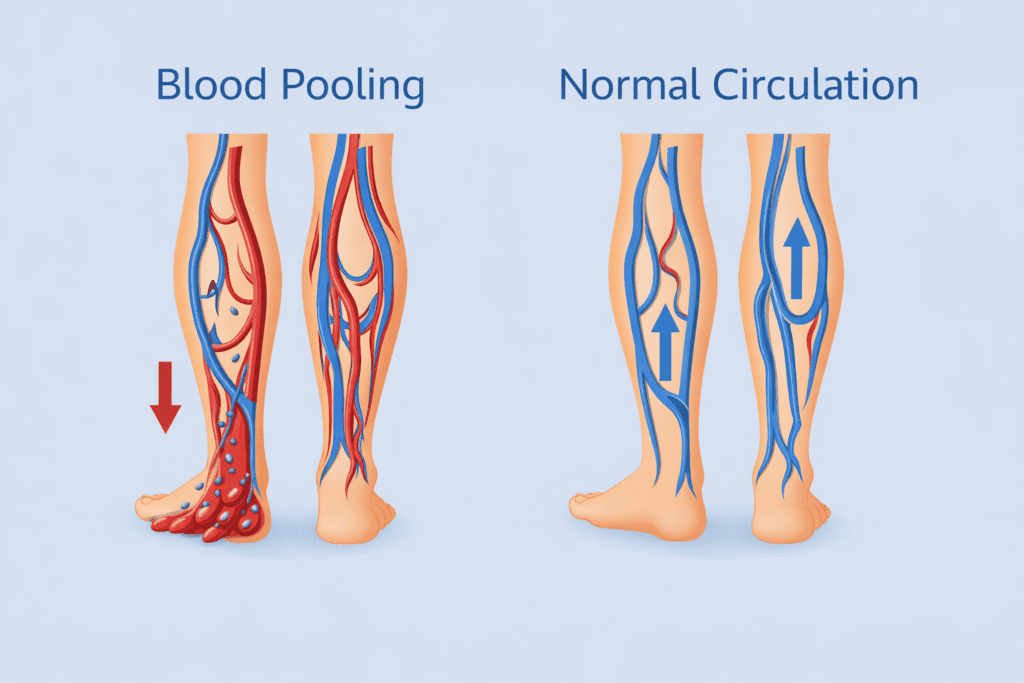
One of the biggest hidden causes of fatigue from standing all day is venous pooling.
When you stand for long periods without moving much, blood begins to collect in your lower legs due to gravity. Normally, your body relies on your calf muscles to push blood back up toward your heart.
Every time you walk, your calf muscles contract and act like a pump. But when you’re standing still, this system becomes less effective.
As explained in resources about how the heart works, your body depends on efficient blood return to maintain oxygen flow.
When that slows down:
- Blood stays in your legs
- Less blood returns to your heart
- Oxygen delivery decreases
This leads to that heavy, sluggish feeling you notice after hours on your feet.
If you’ve experienced fatigue in other situations, you may notice how it differs from tired after walking where movement actually improves circulation.
The Science Behind Static Load Fatigue and Continuous Muscle Overactivation
Another major factor behind why you feel tired after standing all day is static load fatigue.
This happens when muscles stay activated without movement.
When you walk, your muscles contract and relax in cycles. That allows recovery between movements. But when you stand still, your muscles remain partially contracted the entire time.
Over time:
- Muscle fibers don’t get a break
- Waste products build up
- Oxygen delivery becomes less efficient
This is very different from what happens during prolonged sitting, where compression plays a bigger role, as explained in why sitting too long makes you tired.
Standing fatigue is about constant activation, not inactivity.
How Reduced Oxygen Delivery Gradually Lowers Your Energy Levels
Your energy levels depend heavily on oxygen delivery.
When circulation slows due to standing, your tissues—including your brain—receive slightly less oxygen over time. This creates a gradual decline in energy rather than an immediate crash.
Here’s the chain:
- Blood pools in your lower body
- Circulation back to the heart slows
- Oxygen delivery drops slightly
- The brain detects reduced efficiency
- Fatigue signals increase
This is why you feel both physically and mentally tired at the end of the day.
The Link Between Standing All Day and Subtle Blood Pressure Regulation Changes
Standing for long hours requires your body to constantly regulate blood pressure to maintain stability.
As blood shifts downward due to gravity, your cardiovascular system compensates to keep enough circulation reaching your brain. This involves continuous micro-adjustments in vessel tension and heart output.
Over time, these adjustments increase physiological workload. Even without noticeable symptoms, this added demand contributes to fatigue by forcing your body to maintain balance under less efficient conditions.
This connection between circulation and pressure regulation is part of how your system maintains energy levels, as explained in circulatory system function.
Why Standing All Day Leaves You Exhausted Even Without Exercise
Many people wonder why they feel exhausted even without intense physical activity.
The answer is that your body is under constant low-level strain. Static muscle activation, reduced circulation, and nervous system signaling combine to create fatigue that feels disproportionate to the effort.
What Happens When These Main Factors Cause Fatigue After Standing All Day
- Blood pooling reduces circulation efficiency
- Calf muscles don’t pump blood effectively without movement
- Postural muscles stay constantly activated
- Oxygen delivery gradually declines
- The nervous system signals fatigue to protect your body
The Real Cause of Heavy Legs and That Drained Feeling After Work
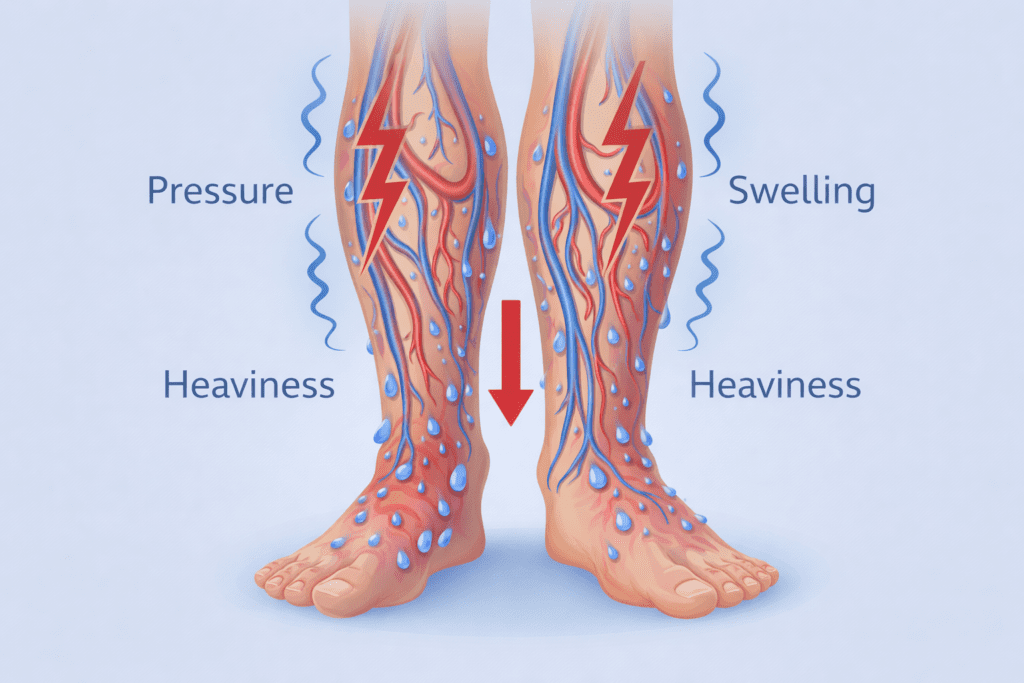
If your legs feel heavy after standing all day, it’s not just muscle soreness.
It’s a combination of fluid buildup, reduced circulation, and muscle fatigue. Blood and fluids accumulate in your lower body, increasing pressure and making movement feel harder.
This creates:
- heaviness
- tightness
- reduced mobility
This pattern can also contribute to broader energy crashes similar to afternoon energy crash prevention where circulation and energy regulation play a role.
How Fluid Accumulation in Your Lower Legs Changes Fatigue by the End of the Day
As the day progresses, fluid doesn’t just stay in your bloodstream—it can begin to shift into surrounding tissues in your lower legs and feet.
This gradual accumulation increases pressure within the tissues, making your legs feel tighter and heavier. You might notice that your shoes feel more restrictive or that your legs feel slightly swollen compared to earlier in the day.
This added pressure doesn’t just affect comfort. It also makes movement less efficient, requiring more effort for each step or shift in posture.
By the end of a long shift, this combination of fluid buildup and muscle fatigue changes how fatigue feels. It becomes less about simple tiredness and more about a deep, heavy sensation that slows you down.
Why Your Legs Feel Heavy After Standing for Long Hours
Yes, this is normal. Heavy legs are usually caused by fluid buildup, reduced circulation, and muscle fatigue. Improving circulation and reducing static load can help relieve this feeling.
What Happens When Your Nervous System Signals You to Slow Down
Your nervous system constantly monitors your body’s efficiency.
When it detects that your circulation is struggling and muscles are fatigued, it sends a signal: slow down.
This signal shows up as fatigue.
Hormones like cortisol and adrenaline help maintain alertness earlier in the day, but as strain builds, your system shifts toward conserving energy. This is similar to patterns seen in mental fatigue after work.
The Counterintuitive Truth About Standing Still vs Moving Around All Day
Here’s the surprising truth:
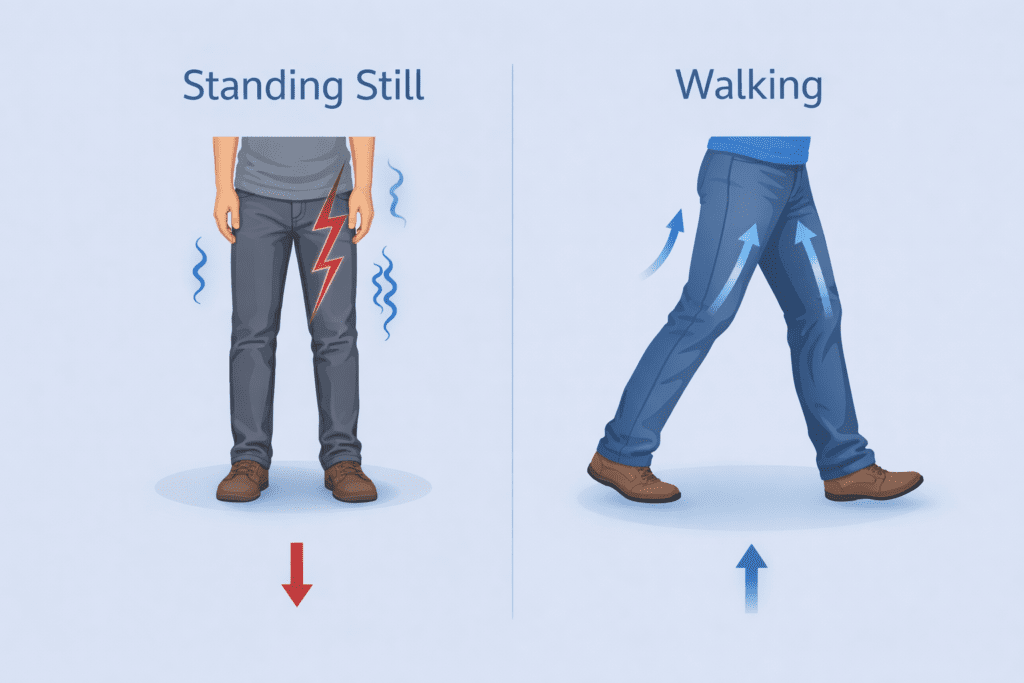
Standing still can be more exhausting than walking.
When you move:
- circulation improves
- muscles cycle between contraction and relaxation
- oxygen delivery increases
When you stand still:
- muscles stay engaged
- circulation slows
- fatigue builds
The Hidden Reason Why Standing Fatigue Differs From Movement Fatigue
| Factor | Standing Still | Walking or Moving |
|---|---|---|
| Muscle activity | Constant contraction | Cycles of contraction and relaxation |
| Blood circulation | Slower | Improved |
| Oxygen delivery | Reduced over time | Maintained |
| Energy usage | Low but continuous | Balanced |
| Fatigue buildup | Gradual and heavy | Slower and manageable |
What Happens When You Alternate Weight Distribution Instead of Standing Completely Still
Remaining completely still creates continuous strain on the same muscle groups. But when you shift your weight from one foot to the other, you introduce variation into that load.
This redistribution allows certain muscles to briefly reduce their workload while others take over. The result is a more balanced use of your muscular system rather than constant pressure on a single set of tissues.
In addition, weight shifting creates subtle changes in blood flow patterns. These changes help prevent blood from settling in one area for too long, supporting more stable circulation throughout the day.
Even small adjustments in posture can significantly reduce how quickly fatigue develops.
What Most People Miss About Fatigue That Builds Hour by Hour
One of the biggest reasons this fatigue feels overwhelming is because it builds gradually.
You may feel fine in the morning, but over time:
- circulation becomes less efficient
- muscle fatigue increases
- fluid builds in your legs
- fatigue signals intensify
By the end of the day, everything combines into a strong feeling of exhaustion.
How Your Body’s Internal Clock Influences Fatigue During Long Standing Hours
Your body doesn’t operate at the same energy level all day.
In the morning, higher cortisol levels support alertness and help your body handle physical demands more efficiently. As the day progresses, these levels gradually decline.
This natural shift is part of your circadian rhythm. When combined with prolonged standing, it amplifies fatigue.
By late afternoon, your body is dealing with both accumulated physical strain and a biological drop in energy. This overlap makes fatigue feel more intense, even if your activity level hasn’t changed.
The Impact Of Work Environment, Flooring, and Footwear on Fatigue Levels
Your environment plays a major role.
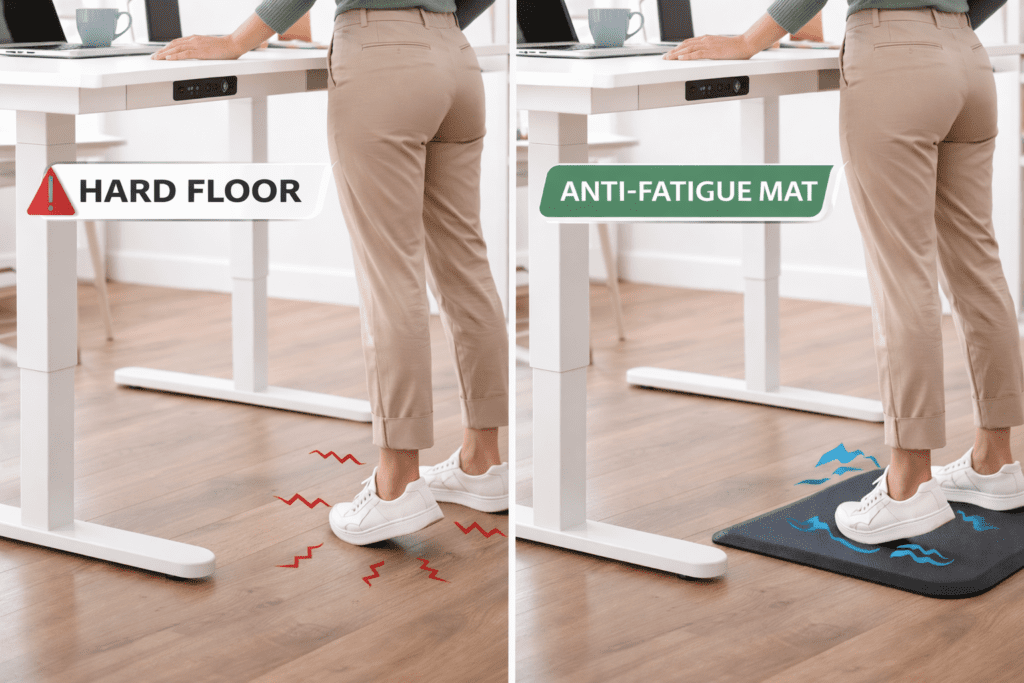
Hard surfaces like concrete increase strain on your muscles and joints. Poor footwear increases muscle workload and reduces support.
Even hydration matters. Proper fluid balance supports circulation, which is why strategies like simple daily hydration habits for energy and hydration routines for busy adults can help.
Workplace ergonomics also influence fatigue. According to CDC ergonomics guidance, reducing strain on the body can improve energy levels.
You can also reduce strain using small adjustments like a 3-minute posture reset.
Why Warm Indoor Environments Make Standing Fatigue Feel More Intense
Temperature plays a bigger role in fatigue than most people realize.
In warm environments—such as busy stores, kitchens, or warehouses—your body redirects more blood toward the skin to help regulate heat. This process helps you cool down, but it also reduces how efficiently blood circulates through deeper tissues.
When you combine this with prolonged standing, circulation becomes even less efficient. Your body is now trying to manage both gravity and temperature at the same time.
This creates an additional layer of strain. Energy is used not just to maintain posture, but also to control internal temperature.
As a result, fatigue builds faster and feels more intense, even if your activity level hasn’t increased.
The Impact Of Footwear Compression and Arch Support on Lower Body Circulation
Footwear affects more than comfort—it directly influences circulation and muscular efficiency.
Shoes that compress the foot too tightly can restrict small blood vessels, limiting how easily blood moves through the lower extremities. This can increase the sensation of heaviness and slow recovery during long standing periods.
At the same time, insufficient arch support shifts the burden onto stabilizing muscles. Instead of distributing weight evenly, your body compensates by activating additional muscle groups, which increases energy demand.
Over the course of a full shift, these small inefficiencies accumulate and contribute to overall fatigue.
What Happens When Standing Fatigue Builds Through the Day in Stages
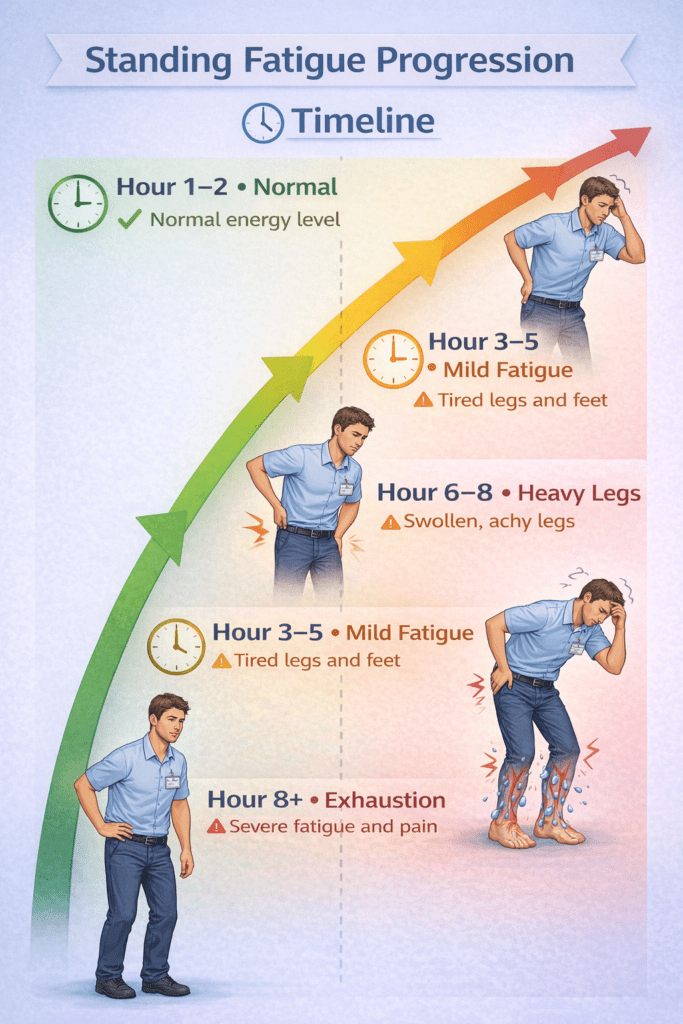
Here’s how fatigue typically progresses:
Hour 1–2: minimal fatigue, circulation still efficient
Hour 3–5: muscle fatigue begins, circulation slows
Hour 6–8: blood pooling increases, legs feel heavy
Hour 8+: strong fatigue signals, mental exhaustion appears
The Impact Of Time Progression on Fatigue Levels During Long Standing Hours
| Time Standing | What Happens in Your Body | How It Feels |
|---|---|---|
| 1–2 hours | Circulation still stable, muscles adapting | Minimal fatigue |
| 3–5 hours | Muscle fatigue begins, circulation slows slightly | Mild heaviness, reduced energy |
| 6–8 hours | Blood pooling increases, oxygen delivery drops | Noticeable fatigue, heavy legs |
| 8+ hours | Nervous system signals increase, strain accumulates | Strong exhaustion, mental fatigue |
What Happens When Standing Fatigue Becomes a Repeated Daily Stress Pattern
When standing fatigue happens occasionally, your body can recover fairly quickly. But when it becomes part of your daily routine, the pattern starts to change.
Instead of resetting overnight, your body begins each new day with a slight carryover of fatigue. Circulation may feel slower earlier in the shift, and muscle recovery becomes less complete over time.
As this pattern repeats, your tolerance for standing decreases. What once felt manageable for several hours may begin to feel exhausting much sooner. This is not because your body is getting weaker, but because it is adapting to a repeated strain that never fully resets.
Over time, this creates a cycle where fatigue builds faster, lasts longer, and feels more intense—even if your workload stays the same.
What Happens When Your Circulation Takes Time to Rebalance After Sitting Down
When you finally sit down after hours of standing, your body doesn’t immediately return to normal. Circulation needs time to rebalance.
Blood that accumulated in your lower legs doesn’t instantly move back upward. Instead, your vascular system gradually redistributes it, which can take several minutes depending on how long you’ve been on your feet.
During this transition, your heart and blood vessels adjust pressure and flow to stabilize oxygen delivery again. This delay is why fatigue lingers instead of disappearing right away.
This process is part of how circulation adapts under load, similar to how the body regulates blood flow as described in how the heart works.
The Link Between Standing All Day and Both Physical and Mental Fatigue
Standing fatigue doesn’t just affect your body—it affects your brain too.
Reduced oxygen delivery and continuous strain signal your nervous system to conserve energy. This leads to both physical exhaustion and mental fatigue.
The Link Between Physical Strain Signals and Perceived Mental Exhaustion
Physical fatigue doesn’t stay isolated in your muscles—it’s interpreted by your brain.
As your body detects ongoing strain, it sends signals that influence how you feel mentally. These signals are designed to encourage rest and prevent further overload.
The brain prioritizes efficiency, not just physical capability. So even when your muscles can still function, your perception of fatigue increases to limit unnecessary energy use.
This is why mental exhaustion can feel stronger than the actual physical demand. It’s a protective response shaped by how your nervous system processes strain over time.
How to Reduce Fatigue From Standing All Day Using Circulation-Based Strategies
To reduce fatigue, you need to improve circulation and reduce static load.
Each recovery strategy works because it targets a specific part of the fatigue mechanism.
Micro-movements help restore the muscle pump, improving blood return to the heart. Hydration supports blood volume, making circulation more efficient. Supportive footwear reduces unnecessary muscle strain, allowing your body to use less energy to maintain posture.
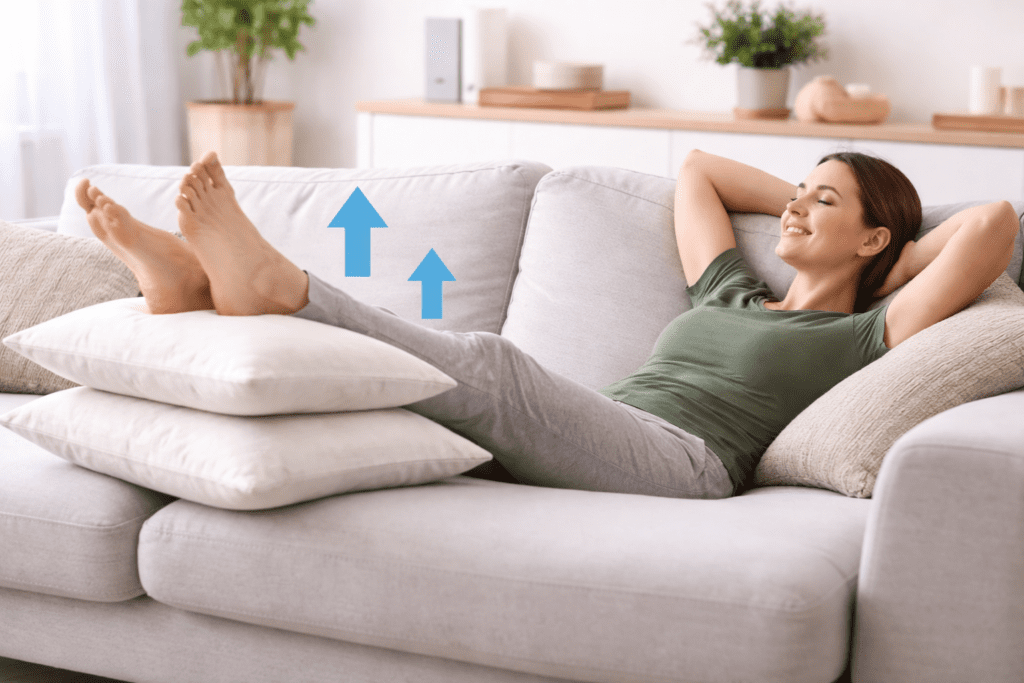
Leg elevation works differently—it uses gravity in your favor. By raising your legs, you allow pooled blood to flow back more easily, reducing pressure and improving circulation.
When combined, these strategies don’t just reduce symptoms. They directly address the underlying causes of fatigue, helping your body recover more efficiently and maintain energy throughout the day.
Want a simple next step?
Pair these circulation-based strategies with a quick posture reset and better hydration habits for energy to reduce how quickly fatigue builds during the day.
Why Short Walking Breaks Restore Energy Better Than Standing Still During Rest
When people take breaks during long standing shifts, they often remain standing in place. But this type of rest doesn’t fully address the underlying cause of fatigue.
Walking—even briefly—reactivates the natural muscle pump in your legs. Each step helps push blood upward, improving circulation and restoring oxygen delivery more effectively than standing still.
Even one to two minutes of slow walking can create a noticeable difference. It resets circulation, reduces pressure in the lower legs, and helps your muscles move out of a constant activation state.
Compared to passive rest, active recovery through light movement is far more effective at reducing fatigue buildup.
How Micro-Movements Activate the Calf Muscle Pump and Improve Circulation
Even when you’re unable to walk, your body still benefits from small, controlled movements.
Simple actions like lifting your heels, gently rocking forward and backward, or flexing your toes engage the calf muscles. These muscles act as a natural pump that pushes blood upward through your veins.
Without these movements, circulation slows and fatigue builds faster. With them, blood flow improves and oxygen delivery becomes more consistent.
These micro-movements create small circulation resets throughout the day, helping prevent the buildup of fatigue rather than trying to fix it afterward.
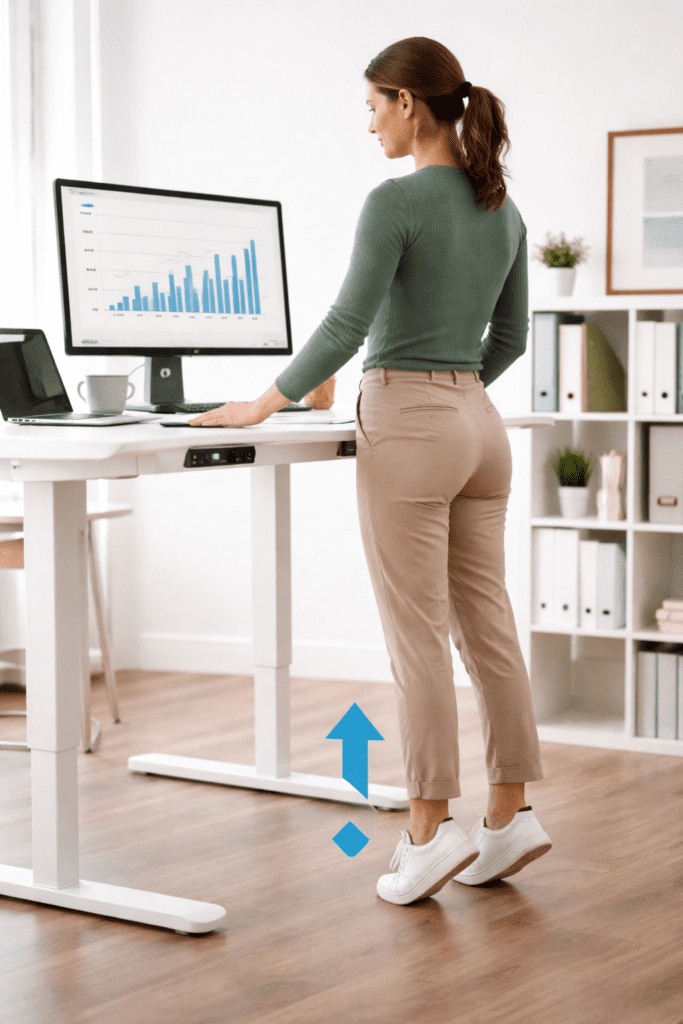
Quick ways to reduce fatigue from standing all day:
- Move your legs every 10–20 minutes
- Shift your weight regularly
- Wear supportive footwear
- Stay hydrated throughout the day
- Elevate your legs after work
What Happens When You Use a Structured Recovery Protocol After Long Standing Hours
After your shift, recovery is key.
Use this simple routine:
- Elevate your legs for 10–15 minutes
- Drink water to restore blood volume
- Stretch your calves and lower back
- Take a short walk to reactivate circulation
Improving your recovery habits can also support better sleep, as shown in improving sleep quality with evening habits and help prevent patterns like wired but tired at night.
Why Understanding Standing Fatigue Helps You Take Control of Your Daily Energy
Feeling tired after standing all day is not a sign of weakness or poor fitness. It’s a direct result of how your body manages circulation, muscle activity, and gravity over extended periods.
Once you understand that standing fatigue comes from reduced blood flow, continuous muscle activation, and gradual energy loss, the experience becomes easier to manage.
Small changes—like adding movement, improving footwear, and supporting circulation—can make a meaningful difference in how your body feels by the end of the day.
Instead of simply pushing through exhaustion, you can start working with your body’s natural systems. And when you do, standing for long hours becomes far more manageable and far less draining.
Even small changes in your daily routine can prevent fatigue from building in the first place.
When you introduce regular movement, improve circulation, and reduce static strain, your body no longer needs to compensate as aggressively throughout the day. This reduces how quickly fatigue signals appear and how intense they feel by the end of your shift.
Over time, these adjustments improve your body’s ability to handle prolonged standing more efficiently. Instead of feeling drained after every shift, your energy becomes more stable and predictable.
This is not about eliminating fatigue completely, but about preventing it from reaching a level that disrupts your day.
When small habits are repeated consistently, your body begins to adapt more efficiently to prolonged standing.
Instead of reacting strongly to circulation changes and muscle fatigue, your system becomes better at managing blood flow and distributing physical load throughout the day.
This means fatigue builds more slowly and feels less overwhelming, even during longer shifts.
Over time, these small adjustments create a noticeable difference in how your energy levels hold up, making standing for extended periods more manageable and less draining overall.
Keep improving your energy from every angle.
If this article helped, the next useful reads are mental fatigue after work, evening habits that improve sleep quality, and why you feel wired but tired at night.
People Also Ask
Is it normal to feel extremely tired after standing all day?
Yes, because prolonged standing reduces circulation efficiency and keeps muscles constantly active.
Why do my feet and legs hurt after standing for hours?
Because of pressure buildup, fluid accumulation, and continuous muscle strain.
Does standing all day affect blood circulation?
Yes, it slows blood return from the legs, especially without regular movement.
Why does standing still feel more tiring than walking?
Because muscles stay engaged continuously instead of cycling between contraction and rest.
How long does it take to recover from standing all day?
Most people recover within 30 minutes to a few hours with rest and improved circulation.
Can standing all day make you feel mentally exhausted?
Yes, due to reduced oxygen delivery and nervous system fatigue signals.
What is the fastest way to reduce fatigue from standing?
Improving circulation through movement, leg elevation, and hydration.
About This Content
This content is based on physiological principles related to circulation, muscle activation, and energy regulation. It is designed to help readers better understand common fatigue patterns experienced during everyday activities like prolonged standing.
The explanations in this article reflect current knowledge about how the body responds to gravity, blood flow changes, and sustained muscle engagement over time.
